
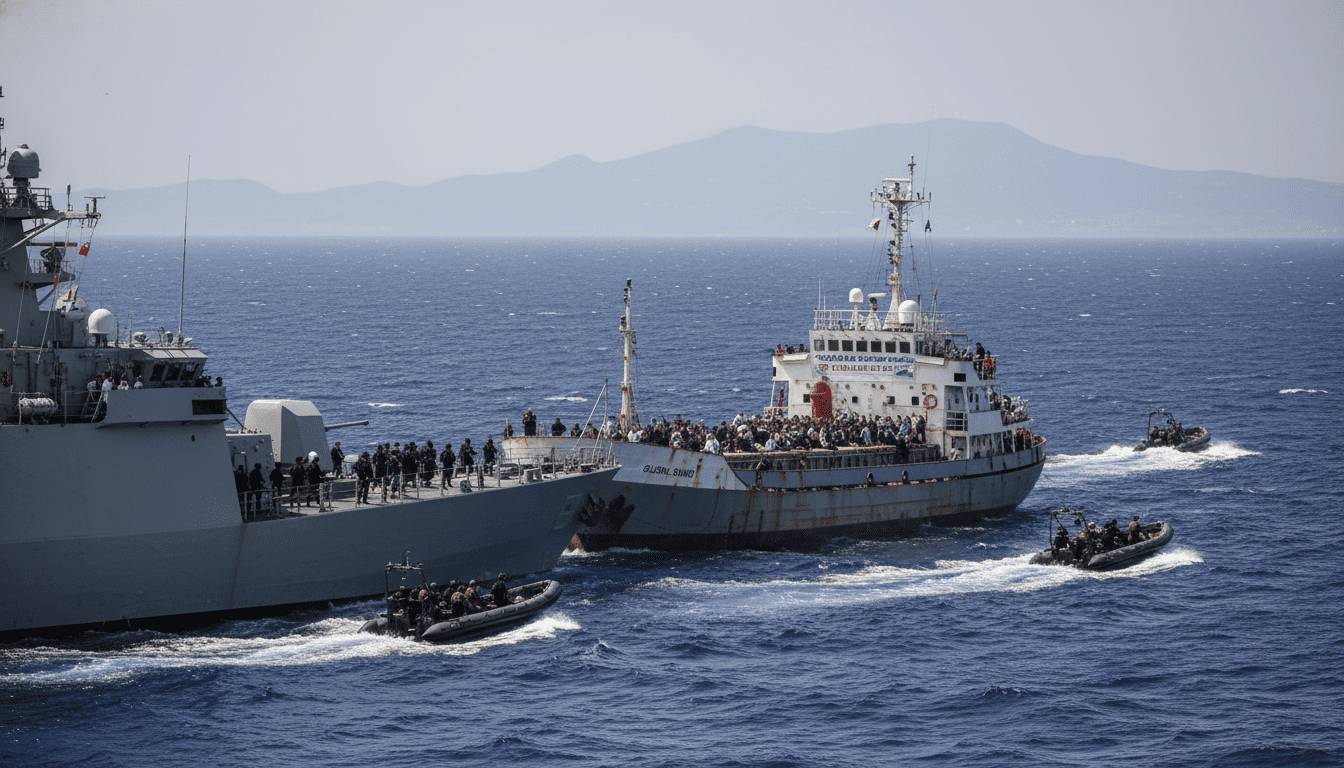
Israeli Navy Intercepts Global Sumud Flotilla Off Crete, Detains 175 Activists
Israeli navy intercepted the Global Sumud Flotilla in international waters off Crete, detaining 175 activists and seizing more than 20 vessels. Greece has agreed to accept the detained people and arrange their return to home countries while legal and diplomatic questions mount. The operation has reignited debate over maritime law and aid deliveries to the Gaza Strip.
Israeli Navy Seizes More Than 20 Vessels
The Israeli military said its naval forces intercepted over 20 vessels from the Global Sumud Flotilla beyond the territorial sea of Greece. Officials reported that the operation led to the detention of 175 people and that several boats were later moored at the port of Ierapetra in southeast Crete. Israeli authorities characterized the action as necessary and peaceful and said it was aimed at preventing an unauthorized delivery to the Gaza Strip.
All detentions took place in international waters according to the Israeli account, a detail that has become central to subsequent legal and diplomatic exchanges. The number of vessels involved represented a fraction of a larger initiative that had mobilized dozens of civilian boats from several European ports. Israeli officials emphasized logistical control and screening as the immediate priorities following the interdiction.
Greece to Receive Detainees and Arrange Repatriation
Greek authorities announced they would accept those taken into custody by the Israeli navy and coordinate their return to their countries of origin. Greek officials said some of the flotilla boats remain in Ierapetra while authorities process the situation and prepare for repatriation. The offer by Athens aims to avoid prolonged detention on foreign naval vessels and to ensure the individuals can be returned under civil procedures.
Greek involvement underscores the regional dimension of maritime aid attempts to Gaza and highlights the practical challenges of handling civilians intercepted at sea. Local authorities on Crete have begun logistical work to document the vessels and identify the nationalities of the activists. International consular contacts are expected to follow as governments seek clarity on the status of their citizens.
Two Activists Taken to Israel for Questioning
Israel’s foreign ministry said two activists will be transferred to Israel for questioning and potential legal action. One person is reportedly suspected of links to a designated terrorist group while another faces allegations of unspecified illegal activities, according to the Israeli statement. Officials did not provide further details immediately, citing ongoing inquiries.
The decision to bring suspects to Israel has drawn attention because it raises questions about jurisdiction and the legal basis for prosecutions originating from an interception in international waters. Legal experts and human rights organizations are likely to seek documentation of the grounds for the transfers as the situation evolves.
Germany and Italy Express Concern Over Legality
Germany and Italy issued a joint statement expressing concern about the interception and suggesting that stopping a flotilla in international waters may not be compatible with international law. The two governments called for a clear legal assessment and urged restraint and transparency from all parties involved. Their position reflects broader unease in parts of Europe about the handling of civilian aid efforts at sea.
Israel has countered that the operation complied with international law and that early preventive measures were justified given the size of the flotilla. The Israeli foreign ministry and military spokespeople have argued that security considerations required the intervention and that forces acted to minimize risk to both naval personnel and civilians.
Conflicting Accounts of Use of Force During Boarding
Participants in the flotilla described a more confrontational encounter, saying Israeli ships encircled the aid vessels and issued threats. Activists reported that naval personnel pointed lasers and semi automatic rifles at participants and ordered them to lie on their hands and knees, a claim that amplifies concerns about the proportionality of the operation. These firsthand accounts contrast with Israeli statements that the boarding proceeded peacefully.
Independent verification of either account is not yet available and is likely to be sought by journalists and rights monitors. Photographs and videos shared by some participants show scenes aboard small boats and at the Greek port, but authorities from different sides have provided divergent narratives about compliance, warning, and the conduct of troops during the interdiction.
Repeated Aid Missions and a Pattern of Interception
Organizers said more than 50 boats had set out from France, Italy and Spain in recent weeks as part of a renewed push to deliver humanitarian aid to Gaza. The Global Sumud Flotilla follows an earlier attempt at the end of 2025 that was also stopped by the Israeli navy, indicating a pattern of repeated efforts and interceptions. Organizers and supporters argue the missions are civilian humanitarian actions intended to draw attention to conditions in Gaza.
Israel and some of its allies emphasize the security risks of unsanctioned maritime deliveries and cite the need to control entry into the coastal enclave. The recurring incidents have produced diplomatic friction and prompted calls for clearer rules and mediation to prevent dangerous confrontations at sea.
The immediate outlook includes diplomatic consultations between Israel, Greece and affected European states and probable legal scrutiny of the interceptions. Consular access, the fate of the two activists transferred to Israel, and the timetable for repatriation will be among the next items that governments and international observers monitor closely.
