
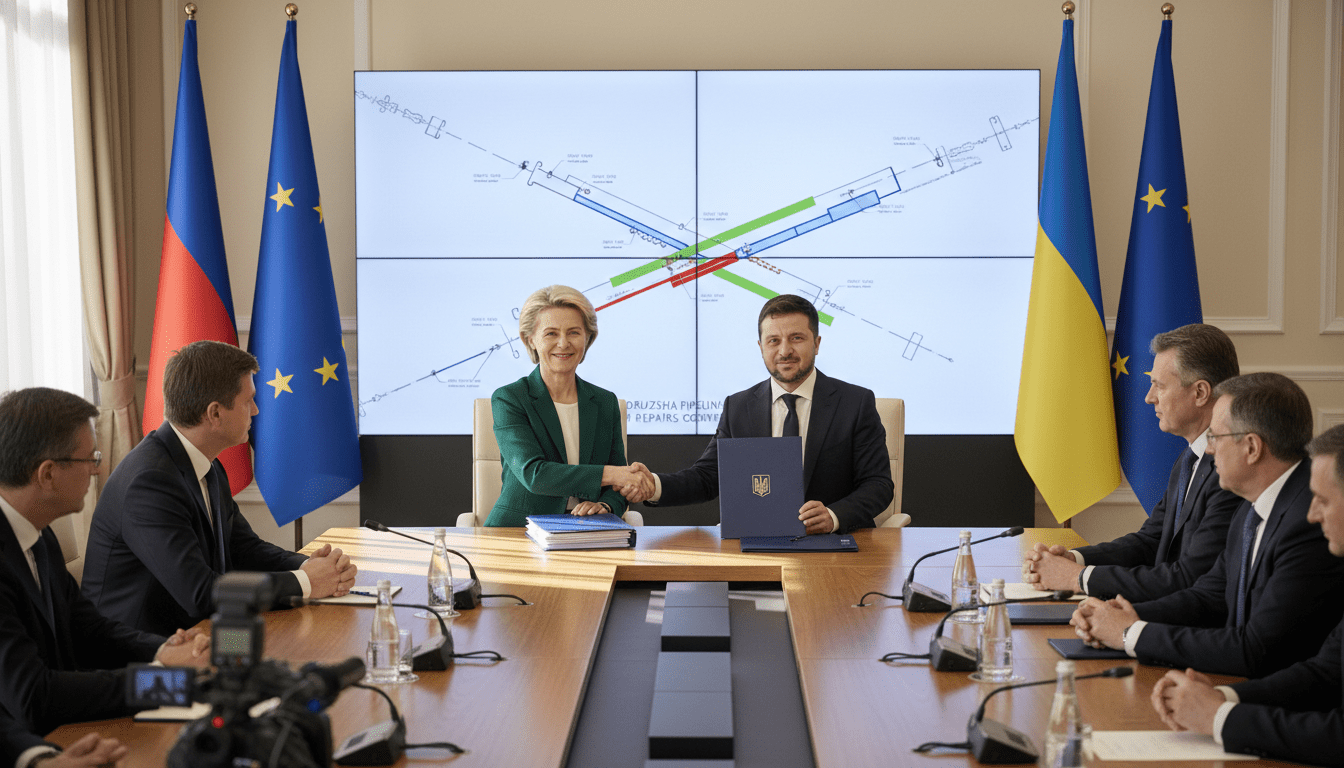
EU loan release tied to Druzhba pipeline repair as Hungary lifts veto
EU unlocks €90bn loan to Ukraine after Hungary lifts veto over the Druzhba pipeline, splits in the bloc over Russian oil, energy dependence and accession.
The European Union on April 23 approved a €90 billion loan package for Ukraine after Hungary lifted a veto linked to the restoration of flows through the Druzhba pipeline. The decision ended a standoff in which Budapest had tied Kyiv’s access to EU financial support to the resumption of oil deliveries that supply Hungary and Slovakia. Critics in Kyiv and across Europe said the resolution effectively routed significant revenue back to Russia, while Hungary and Slovakia stressed national energy security concerns. The confrontation has underscored how the Druzhba pipeline remains a political as well as an economic lever in the wider conflict.
Hungary lifts veto after Druzhba repair
Hungary reversed its block once operators declared that damage to the Druzhba pipeline had been mended and crude was moving again through the route that crosses Hungarian territory. Budapest’s move unlocked the EU loan after months of diplomatic pressure from Brussels and protests from other member states. Hungarian officials had argued their populations and refineries depended on the pipeline as their primary source of crude oil. The timing of the repair and Budapest’s U-turn prompted suspicion and sharp criticism from Ukrainian lawmakers.
Central Europe’s reliance on Druzhba exposed
For Hungary and landlocked Slovakia the pipeline is more than a convenience; it is a core supply artery that sustained roughly 9.25 million tonnes of crude last year between the two states. Neighbouring EU members such as Austria, Czechia, Germany and Poland reduced or eliminated their reliance on Druzhba by using seaborne imports and alternative pipelines. Energy analysts stress that for some Central European refineries the cost and disruption of permanently switching to imported refined products would be severe, affecting outputs like naphtha for fertiliser and feedstocks for plastics. The disparity in options helped crystallise a political impasse at the heart of the EU decision.
Kyiv’s actions and accusations of coercion
Ukrainian officials accused Hungary and Slovakia of leveraging energy to extract political concessions, and some in Kyiv described the arrangement as effectively rewarding Moscow. Members of Ukraine’s parliament and energy committee framed the decision as morally fraught, arguing that funds freed by the loan would be spent on defending the country while some purchases would indirectly flow to Russia. Brussels repeatedly urged Kyiv to allow inspections of the damaged site before the repair was certified, a step Kyiv initially resisted on safety grounds. The dispute quickly became a major test of EU solidarity over support for Ukraine.
Sabotage inside Russia and pipeline disruptions
In response to the leverage that Druzhba provided, Ukrainian security services carried out operations targeting pumping stations that feed the pipeline inside Russia, including attacks reported in Tatarstan and Samara. Those strikes damaged storage tanks and infrastructure far from the frontline, and officials in Kyiv framed them as measures to limit Russia’s export capacity. International estimates linked the damage to a substantial reduction in Russian export throughput, with analysts saying flows through Druzhba and other routes fell materially compared with late 2025. The strikes have added a new dimension to energy security across Europe and raised questions about the durability of pipeline-dependent supplies.
Political calculations in Budapest and Bratislava
The standoff mirrored domestic political manoeuvres in Hungary and Slovakia, where leaders used the pipeline issue to bolster nationalist narratives and influence EU policy. Viktor Orbán’s government had long opposed closer ties between Brussels and Kyiv, and a previous referendum and parliamentary actions reflected deep domestic scepticism toward Ukrainian accession. In Slovakia, Prime Minister Robert Fico adopted a combative posture toward Kyiv, at times pursuing closer ties with Moscow that alarmed European partners. Both capitals have presented energy access as a matter of national interest, complicating collective EU responses.
EU unity and the accession crossroads
The loan agreement has forced the EU to confront difficult trade-offs between immediate support for Ukraine and the political realities within its own membership. Analysts warn that the episode could crystallise divisions over accession criteria and sanctions policy, with France, Germany and the Netherlands under pressure to clarify their stances. Brussels faces a test over whether financial rescue and political integration can be decoupled from bilateral disputes that exploit energy infrastructure. The longer-term question is whether the EU can reconcile member-state security needs while maintaining a coherent policy toward Russia and Ukraine.
The resolution of the Druzhba-linked impasse buys Ukraine urgently needed funds but leaves lingering doubts about the bloc’s ability to insulate its foreign policy from national energy dependencies and bilateral disputes.
