
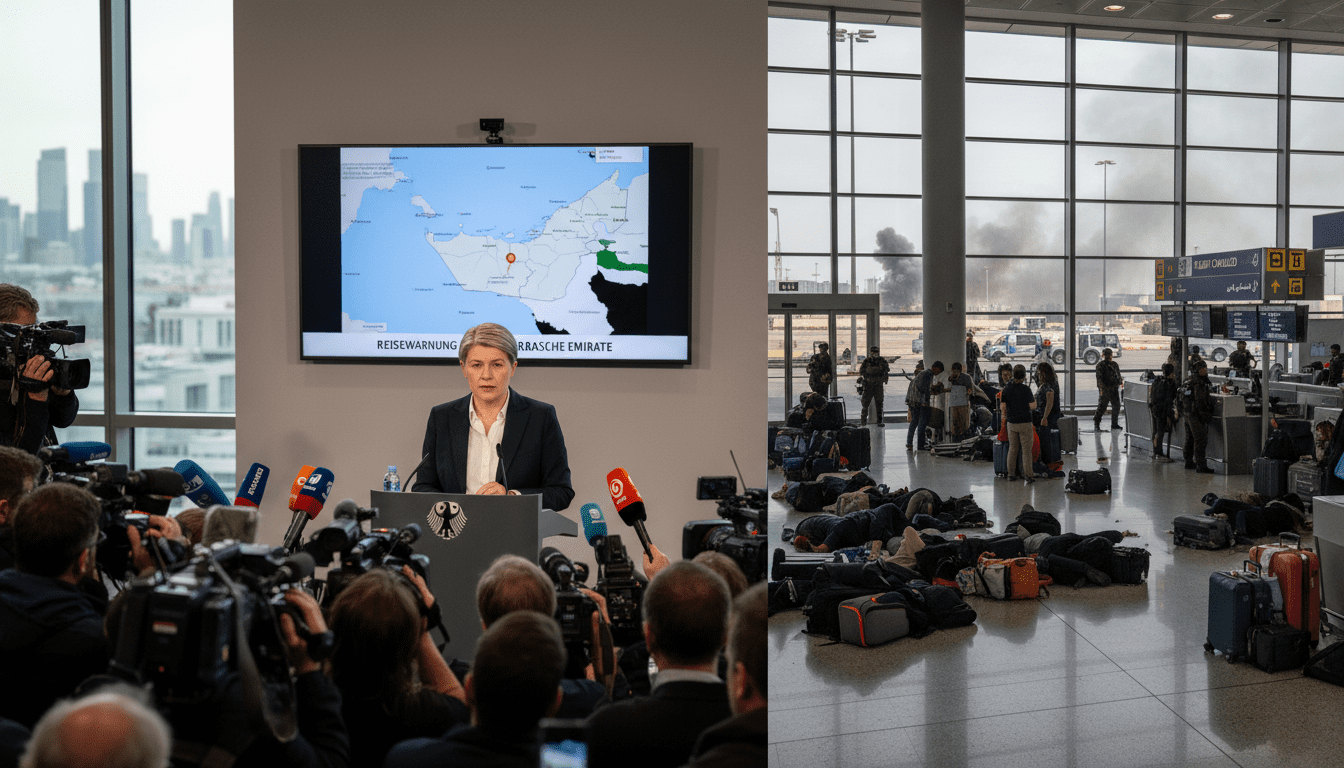
Dubai travel warning: Germany advises against travel to UAE as attacks and flight disruptions leave tourists stranded
Germany issues Dubai travel warning after Iranian rocket and drone strikes; thousands affected as flights are suspended and evacuations continue for Germans.
The German Foreign Office has issued a formal Dubai travel warning as Iranian rocket and drone strikes and related security incidents disrupt travel and daily life in the United Arab Emirates. The advisory explicitly names Dubai and Abu Dhabi and urges Germans to reconsider travel plans amid an unstable security environment. Several recent attacks on energy and industrial targets, flight suspensions and government-organized evacuations have left thousands of German holidaymakers and residents affected.
German Foreign Office Warns Against Travel to the UAE
The Foreign Office warns that the security situation in the UAE remains volatile and can deteriorate without warning. Officials note that while some air traffic has resumed under restrictions, further airspace closures and disruptions cannot be ruled out. The advisory also emphasizes heightened security around Jewish and Israeli sites and advises caution in crowded public places.
US–Iran Two-Week Truce Did Not End Hostilities
On April 8, 2026, the United States and Iran agreed to a two-week ceasefire, but Iran has continued to launch rockets and drones at the UAE and other Gulf states, according to official reports. Attacks have repeatedly targeted energy and industrial infrastructure, and agencies such as Reuters and Bloomberg have reported on strikes against facilities including an Emirates Global Aluminium plant in Abu Dhabi. The continued strikes underline that the truce has reduced but not eliminated the risk of further incidents.
Airports Disruptions and Airline Suspensions
Airport operations in Dubai and Abu Dhabi have resumed with restrictions after earlier shutdowns, yet volatility remains, with the possibility of sudden suspensions and delays. Dubai International (DXB) was temporarily closed on March 16 after a nighttime drone strike set a fuel depot on fire, and several carriers have announced extended suspensions. Lufthansa has suspended flights to Dubai and Tel Aviv through May 31 and halted routes to Abu Dhabi, Amman, Beirut, Dammam, Riyadh, Erbil, Muscat and Tehran through October 24, while Eurowings has paused certain Middle East routes through April 30.
Thousands of Tourists Stranded and Evacuations Organized
The disruption has affected an estimated 30,000 travelers booked with German tour operators who were in the region or transiting through Gulf hubs, the German Travel Association reported. In early March the German government organized evacuation flights; the first evacuees arrived back in Frankfurt on March 5, and Emirates flights with German passengers landed in Munich and Frankfurt on March 3. More than 10,000 Germans have registered on the Foreign Office crisis list for the Gulf region, reflecting the scale of those seeking consular support and information.
Incidents and Life in Dubai After Explosions
Residents and visitors report a tense normality in Gulf cities where regular explosions and intercepts have become part of daily life, according to local and international news agencies. On February 28 falling debris from intercepted missiles caused explosions across the Emirates, including reports of impacts on Palm Jumeirah and a fire at the Burj al Arab that injured four people. Officials confirmed at least one death in Abu Dhabi from debris of an intercepted projectile, and further episodes, such as a March 13 facade hit in Dubai, were reported without casualties.
Security Guidance, Local Restrictions and Legal Risks
Authorities in the UAE have increased security measures at sensitive sites, and the Foreign Office and travel industry have issued practical guidance for travelers. German authorities advise registration in the ELEFAND crisis-preparedness list, keeping contact details up to date, and following instructions from local security forces. Travelers should avoid large gatherings, refrain from photographing military, airport, port or palace facilities and exercise caution around Jewish and Israeli institutions. The advisory also notes broader legal realities in the UAE, including strict rules on public conduct and ongoing application of severe penalties for violations.
Germany’s travel advisory extends beyond the UAE; warnings and exit recommendations currently apply to several regional states, including Bahrain, Iraq, Israel, Yemen, Jordan, Oman, Kuwait, Lebanon, Saudi Arabia and Qatar. For Lebanon, an explicit evacuation recommendation is in force, and Iran remains under a standing travel warning and evacuation recommendation issued since autumn 2022.
Officials and travel-sector bodies urge affected travelers to contact their tour operator or airline for rebooking or refund options and to monitor official communications. Consular help, registration on crisis lists and adherence to local orders remain the primary tools for Germans seeking assistance amid rapidly changing conditions.
Travelers in the UAE should keep mobile devices charged, limit nonessential movement, follow local media and official channels for updates, and coordinate with their travel provider and the German Foreign Office if they require consular assistance.
