
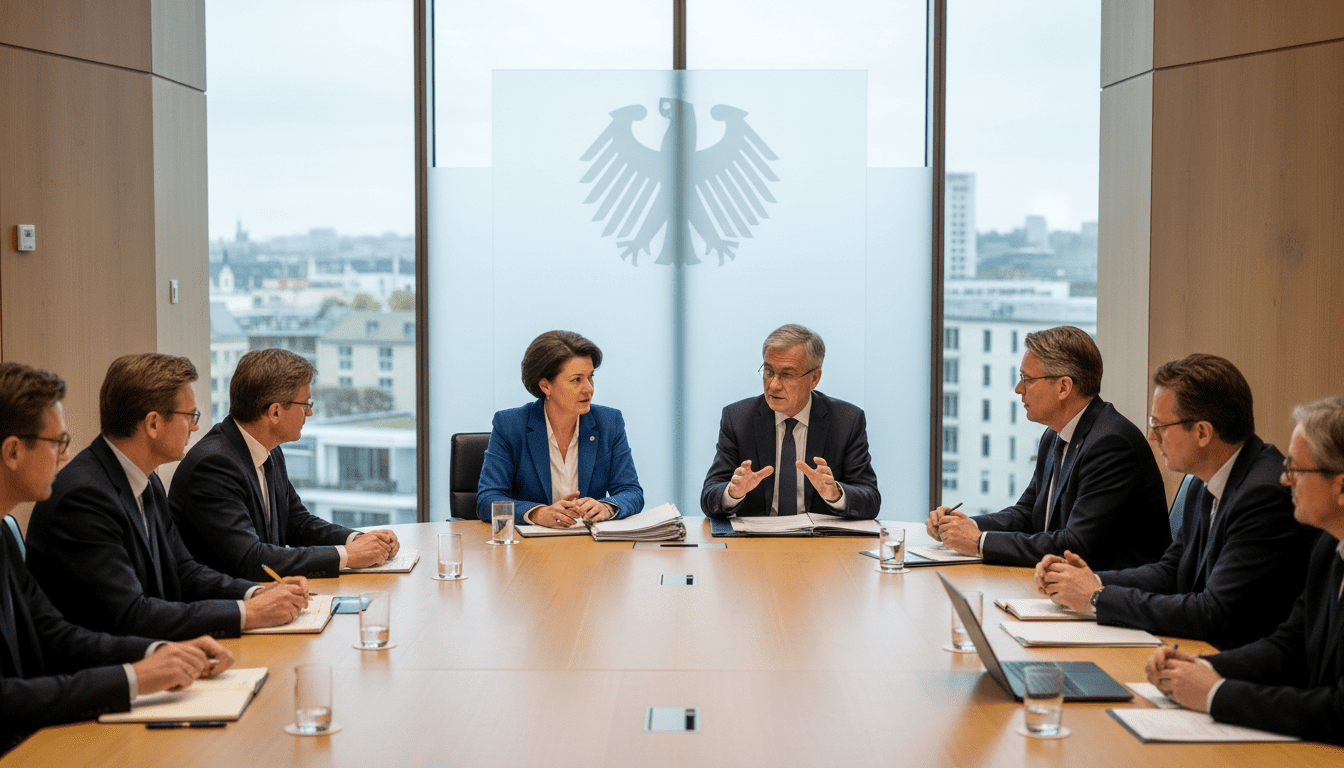
Coalition Seeks Breakthrough on Health Insurance Financing Reform Ahead of Cabinet Vote
Coalition negotiators in Germany are racing to clinch a deal on a health insurance financing reform, with the proposal set for a cabinet debate and the keyword “health insurance financing reform” central to talks.
Negotiations have intensified over the weekend and continued into Monday as CDU, CSU and SPD leaders and their underwriters worked to finalise a compromise on a draft law Health Minister Nina Warken (CDU) plans to bring to the federal cabinet on Wednesday. The draft is tightly linked to the broader 2027 budget talks, making agreement both politically urgent and fiscally complex. Parties are focusing on how to close an expected gap in statutory health insurance (GKV) funding without triggering higher contribution rates for insured members.
Pantazis floats partial federal top-up
Christos Pantazis, the SPD’s health-policy spokesman, proposed a compromise that would stop short of the full €12 billion annual federal transfer recommended by experts. Pantazis suggested committing an initial, smaller federal contribution — later framed internally as roughly €2–4 billion per year — as a “signal” toward stabilising contributions and sharing the burden more broadly. He highlighted a specific benchmark increase from the current federal reimbursement of about €144 to roughly €233 per eligible person per month as the pathway to that cost range.
Union factions press for larger federal share
Within the coalition, CDU and especially CSU forces, along with the Junge Union, have pushed for a significantly higher federal share to cover the health costs of Bürgergeld recipients. The issue received additional momentum when North Rhine-Westphalia’s health minister, Karl-Josef Laumann (CDU), publicly backed the call for more central government funding. Those advocating a larger transfer argue the federal budget should shoulder insurance costs that are not covered by employers or the labour agency.
Finance minister signals limited fiscal room
Finance Minister Lars Klingbeil (SPD) has been blunt that the 2027 budget leaves little room for additional tax-financed measures, complicating plans for a larger federal top-up. Klingbeil’s stance has made compromise necessary, pushing negotiators to explore phased or partial funding rather than a single large annual transfer. The tension reflects competing priorities across the coalition as they attempt to reconcile social policy aims with tight fiscal targets.
Warken’s draft and the GKV deficit challenge
Warken’s bill aims to head off a projected GKV financing shortfall expected to exceed €15 billion in 2027, and to prevent further rises in statutory contribution rates. Her draft draws on recommendations from the independent Financial Commission on Health but diverges on the scale of immediate federal funding for Bürgergeld-related costs. Because the minister judged the 2027 budget too constrained to absorb a full increase, the higher federal contribution was initially omitted from her proposal — a decision now under pressure as negotiators seek workable middle ground.
Revenue options from the Financial Commission
The Financial Commission has outlined revenue options that could partly offset GKV pressures, proposing tax increases on tobacco and spirits and a new levy on sugary drinks. Those measures could yield about €1.9 billion in 2027, according to commission estimates, but the funds would not be ring-fenced specifically for health spending. Lawmakers must decide whether to adopt such earmarked or general-tax solutions while weighing political feasibility and the principle that state responsibilities should not be financed by shifting costs onto insured individuals.
Final negotiations are expected to hinge on whether the coalition can endorse Pantazis’s staged approach and identify concrete budget lines or revenue measures to cover any agreed federal top-up. Ministers will present their positions to the cabinet on Wednesday, leaving little time for further heavy political lifting if the coalition is to secure a coherent package tied to the 2027 budget.
