
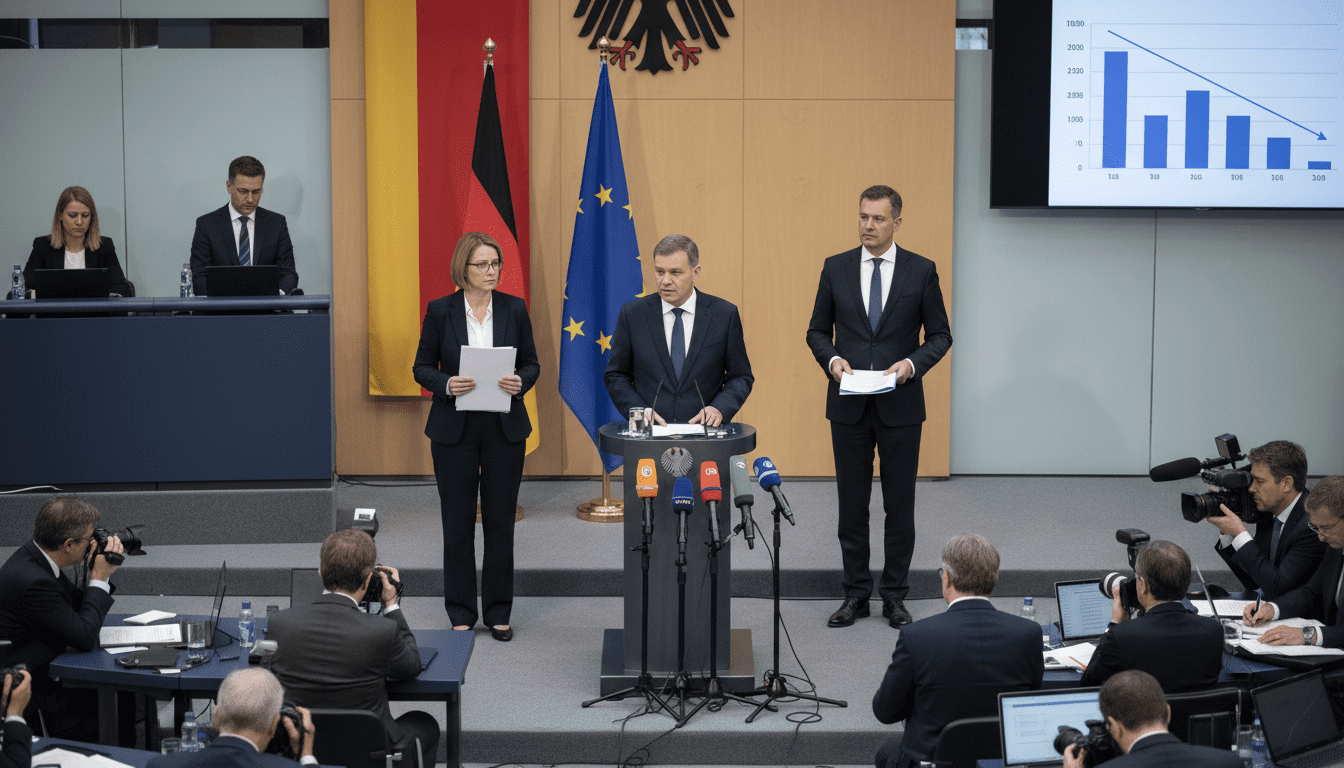
Germany’s stalled growth prompts new German economic reforms as coalition unveils overhaul of taxes, pensions and health care
One year after Chancellor Friedrich Merz pledged to restore growth, German economic reforms are now at the centre of a government push to revive an ailing economy after Berlin cut its 2026 growth forecast. The coalition’s proposals target the tax and welfare systems, but analysts warn that the timing and design of those reforms will determine whether they boost investment or merely shift burdens. Political pressure to deliver results has increased as global risks and past spending choices have left little room for error.
Chancellor’s pledge and the growth shortfall
A year ago Chancellor Friedrich Merz framed a broad program of investment and reform as the route back to robust expansion, promising Germany would become a global growth engine again. Economic reality has proved more muted: the government this spring lowered its 2026 growth projection from roughly 1.0 percent to 0.5 percent, citing international shocks and persistent structural drag. That downgrade has sharpened the focus on German economic reforms as the coalition seeks measures that can generate faster output and higher employment.
Official forecast revision and underlying causes
The government’s decision to pare back its growth outlook reflected a mix of external and domestic factors, officials say, with geopolitical shocks exacerbating long-standing competitiveness gaps. Economists have flagged weak productivity gains, ageing demographics and underinvestment in key sectors as obstacles that simple fiscal impulses may not overcome. Observers also point to the economic consequences of recent conflicts abroad, which continue to weigh on trade and energy costs.
Coalition’s reform package and stated goals
The black-red coalition has proposed a tranche of measures aimed at reshaping health care, pensions and the tax code to reduce the tax-and-contribution burden on firms and workers. Proposals under discussion include targeted tax relief for businesses, adjustments to social contributions and structural changes to the pension system intended to shore up long-term sustainability. The government frames these moves as a combined strategy to increase incentives, lower costs and make Germany a more attractive place for investment.
Debate over debt use and past spending choices
A separate line of criticism from economists focuses on the handling of recent state borrowing, with some arguing that large increases in debt were not consistently channelled into productive investment. Those analysts contend that if new funds were diverted to short-term or politically driven expenditures, the leverage to stimulate lasting growth is reduced. That critique has intensified scrutiny of whether the coalition’s German economic reforms will prioritise capital projects and reform measures with measurable returns.
Business, labour and market reactions
Business groups have welcomed the aim of lowering employer costs but caution that clarity and predictability are essential to unlock investment decisions already on hold. Trade unions have demanded protections for workers, warning that tax reductions for firms must not come at the expense of wages or social services. Financial markets are watching policy signals closely; sustained policy coherence and clear timelines for implementation will be key to restoring investor confidence.
Implementation challenges and political calculation
Turning broad reform proposals into effective policy will require legislative consensus across the coalition’s parties and careful sequencing to avoid unintended economic distortion. Lawmakers must balance immediate demand support with structural steps that raise productivity, such as digitalisation and infrastructure upgrades, if the reforms are to have lasting impact. Political incentives are also at play: with public patience limited, leaders may favor headline measures that produce rapid but modest relief over deeper, politically costly structural change.
The coalition’s emphasis on tax relief and welfare adjustment underlines a strategy to make growth the central political argument for the government’s second year. Success will depend on whether the measures are credible, well-targeted and accompanied by investment in areas that raise Germany’s supply-side potential.
The coming months will reveal whether the proposed German economic reforms can close the gap between ambition and outcomes, as officials move from announcements to lawmaking while economists and business leaders test the proposals against the realities of a slow-growth global environment.
