
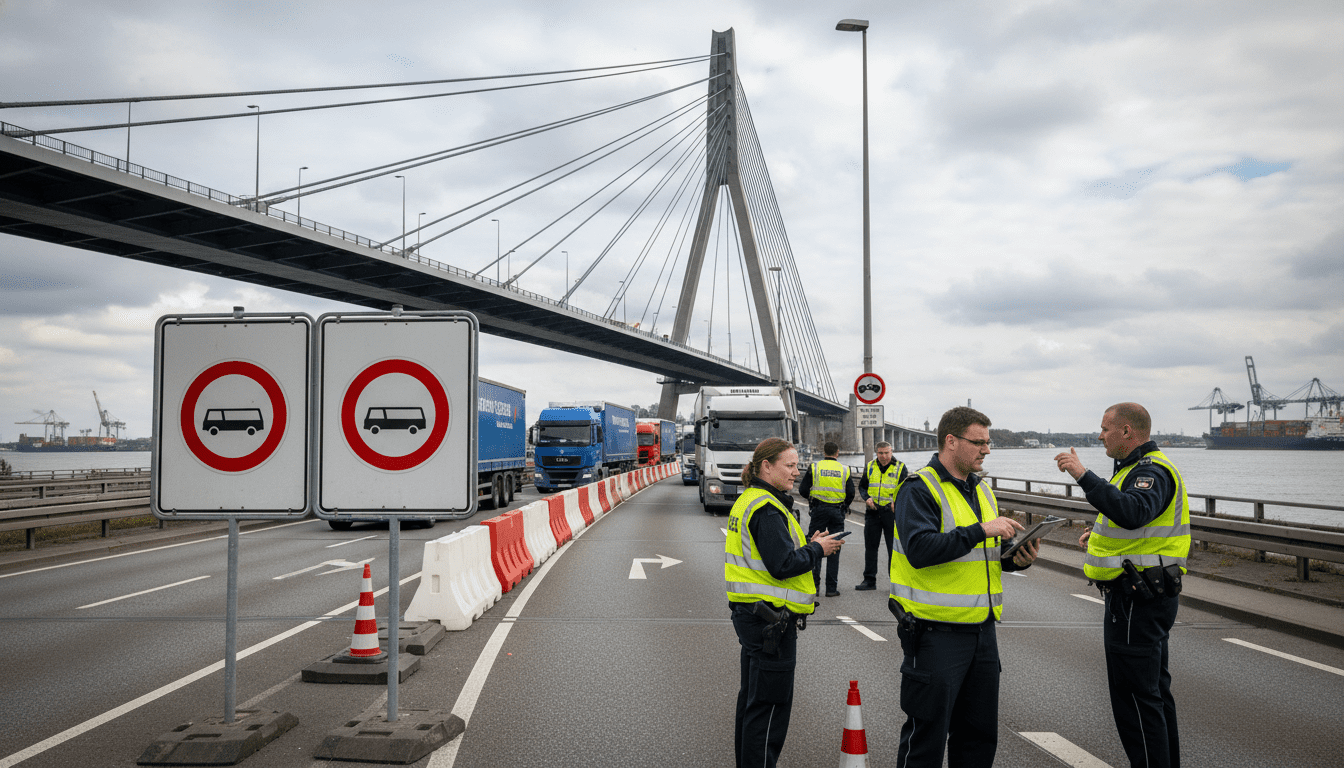
Köhlbrand Bridge inspections prompt ban on heavy transports from May 1, threatening Hamburg port logistics
Köhlbrand Bridge inspections show accelerating structural damage; heavy transports over 44 tonnes banned from May 1, disrupting Hamburg port logistics and exports.
The Köhlbrand Bridge, a 3.6-kilometre cable-stayed landmark carrying about 32,000 vehicles a day, will be closed to permitted heavy transports over 44 tonnes from May 1 after inspections revealed an accelerating pattern of damage. Authorities say deterioration concentrated on longitudinal ribs and ramp structures has worsened despite a 50 km/h speed limit imposed last year. The Hamburg Port Authority framed the measure as necessary to preserve the remaining service life of the structure while plans for a replacement advance.
Inspection reveals accelerating damage to ribs and ramps
Recent structural surveys identified a marked increase in cracking, spalling and weakened material properties on key load-bearing elements of the Köhlbrand Bridge. The Hamburg Port Authority reported the change in damage dynamics as decisive in the decision to restrict the heaviest traffic.
Engineers warned that the pattern of deterioration is not limited to superficial wear and that continued heavy loading could accelerate failure modes that are expensive and time-consuming to repair. Local officials framed the ban as a temporising step intended to limit further decline until a permanent replacement is built.
New ban takes effect from May 1 and targets transports above 44 tonnes
From May 1, vehicles that require special approval because they exceed 44 tonnes will no longer be permitted to cross the Köhlbrand Bridge. The rule affects the heaviest goods movements that previously relied on the bridge as a direct route between eastern and western parts of the port.
Authorities have not published an exact daily count of affected trucks, but industry estimates suggest the restriction will reroute thousands of heavy consignments each month. The ban follows earlier measures, including a reduced speed limit introduced to lower dynamic loading and extend the bridge’s usable life.
Port operations and German exports face knock-on effects
Hamburg’s port is a central hub for German exports and complex hinterland logistics, and the bridge functions as a principal artery across that network. Even small constraints on the Köhlbrand Bridge ripple through rail, road and shipping operations that are tightly scheduled and capacity-limited.
Estimates from port stakeholders put the number of redirected heavy transports at roughly 2,500 per month, a figure that would force rerouting onto secondary roads, barge services or longer overland detours. Companies warn of increased administrative load, heightened staffing needs, and a rise in transport costs that could depress margins and complicate delivery schedules.
Industry response and emergency routing measures
Representatives of the port and the business community have convened rapid-working groups to coordinate alternative routes and adapt infrastructure where possible. The local industry association said crews are already reinforcing approaches, adjusting clearances, and preparing temporary works to accommodate increased flows on detour corridors.
Even where physical detours are feasible, port operators note that logistical complexity will rise. Some firms have signalled plans to shift time-sensitive or oversized loads to maritime transfer options or to consolidate and reschedule movements to reduce the number of exceptional transports.
Replacement planning delayed; new bridge now projected for 2039
The Köhlbrand Bridge’s replacement has been discussed for more than a decade, with initial demolition proposals first made public in 2012. Plans have oscillated between a multi-level tunnel concept and a new bridge, and cost and ground conditions have repeatedly reshaped timelines.
After renewed political debate and a 2024 decision favouring a bridge, officials now project a completion date in 2039 for a new Köhlbrand crossing. The long horizon reflects extensive planning, procurement and potential legal challenges; local leaders are seeking procedural tools in federal law to shorten litigation timelines and accelerate construction approvals.
Alternatives under consideration and federal support pledged
Industry innovators and some harbour entrepreneurs have renewed calls to expand intra-harbour barge and ferry services to absorb part of the heavy cargo flow. Proponents point to concepts such as port feeder barges and small vehicle ferries as scalable ways to transfer oversized loads without using constrained road links.
At the same time, federal officials have indicated that Berlin will shoulder a larger share of replacement costs and support accelerated procedures where possible. Political coordinators for maritime affairs have publicly affirmed a commitment to strengthen northern ports’ infrastructure within the current legislative term.
The immediate ban on the heaviest transports underscores the narrow margin for error in critical port infrastructure and shines a spotlight on years of deferred replacement planning. As emergency routing and interim measures are implemented, companies and authorities will be watching closely for any further deterioration that could force additional restrictions or urgent repairs.
