
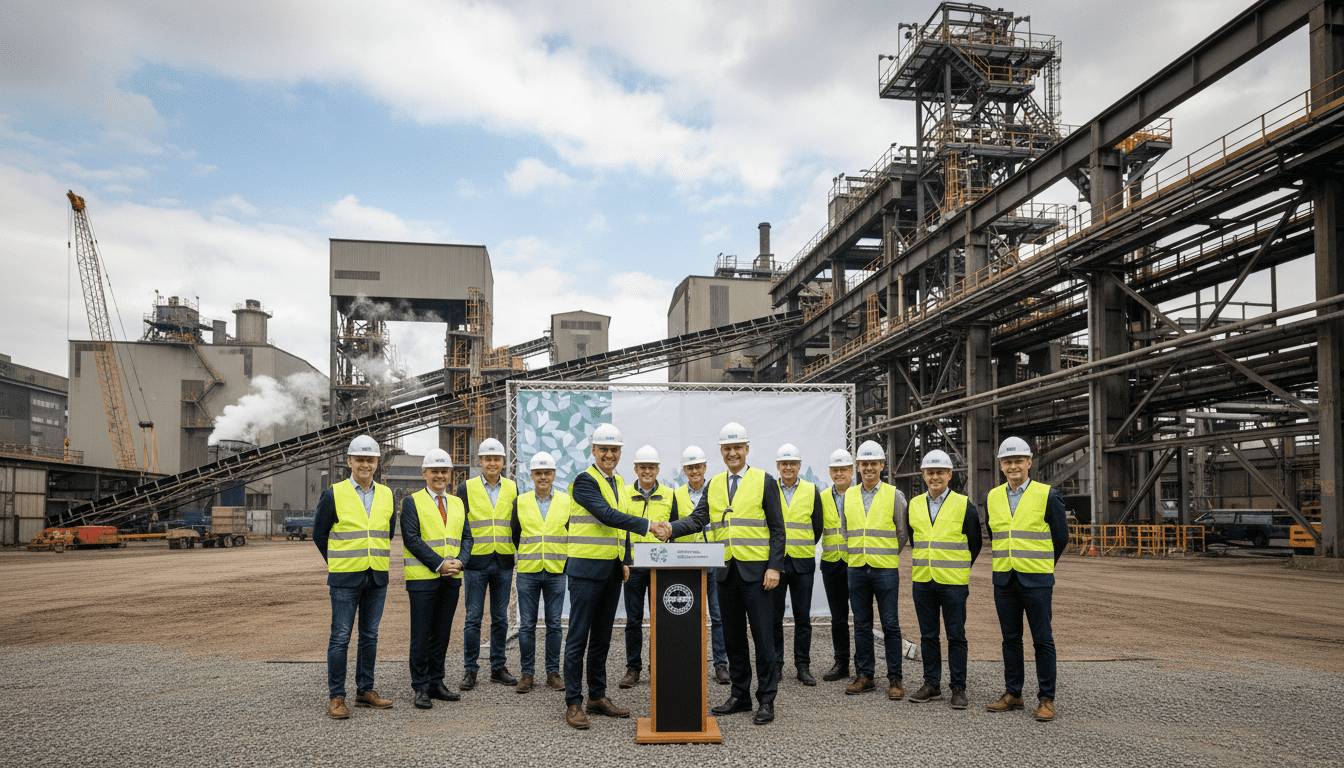
Feralpi Riesa investment: Italian steelmaker opens €120m rolling mill and bets on German recovery
Feralpi Riesa investment: Italian steelmaker opens €120m mill, raising capacity to 1.3M t and betting on German infrastructure, recycling steel and EU action.
Giuseppe Pasini’s family-owned Feralpi has completed a €120 million rolling mill at its Riesa plant, a move the company says will lift the site’s output and underpin its expansion in Germany. The Feralpi Riesa investment follows more than €220 million injected into the German operation over three years and represents the largest single outlay in the company’s history. Management says the new mill and an electric induction furnace will increase local capacity and help position the business for expected demand from regional infrastructure projects.
Investment and scale at the Riesa site
Feralpi’s investment in Riesa is framed as a strategic scale-up rather than a standalone project, and company figures show production ambitions are clear. The group produces roughly 2.6 million tonnes of steel annually overall, of which Riesa currently accounts for about one million tonnes; management now targets raising that output to roughly 1.3 million tonnes. Pasini has also highlighted long-term workforce growth at the site, noting employment levels have roughly tripled since the firm began operations there in the 1990s.
Why management is optimistic about Germany
Pasini points to Germany’s announced infrastructure and defense spending as a central reason for the company’s decision to expand in Riesa. While current demand from core customer sectors is weak, Feralpi expects public construction work — bridges, public buildings and social infrastructure — to strengthen within a year as government programmes take effect. The plant’s location in eastern Germany also offers proximity to markets in Poland and the Czech Republic and potential contracts linked to reconstruction work in Ukraine, boosting its regional sales logic.
Recycling-first production and emissions advantage
A key element of Feralpi’s strategy is its reliance on electric-arc and induction furnace technology rather than blast furnaces that run on coking coal. By melting scrap in electric furnaces, the company produces so-called recycling steel with a materially lower CO₂ footprint compared with traditional integrated producers. The new rolling mill in Riesa is tied to an electrically powered induction furnace, reinforcing Feralpi’s argument that its production model already aligns with lower-emission pathways and requires a different transition profile than larger blast-furnace competitors.
Scrap market pressure and trade flows
Despite the environmental edge, Feralpi faces a tight global market for scrap, which the company describes as the “fuel” of green steelmaking. Management warns that strong global demand combined with limited European availability has pushed volumes abroad, particularly to Turkey where many competitors operate. Company calculations — citing Eurostat data for 2025 — point to European exports of around 16.5–16.6 million tonnes of ferrous scrap, up roughly six percent year-on-year, a development that tightens local supply and squeezes margins.
Energy costs and calls for a common policy
Energy pricing remains a cross-border constraint, but Pasini says Germany’s electricity costs are currently more favourable than in Italy, where gas dependence keeps prices high. He cites market differentials this spring, noting wholesale power in Germany traded notably below prices seen in northern Italy, which affects where energy-intensive processes are most competitive. Pasini urges a coordinated European approach to energy policy, arguing that stable, lower power prices — he mentions a target of about €50 per megawatt-hour — would strengthen manufacturing competitiveness across the bloc.
Risks, strategy and a family-business mindset
Pasini frames the Riesa expansion in light of family business experience and a long-term investment horizon, recalling a generational maxim to invest during the most difficult moments. He acknowledges the sector faces a threefold squeeze from low-cost imports, softer demand in key downstream industries, and higher energy bills tied to decarbonisation efforts. Nonetheless, the firm’s focus on locally priced construction steel, shorter transport distances, and recycling-based production forms the backbone of its risk-management strategy for the German operation.
Feralpi’s Riesa investment underscores a bet on Europe’s infrastructure pipeline and on a production model built around recycling and electrification, but it also highlights structural strains in raw-material flows and energy markets that will require policy attention to preserve competitiveness.
