
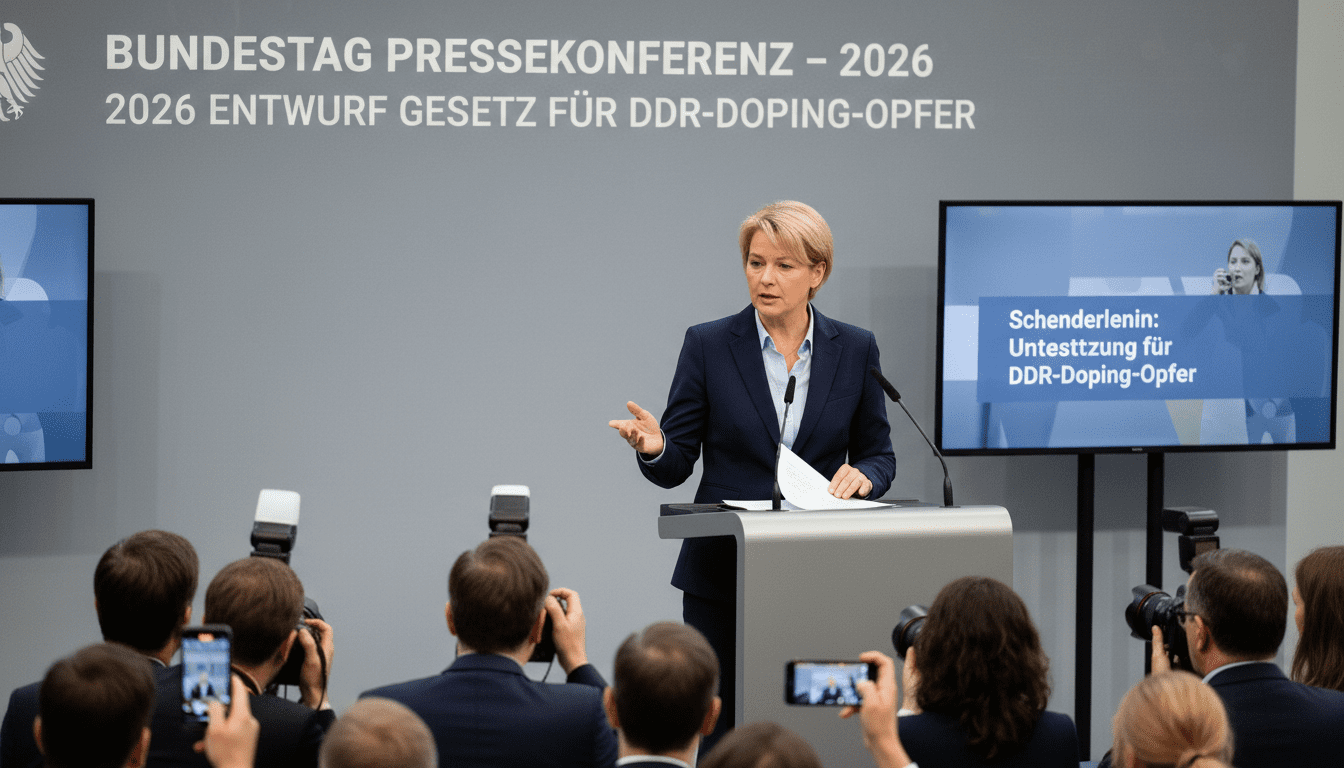
German government to prepare 2026 draft law to support GDR doping victims
Sports Minister Christiane Schenderlein announces a 2026 draft bill to recognize and compensate GDR doping victims after years of limited, one-off aid and sustained advocacy.
Federal push to produce a draft bill in 2026
Christiane Schenderlein, Germany’s Minister of State for Sport and Civic Engagement, said the Bundeskanzleramt will take the lead on a referentenentwurf intended to support GDR doping victims. She made the announcement at a panel in Berlin organized by the Bundesstiftung Aufarbeitung in cooperation with the Doping-Opfer-Hilfe association, and said other ministries will be involved in the process.
Schenderlein framed the initiative as a coordinated federal response following a parliamentary request and legal guidance, and indicated the government intends to move the draft forward during 2026. The plan signals a shift from prior short-term measures toward a legislative solution aimed at broader recognition and longer-term support.
History of limited compensation and uptake
Between the offers made up to 2019, affected athletes were twice able to accept a temporary compensation scheme that provided a one-off payment of €10,500, which roughly 1,600 former athletes accepted. That measure was intended as limited redress for people subjected to state-sponsored or coerced doping in the former East Germany.
Victims and advocates have long argued the one-off payment was inadequate given lifelong health consequences, many of which emerged only decades after treatment. The new drafting effort responds directly to criticism that earlier compensation did not account for chronic illnesses, lost livelihoods, and the particular vulnerability of child athletes.
Documentary evidence of systematic practices
Government investigators and files from the Stasi and the Central Investigation Unit for Government and Reunification Crimes have documented widespread and sometimes coercive administration of performance-enhancing drugs. Witness testimony and archival material show that treatments included substances that were not approved domestically and whose long-term effects were uncertain.
Those records also indicate that known side effects were often concealed from athletes, including minors, leaving many without informed consent. The historical record underpins calls from survivors and legal authorities that state responsibility should be acknowledged through formal recognition and reparative measures.
Advocates and victims press for timely recognition
Survivor groups, the Doping-Opfer-Hilfe association and rights advocates such as Evelyn Zupke, the federal commissioner for the victims of the SED dictatorship, confronted officials at the Berlin event with urgent pleas. Many victims described severe, sometimes life-threatening conditions and said they lack the time or strength for prolonged legal fights for formal recognition.
Earlier attempts to secure more comprehensive consideration during the 2025 amendment of the SED-Unrechtsbereinigungsgesetz failed to produce a durable solution, though the new Bundestag issued an Entschließungsauftrag from across party lines — CDU/CSU, SPD, Greens and FDP — asking the government to examine a legislative remedy. That parliamentary direction, combined with a Federal Administrative Court position, has helped propel the current drafting effort.
Process, scope and likely measures under consideration
Officials have indicated the referentenentwurf will involve multiple ministries and will not be limited to a single form of compensation, opening the door to options such as regular small pension-like payments, expanded medical support, or streamlined recognition procedures. The involvement of the Bundeskanzleramt suggests the draft will aim for interministerial consensus before formal cabinet stages.
Key questions remain: who will qualify as an official victim group, what evidence standard will be required, and whether recognition will extend to non-athlete victims exposed through related medical programs. Lawmakers and advocates will be watching whether the draft prioritizes quick, broad relief or a more narrowly defined scheme with stricter eligibility rules.
A transparent timetable is expected to emerge once the referentenentwurf is circulated externally, but Schenderlein’s statement sets the political expectation that the process will be initiated during 2026. The pace of follow-up parliamentary debate and potential amendments will determine how rapidly affected people might see tangible support.
The announcement renews attention on the long-term consequences of state-sponsored doping and places pressure on Germany’s federal institutions to translate decades of documentation and court rulings into concrete assistance for survivors.
