
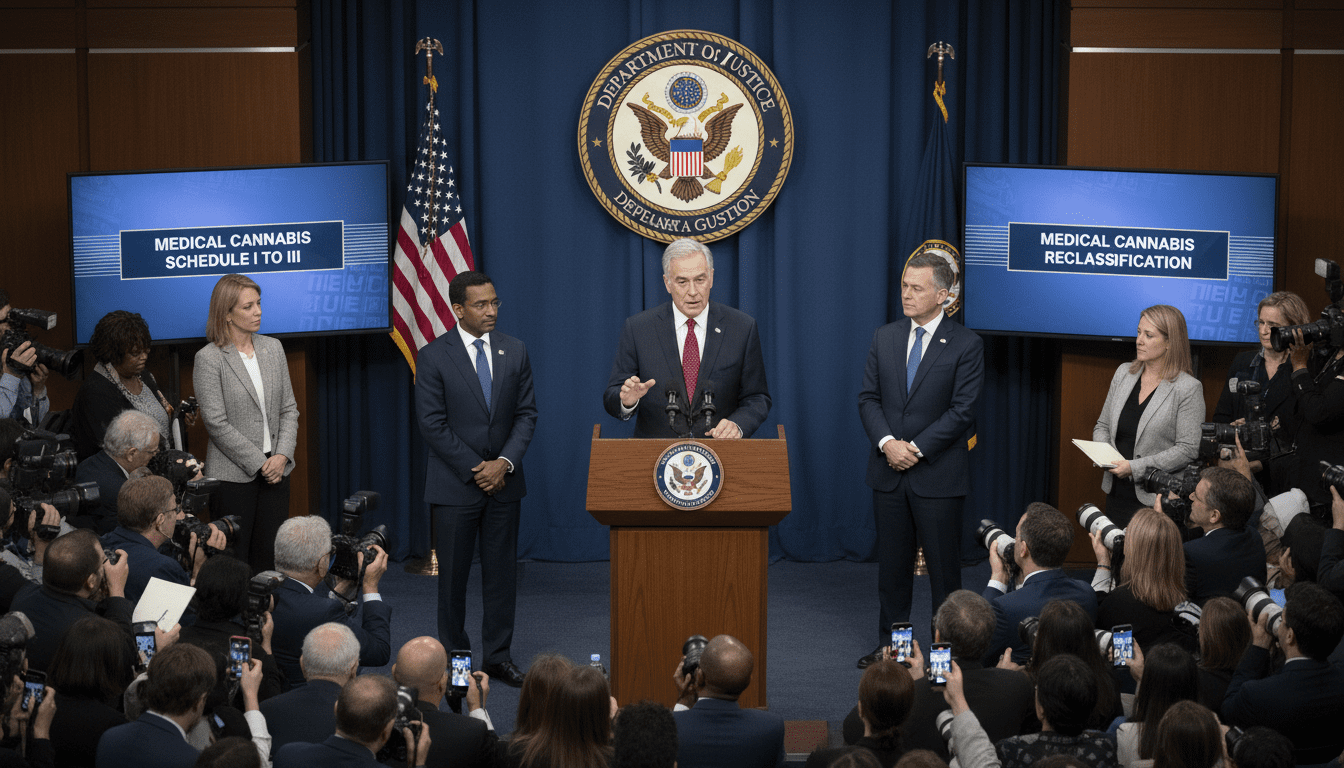
US Moves Forward on Medical Cannabis Reclassification, Easing Patient Access
US Justice Department downgrades FDA-approved cannabis to Schedule III, easing medical cannabis access for patients while stopping short of federal legalization.
Federal reclassification announced
The US Justice Department announced that cannabis products approved by the FDA and licensed by states have been moved from Schedule I to Schedule III under federal drug classification rules. This medical cannabis reclassification applies specifically to those products that meet federal approval and state licensing requirements.
Acting Attorney General Todd Blanche said the change reflects a determination that approved cannabis formulations carry a moderate to low risk of addiction. The department framed the move as aimed at expanding treatment options and enabling physicians to make more informed medical decisions.
Scope limited to approved, state‑licensed products
The Justice Department emphasized the relabeling does not decriminalize cannabis broadly or alter state laws on recreational use. Only products that have passed FDA review and that are distributed under state licensing regimes are included in the new Schedule III designation.
Legal experts say the narrow scope leaves most non‑approved cannabis products unaffected at the federal level. Patients who use state medical programs with approved formulations will see the clearest regulatory benefits under the new classification.
Acting Attorney General Blanche’s rationale
Blanche characterized the decision as a public‑health and medical judgment, noting available evidence supported a lower addiction risk for approved formulations. He and department officials argued the change should reduce barriers to clinical use and to physician guidance on treatment.
The Justice Department also cited a December presidential executive order aimed at expanding medical cannabis research as underpinning the move. Officials stressed the reclassification is intended to facilitate studies and therapeutic access rather than effect a broad policy shift on legalization.
Presidential order and research expansion
The department pointed to the executive order issued in December by President Donald Trump, which directed federal agencies to broaden research into therapeutic applications of cannabis. Trump, according to the department, framed that directive as focused on research rather than on decriminalization.
Administration sources said the order encouraged agencies to review regulatory obstacles that had constrained clinical trials and data collection. The reclassification of approved products is being presented as a concrete step to implement the research priorities outlined in that December directive.
Market reaction and fiscal implications
Equity markets reacted quickly to the announcement, with several cannabis companies seeing shares rise in premarket trading by between six and 13 percent. Analysts attributed the gains to anticipated increases in market access and potential reductions in the tax liabilities that have historically applied to many cannabis businesses.
By moving approved products to Schedule III, the federal tax treatment and regulatory compliance obligations for qualifying firms could change, potentially lowering operational costs. Investors also cited the likelihood that banking and insurance relationships would become easier for companies dealing in FDA‑approved, state‑licensed cannabis formulations.
Regulatory next steps and hearings
While the new designation takes immediate effect for qualifying products, the Justice Department said it will hold an expedited hearing to consider a broader rescheduling of cannabis. The announced hearing aims to examine scientific evidence, clinical data, and public‑health implications for a more comprehensive reclassification.
Observers expect that any broader federal change would require lengthy administrative and possibly judicial processes, and would need to reconcile differences among federal, state, and local regulatory regimes. Lawmakers and health advocates are poised to submit testimony and studies during the hearing process.
Public health groups welcomed measures that expand research but urged caution, saying access must be balanced with robust safety monitoring. Industry representatives urged regulators to clarify implementation timelines so manufacturers, prescribers, and insurers can adapt compliance, labeling, and reimbursement practices.
The Justice Department’s decision marks a notable federal shift in how medically oriented cannabis products are classified, signaling a policy focus on research and clinical access while maintaining existing statutes for non‑approved uses.
