
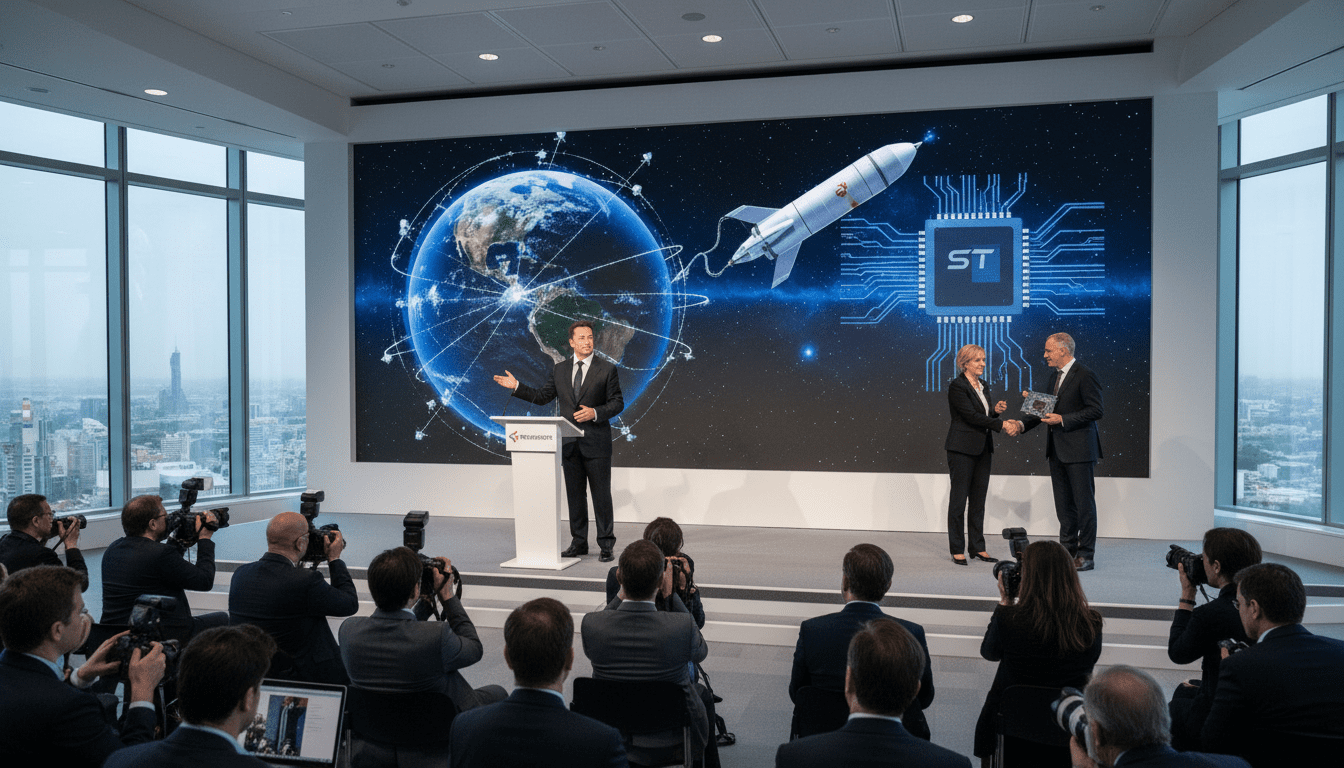
SpaceX Starlink to Offer Global Satellite Mobile Service, Build Orbital Data Centers and Refueling Stations
SpaceX Starlink will roll out satellite-based global mobile service and plans orbital data centers and refueling stations, reshaping space communications.
SpaceX announced an accelerated push to expand Starlink beyond broadband internet into satellite-based global mobile telephony, while preparing to host computing infrastructure and refueling facilities in low Earth orbit. The company says these developments could arrive over the next several years as Starlink matures and demand for resilient, global connectivity grows. Industry suppliers such as STMicroelectronics are already reporting revenue tied to Starlink hardware, underscoring the commercial ripple effects of SpaceX’s roadmap.
SpaceX expands Starlink into satellite mobile telephony
SpaceX is positioning Starlink to deliver direct-to-device mobile service that would reach users beyond terrestrial cell networks. The plan involves adapting the Starlink satellite constellation and user terminals to support traditional voice and cellular data on a global scale. If deployed widely, the service could offer coverage in remote areas, on maritime routes, and during disasters where ground infrastructure is compromised.
Plans for orbital data centers and computing hubs
Beyond connectivity, SpaceX is proposing to host data centers in orbit that bring compute resources closer to satellite-based services and reduce latency for certain applications. These orbital computing hubs would act as extensions of terrestrial cloud services, processing data in space before passing results to ground networks. The concept targets workloads that benefit from proximity to satellites, such as real-time imaging, edge analytics, and persistent low-latency communications.
Orbital refueling stations for next-generation spacecraft
SpaceX also envisions building fueling and servicing facilities in orbit to support future spacecraft generations and extend mission lifetimes. Such refueling stations would enable longer missions, more ambitious satellite servicing, and faster transit to higher orbits or the Moon. The infrastructure aligns with broader industry moves to create a sustainable in-space logistics chain and to reduce reliance on single-launch payload limitations.
STMicroelectronics gains from Starlink supply contracts
Suppliers are already seeing the financial impact of Starlink’s expansion, with STMicroelectronics cited as a notable beneficiary due to its semiconductor components used in satellite and terminal hardware. Revenue tied to satellite components underscores how large-scale constellation projects can stimulate global supply chains for chips, antennas, and power-management systems. Analysts note that continued Starlink growth would likely deepen supplier relationships and create durable demand for space-grade electronics.
Regulatory and technical hurdles remain
Deploying mobile telephony, orbital data centers, and refueling depots will require SpaceX to navigate complex regulatory frameworks and technical obstacles. Spectrum coordination, cross-border licensing for mobile services, and compliance with space debris mitigation policies are among the regulatory challenges. On the technical side, thermal control, radiation hardening for orbiting servers, and secure in-orbit fuel transfer procedures will need rigorous testing and certification.
Market implications for telecom and space industries
If realized, SpaceX’s plans could disrupt traditional telecom operators by offering a complementary or competing global mobile layer, especially in underserved regions. Satellite-delivered mobile service would change how carriers address roaming, coverage, and emergency backup, and could accelerate partnerships or competition between terrestrial and space-based providers. The emergence of orbital data centers and logistics could also spawn new commercial segments, prompting investment from cloud providers, defense contractors, and logistics firms.
SpaceX faces operational scaling challenges even as demand for resilient global connectivity grows, and the company’s moves will be watched closely by regulators, industry partners, and investors. Suppliers such as STMicroelectronics demonstrate how hardware ecosystems adapt to constellation-scale programs, but long-term success will hinge on resolving spectrum, safety, and economic questions. The next several years are likely to determine whether Starlink’s ambitions become foundational elements of 21st-century communications and space infrastructure.
