
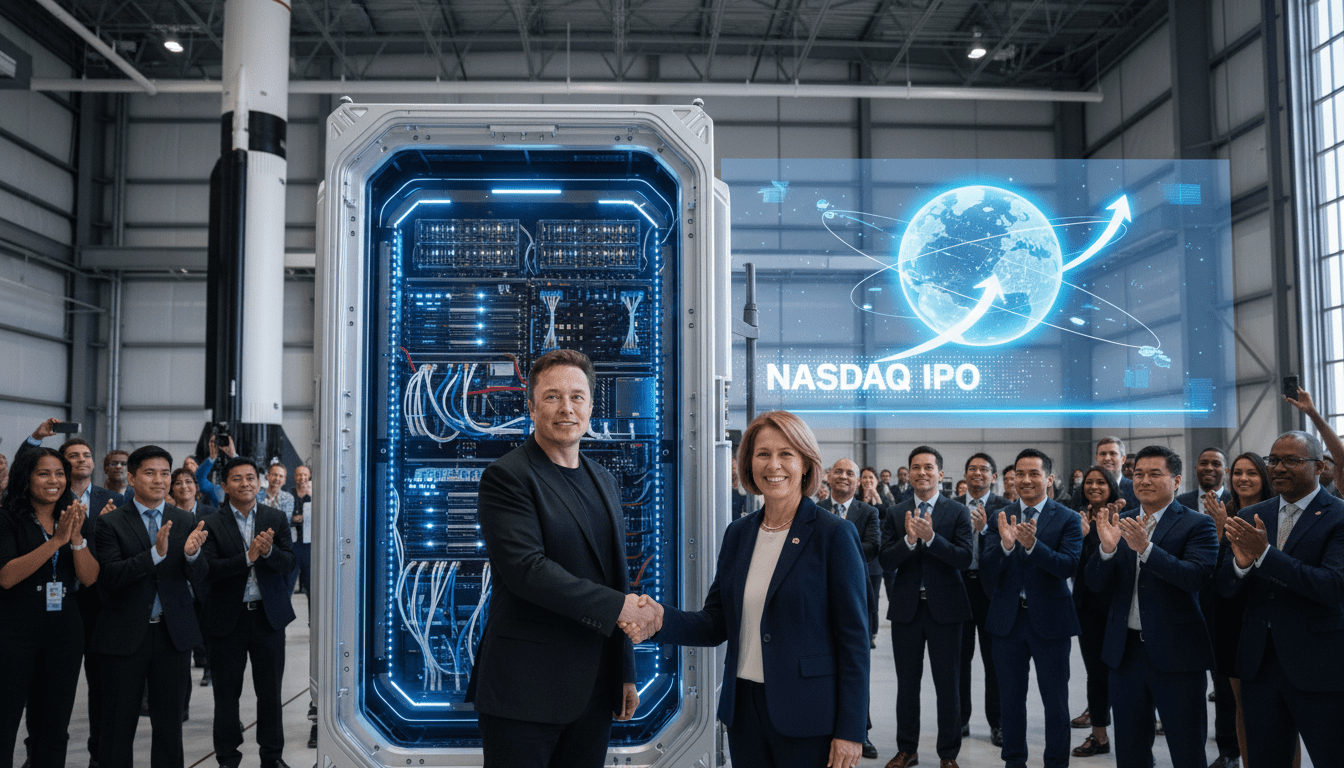
SpaceX IPO Looms as Musk Seeks Nasdaq Capital for Ambitious Orbital AI and Starlink Expansion
SpaceX IPO nears as Elon Musk seeks Nasdaq capital to fund orbital AI data centers and Starlink growth, prompting debate over valuation and investor risk.
Elon Musk’s SpaceX is preparing for a potential SpaceX IPO that could be among the largest in history, while unveiling plans that extend from satellite internet to orbital artificial intelligence infrastructure. The company’s announced intentions — including filings that describe millions of interconnected satellites and the recent acquisition of X.AI — have sharpened investor focus on how a public listing would fund an array of costly space projects. Reports in U.S. media suggest a Nasdaq debut as soon as June, and speculation about the size and valuation of the deal has driven intense market interest and scrutiny.
From an El Segundo warehouse to market leadership
SpaceX began in a sparse El Segundo warehouse in 2002, funded largely by proceeds from Musk’s sale of PayPal stakes, and has since become the dominant commercial launch provider. The company now handles a large share of global payload launches and provides crew transport to the International Space Station with its Crew Dragon capsule, roles that have shifted substantial government and commercial business toward SpaceX. Analysts who track the industry say Starlink is the company’s most significant revenue engine, and launch cadence remains largely driven by the satellite program’s deployment needs.
FCC filing and the vision for orbital AI data centers
In recent months SpaceX submitted documents to U.S. regulators outlining plans to build orbital data centers and to expand its satellite fleet dramatically, a proposal that would combine space-based solar power with AI compute workloads. The filings spoke to the technical concept of using space-based resources to host large-scale computing, and company executives have argued that solar energy in orbit could make such infrastructure economically viable. The idea has prompted comparison with other tech leaders’ exploratory work on space compute, but SpaceX’s public assertions about timelines and scale have been more expansive than most peers.
Moon-based manufacturing and a lunar catapult concept
Beyond orbital data centers, reports attribute to Musk ideas for a lunar manufacturing facility and unconventional launch concepts, including a large-scale “catapult” to place objects into orbit from the Moon. Such proposals remain at an early, speculative stage and would require enormous engineering, logistical and financial investments if pursued. Observers caution that while the concepts are headline-grabbing, turning them into operational programs would stretch timelines and budgets far beyond the company’s current activities.
The IPO math: size, valuation and market expectations
Multiple U.S. outlets have reported that SpaceX is preparing a major public offering that could raise between $40 billion and $80 billion, figures that would place the float among the largest ever if confirmed. Rumors of an aspirational valuation approaching $2 trillion have circulated, a number Musk publicly urged followers not to treat as fact. Industry estimates such as those from PitchBook have placed SpaceX’s recent revenue in the low tens of billions and suggested operative profitability, but translating existing earnings into the valuations described by pundits would require exceptionally high growth expectations and multiple expansion.
X.AI purchase and the pressure of AI-related losses
SpaceX’s acquisition of the AI startup X.AI has framed much of the rationale offered for a large IPO, with company leaders linking the buy to a vertically integrated strategy that pairs AI software with space-based compute and the Starship launcher. Media reporting has cited insiders saying X.AI is incurring steep monthly losses driven by compute and training costs, a profile that some analysts view as a financing burden on any acquirer. That dynamic has fueled debate over whether the consolidation creates genuine operational synergies or simply layers a loss-making AI arm atop a capital-intensive space business.
Retail allocation, the Musk factor and investor appetite
According to reporting on underwriter plans, a substantially larger share of initial shares could be earmarked for retail investors than is typical for blockbuster listings, a move that appears designed to harness Musk’s wide popular following. Banks involved in the offering have reportedly prepared for heavy demand from individual investors who have historically backed Musk ventures such as Tesla. Yet some market participants warn that a high-profile retail push, combined with unverified valuation talk, raises the potential for frothy demand that may not reflect long-term fundamentals.
The coming weeks are likely to define whether the SpaceX IPO will proceed on the timelines and scales currently reported, and whether public markets will accept the narrative linking satellite internet, orbital AI compute and lunar ambitions into a single valuation. For investors and regulators alike, the transaction will serve as a test of how much speculative premium remains available for vision-driven industrial ventures that promise transformational technology but demand unprecedented capital.
