
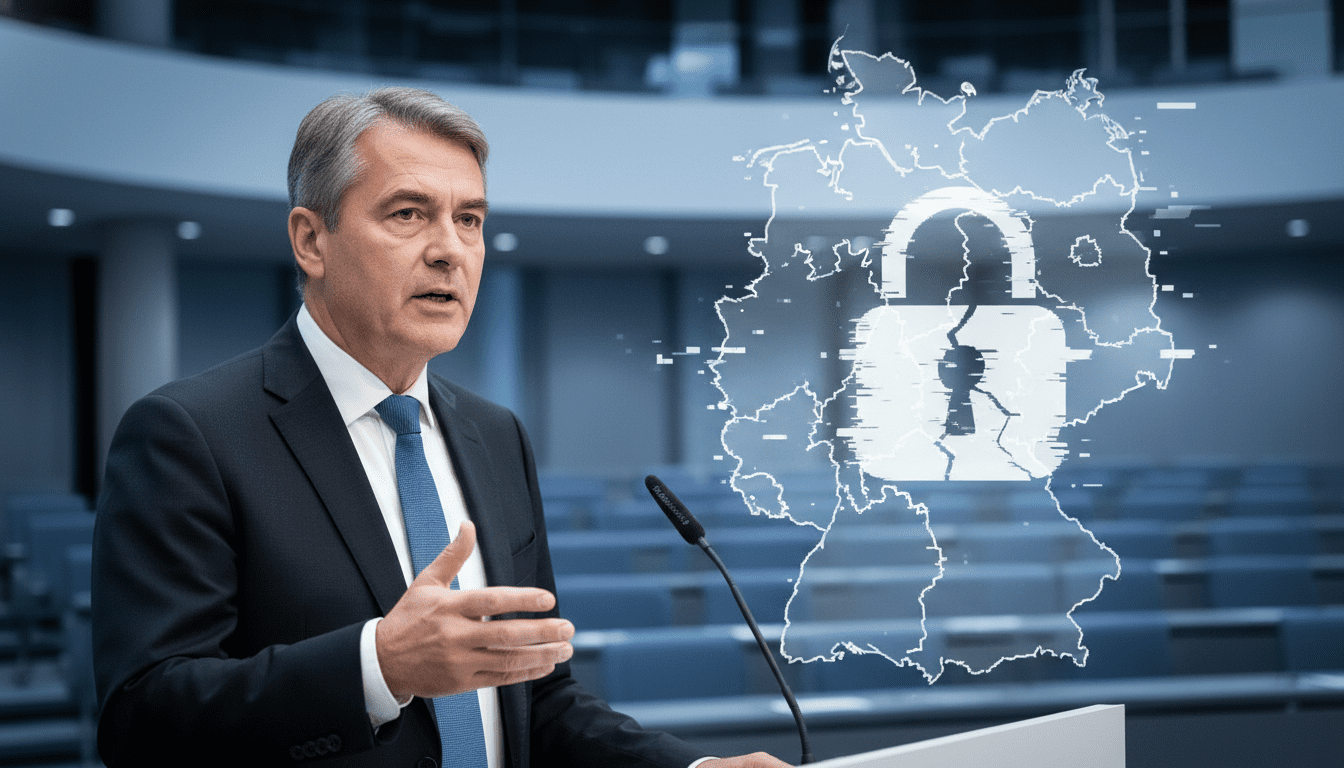
Bitkom President Ralf Wintergerst Urges More Investment and Less Regulation to Secure Digital Sovereignty
Ralf Wintergerst urges the EU to end unanimity, boost investment and cut regulation to secure Europe’s digital sovereignty and accelerate tech growth now.
Germany risks losing ground on digital sovereignty, Bitkom president Ralf Wintergerst warned, arguing that political gridlock and excessive regulation are stifling the continent’s tech ambitions. Wintergerst, who also serves as CEO of security-technology firm Giesecke+Devrient, delivered his remarks at a Club Wirtschaftspresse event in Munich, calling for concrete policy shifts to unlock investment and speed technology deployment. He singled out the unanimity rule in the European Union and the continent’s bank-dominated funding model as major obstacles to rapid progress. The executive tied his proposals to a broader goal: making Europe less dependent on foreign technology while strengthening its own industrial and research base.
Political paralysis hampers decision-making
Wintergerst told the audience that Germany is effectively “not politically capable” of decisive action, describing a domestic and European political process in which too many decisions are stalled or blocked. He contrasted the EU’s requirement for unanimous consent in many areas with the clearer majority dynamics seen in other democracies, saying the unanimity principle prevents timely responses to strategic challenges. The Bitkom president argued that this structural feature reduces the ability of governments to implement coherent industrial and digital policies across Europe. He said the result is a widening gap between technological potential and practical results.
Abolishing EU unanimity to speed strategic moves
Calling for the abolition of the unanimity rule, Wintergerst suggested the change would allow the EU to act faster on matters that affect digital infrastructure, security and market competition. He argued such a reform would reduce the ability of single member states to block measures that have broad continental benefits. Wintergerst acknowledged the political sensitivity of changing EU treaty rules, but framed the move as essential to meet geo-economic competition. He emphasized that without institutional reforms, Europe will struggle to coordinate the investments and procurement decisions needed for digital sovereignty.
Capital markets union proposed to finance startups
Wintergerst proposed a stronger European capital markets union as a remedy for slow funding of young technology firms, saying that current reliance on bank lending encourages conservative approaches. He painted a contrast with the United States, where startups often find faster access to venture capital and institutional investors. According to Wintergerst, a deeper European capital market would provide scale and risk tolerance that banks do not, enabling more rapid commercialization of research. He said better access to equity financing is a prerequisite for turning Europe’s research strengths into globally competitive companies.
Less regulation, more state procurement to build national champions
The Bitkom president argued that heavy regulation intended to rein in dominant American tech platforms can unintentionally discourage domestic firms from scaling up. He urged policymakers to pair regulatory measures with targeted state procurement and support for national technologies so local companies can develop market-critical capabilities. Wintergerst called for a pragmatic balance: rules that protect consumers and competition, coupled with public-sector demand that creates reliable first customers for emerging firms. He warned that relying solely on regulation without accompanying investment and market access will not yield genuine digital sovereignty.
Giesecke+Devrient’s pivot underscores industry shift
Winterprest pointed to his own company’s transformation as evidence that German firms can adapt to new market realities. Giesecke+Devrient, historically known for banknote printing, has repositioned itself as a specialist in security technology and reported a record annual revenue of 3.2 billion euros. Wintergerst said the firm’s order intake remained strong, with €1.6 billion booked in the first quarter following €3.6 billion for the full year 2025. He used the company’s results to argue that there is commercial momentum for European technology providers, provided policy and capital structures enable scale.
Technology transfer and transatlantic realism
While stressing the need for European capabilities, Wintergerst acknowledged that total technological decoupling from the United States and China is neither realistic nor desirable. He called for selective technology transfer and international cooperation that preserves strategic autonomy while leveraging global innovation networks. The Bitkom chief argued that a pragmatic approach to partnerships, combined with industrial policies that favor domestic procurement and investment, can strengthen Europe’s hand. This, he said, would position the bloc to negotiate from strength rather than dependency.
Germany and the EU face a choice between incrementalism and systemic reform if they want to close the gap on critical digital capabilities. Wintergerst’s recommendations — institutional change, deeper capital markets, targeted state purchasing and a lighter regulatory touch where appropriate — sketch a roadmap for pursuing digital sovereignty without isolation. Whether European leaders embrace those measures will determine how quickly research strengths translate into market-leading technologies.
