
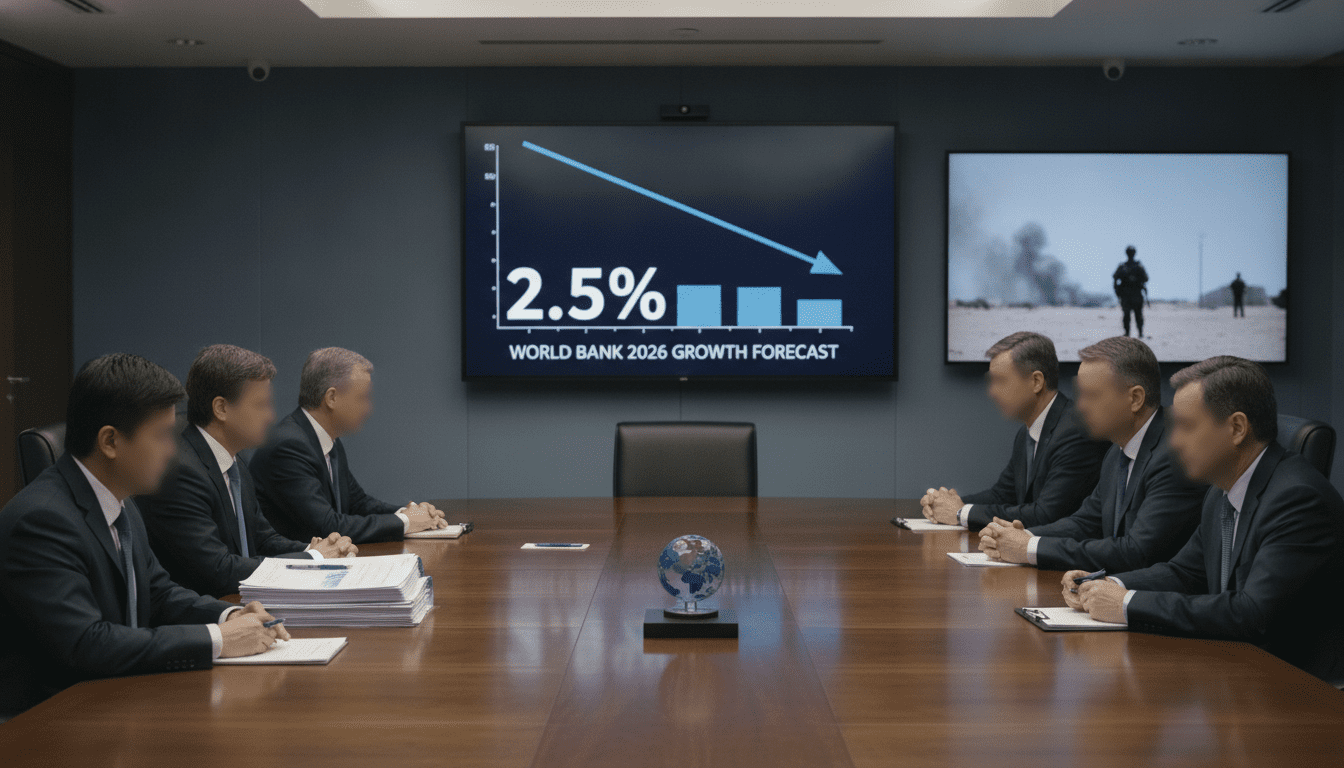
World Bank cuts 2026 growth forecast to 2.5% amid Iran war
World Bank cuts 2026 growth forecast to 2.5% amid the Iran war, citing energy shocks and rising inflation; warns of widening poverty in developing countries and offers support.
World Bank lowers global growth outlook
The World Bank has cut its projection for global economic growth in 2026 to 2.5 percent, describing the outlook as the weakest since the start of the COVID-19 pandemic. The downgrade directly ties the slowdown to the Iran war and the resulting disruption to energy supplies and international trade routes.
The bank said higher inflation and elevated energy prices have clouded prospects for recovery, and its assessment follows similar downgrades from the OECD and the IMF earlier this year. Officials warned the situation could deteriorate further if supply bottlenecks persist, amplifying both price pressures and growth headwinds.
Inflation risks and worst-case scenarios
In a downside scenario, the World Bank estimated global inflation could rise to 4.4 percent while world growth could slump to 1.3 percent for the year. That path would reflect prolonged supply interruptions and sharply higher energy costs, which would squeeze household budgets and corporate margins simultaneously.
Such an outcome would force policymakers into difficult trade-offs between fighting inflation and supporting fragile recoveries, particularly in economies with limited fiscal room. Central banks and finance ministries could face rising pressure to balance interest-rate settings with targeted relief for vulnerable sectors.
Strait of Hormuz disruptions and trade impact
The bank highlighted the near halt of shipping and commodity trade through the Strait of Hormuz as a key channel transmitting the shock to the global economy. Insurance costs and rerouting expenses for tankers and bulk carriers have risen, raising the landed cost of oil and other commodities for importers worldwide.
Higher transport and energy costs have a ripple effect across supply chains, increasing production costs and slowing trade flows. The World Bank’s analysis points to both direct price effects from constrained fuel supplies and indirect impacts from reduced trade volumes in affected regions.
Developing countries at heightened risk
The World Bank warned that poorer and fragile states are bearing the brunt of the crisis, with limited buffers to absorb price shocks or to finance emergency responses. The bank projects that by the end of 2026 roughly a quarter of developing countries will be poorer than they were in 2019, reversing years of gains in income and human development.
To mitigate the fallout, the institution announced support measures in the range of $50 to $60 billion aimed at assisting governments in vulnerable countries. The bank said some of these funds would be reallocated from other projects, reflecting urgent needs but also raising concerns about the longer-term impact on development programs.
Policy responses and funding challenges
The World Bank’s pledge signals a shift toward crisis management, but it also highlights the constraints facing global financial support systems. Reallocating funds from existing projects may provide quick relief but could delay investments in health, education and infrastructure that underpin longer-term growth.
Donor coordination and multilateral financing will be critical, the bank suggested, as will be measures to protect the most vulnerable populations from steep price shocks. Experts note that without additional concessional financing or debt relief, many low-income countries could face painful trade-offs between welfare spending and debt service.
Outlook for markets and next steps
Markets and policy-makers will be watching incoming data for signs that energy and trade disruptions are easing or worsening, since those signals will determine near-term inflation and growth paths. The World Bank said its projection reflects current conditions but remains conditional on how the conflict and associated supply disruptions evolve.
The bank urged international cooperation to stabilize energy markets and support liquidity for fragile economies, emphasizing that unilateral measures will be insufficient to shield the global recovery. It called for enhanced monitoring of trade corridors and swift coordination on emergency financing to prevent a broader deterioration.
The World Bank’s downgrade underscores how geopolitics can swiftly reshape economic prospects, reinforcing the need for targeted support to vulnerable countries and for policies that strengthen resilience across supply chains and commodity markets.
