
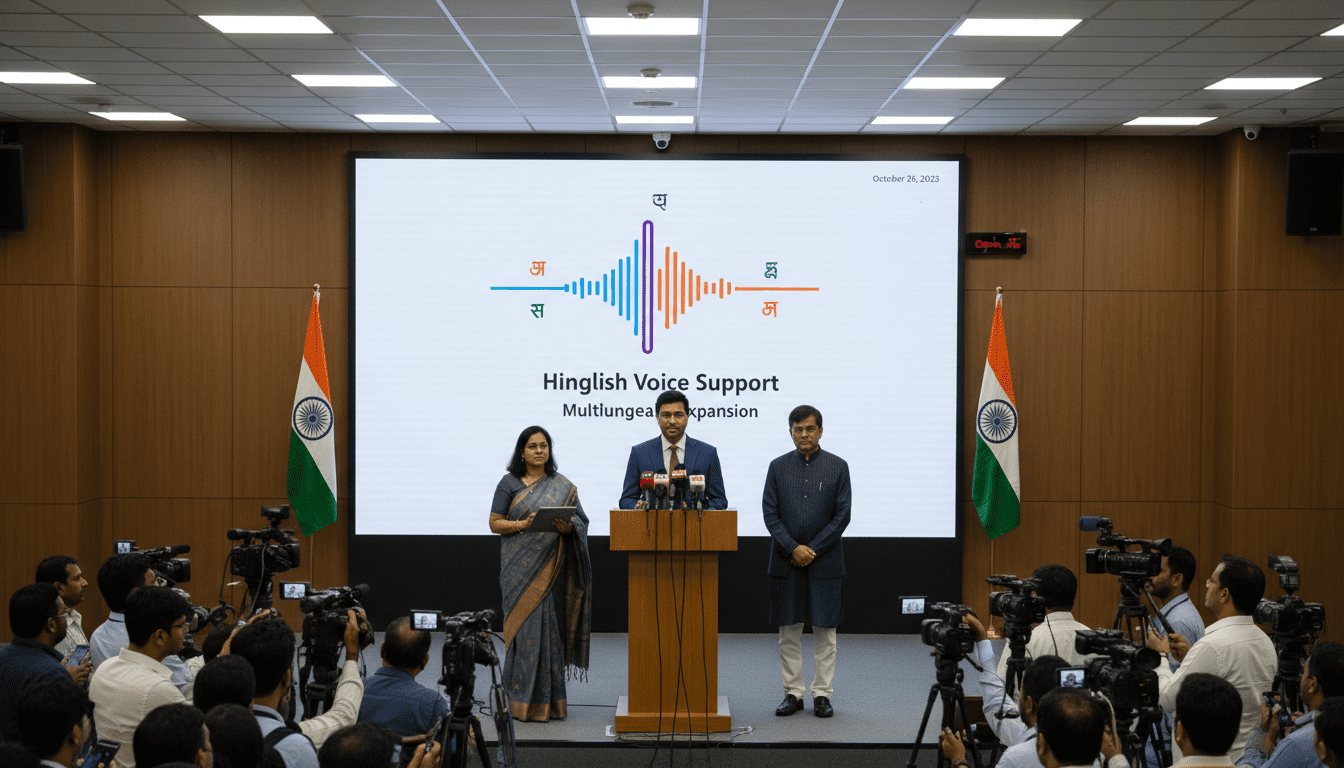
Wispr Flow expands Hinglish voice AI as India becomes its fastest-growing market
Wispr Flow expands in India with Hinglish voice AI, Android launch, lower India pricing and local hires as the Bay Area startup pursues mass-market adoption.
India has become Wispr Flow’s fastest-growing market as the Bay Area startup rolls out Hinglish voice models, an Android app and India-specific pricing designed to transfer heavy local voice habits into mainstream voice AI in India. The company says usage has moved beyond white-collar professionals to messaging and social apps, where mixed Hindi-English speech is common. Recent product launches and a local hiring push underpin an aggressive expansion plan that aims to make voice-first computing accessible to a broader cross-section of Indian users. The startup’s strategy tests whether generative voice tools can overcome India’s linguistic complexity and uneven monetization patterns.
India becomes Wispr Flow’s fastest-growing market
Wispr Flow reports rapid month-over-month growth in India, with adoption accelerating after an India-focused campaign and the rollout of Hinglish support. Company executives say India is now the startup’s second-largest market by users and revenue after the United States.
Independent app-store data shows the app was downloaded more than 2.5 million times globally between October 2025 and April 2026, with India accounting for a notable share of installs even as in-app purchase revenue from India lagged behind other markets. The disparity underlines the monetization challenge the company faces while user traction broadens.
Hinglish beta, Android launch and product shifts
Wispr Flow began beta testing a Hinglish voice model earlier this year and recently launched an Android app to reach the device ecosystem dominant in India. The product initially debuted on desktop and then expanded to iOS before targeting Android users, reflecting a deliberate pivot to mobile-first consumption.
The Hinglish model is designed to handle frequent code-switching between Hindi and English, an everyday speech pattern for many Indians that standard speech-recognition systems struggle to interpret accurately. Early results indicate the language-combination support has driven greater use in conversational and personal apps beyond professional dictation.
Users moving beyond white-collar workflows
The startup initially saw uptake among managers, engineers and other white-collar professionals, but usage patterns are diversifying. Executives report growing adoption by students and older users, often introduced to the app by younger relatives, and increasing engagement within messaging platforms such as WhatsApp.
That shift toward personal messaging and social media use suggests voice AI in India may gain traction through familiar communication habits, rather than through work-only productivity scenarios. Wispr Flow’s India user base is currently split roughly 50:50 between desktop and mobile, compared with a desktop-heavy footprint in the U.S., signaling a distinct usage profile in the South Asian market.
Pricing and plans to reach mass-market users
To encourage broader adoption, Wispr Flow introduced India-specific pricing in December, offering an annual plan at significantly lower local rates than its global list price. The company has signaled ambitions to reduce costs further over time, potentially bringing consumer monthly pricing down into single-digit-rupee equivalents.
Lower pricing is central to the startup’s stated goal of expanding beyond urban, white-collar customers into households and smaller towns. Executives argue that affordability, combined with improved multilingual performance, is essential for converting widespread voice habits into a scalable subscription business.
Local team, linguistics investment and roadmap
Wispr Flow has bolstered its India presence with local leadership and plans to grow operations to roughly 30 India-based employees over the next year. The hiring will expand consumer growth, partnerships and enterprise teams while complementing existing engineering and support functions.
On the research side, the company employs linguistics PhDs to refine models and plans to widen multilingual support within 12 months, enabling users to switch naturally among English and multiple Indian languages during speech. That technical investment aims to reduce “accent and contextual friction” that analysts say impede voice AI adoption in India.
Market context and technical challenges
Industry analysts characterize India as an especially demanding market for voice AI because of its many languages, dialects and common code-switching behavior. “India is the ultimate stress test for voice AI,” one researcher observed, noting that linguistic diversity and uneven infrastructure complicate product development and deployment.
Several startups and established AI firms are pursuing India-focused voice strategies, attracted by the scale of voice-first behavior and the growth potential. Still, investor interest and product launches must be matched by robust localization, culturally aware user experiences and monetization models that reflect local purchasing patterns.
Wispr Flow’s recent India push tests whether a combination of Hinglish-capable models, targeted pricing and on-the-ground hiring can convert ingrained voice habits into sustained product use and revenue. The company’s success will depend on its ability to scale multilingual accuracy while making the service affordable and easy to adopt across India’s broad user base.
