
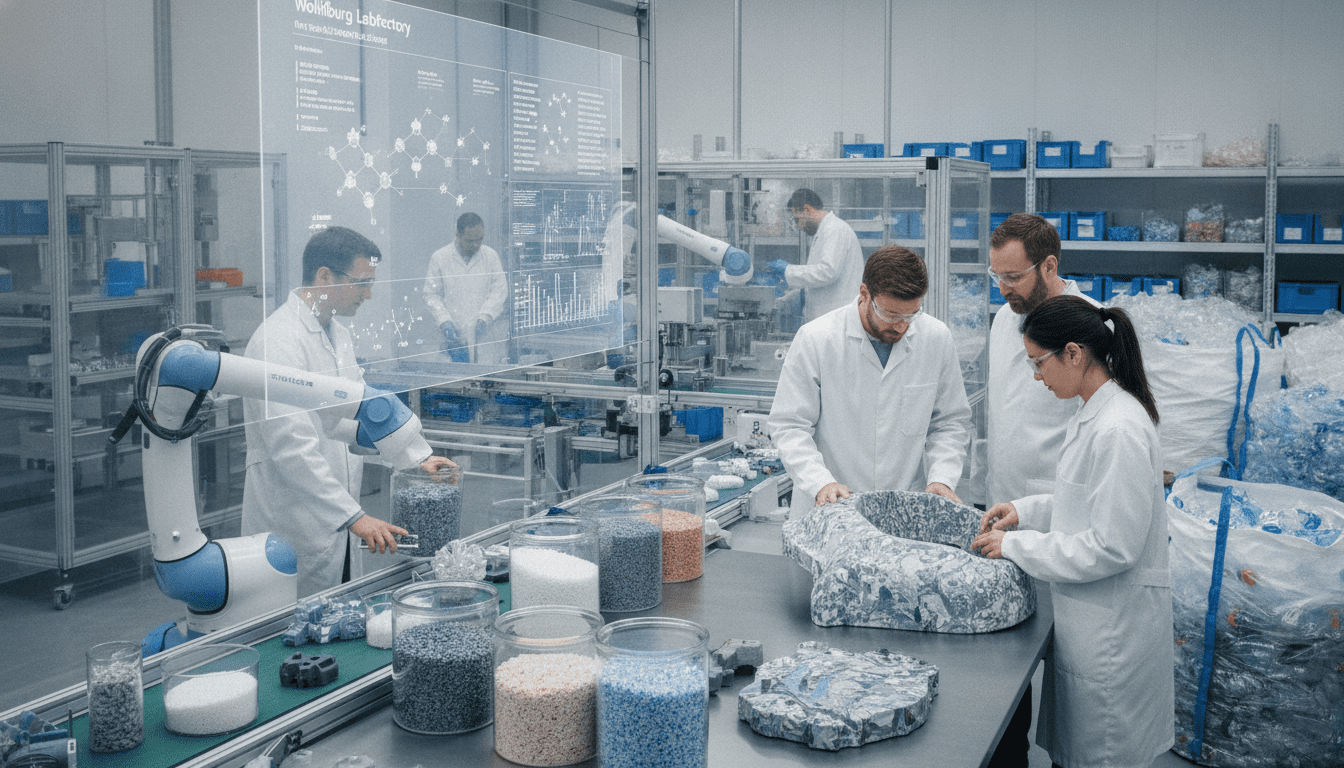
Wolfsburg Labfactory tests circular economy production as EU tightens auto recycling rules
Wolfsburg Labfactory pilots circular economy production with VW, Fraunhofer and industry partners, preparing for EU recycling quotas and BDI forecasts that could reshape auto materials.
The Open Hybrid Labfactory near Wolfsburg is running industrial-scale trials to integrate recycled materials into vehicle components, testing real production workflows under scientific supervision. Volkswagen, four Fraunhofer institutes and TU Braunschweig are collaborating on experiments that expose materials to manufacturing conditions, with the aim of meeting rising circular economy requirements. The facility is assembling and disassembling parts, subjecting plastics and coatings to heat and handling to evaluate whether recycled feedstocks can meet automotive durability and aesthetic standards.
Labfactory runs production-scale material tests
The Labfactory’s equipment resembles heavy industrial machinery more than a conventional research lab, with some systems weighing thousands of tonnes and operating at temperatures around 200 degrees Celsius. Engineers insert polymer sheets into heated molds to form interior parts, then immediately subject the outputs to mechanical and surface tests. Those trials produce high volumes of imperfect parts by design — a deliberate strategy to gather statistically relevant data on longevity and failure modes.
Industry and research partnership funded by federal research program
The campus was built with support from the Federal Ministry of Education and Research as one of nine funded facilities nationwide, creating a shared space where OEMs, suppliers and institutes work side by side. Companies from large suppliers to medium-sized toolmakers participate, including names from heavy machinery, adhesives and materials science. The proximity of industry and academia is intended to accelerate translation from lab insight to shop-floor practice, shortening the feedback loop on material choices and recycling processes.
EU targets and BDI forecast increase urgency
European Union rules now require new cars to include a rising share of recycled content, with targets such as reaching roughly 15 percent recycled material by 2032 and higher levels thereafter. At the same time, the Federation of German Industries (BDI) projects that the gross value added of a national circular economy could more than double from its current baseline of about €60 billion by 2045. Those regulatory and economic signals are pushing automakers and suppliers to prioritize material reuse and to test how higher quotas affect product performance.
Tests show recycled plastics meet composition but struggle with coatings
Researchers report that many recycled polymers can satisfy mechanical specifications, yet coatings and surface treatments remain a recurring challenge. Comparative tests in Wolfsburg found parts made from recovered polyamides, fishing-net recyclates and airbag-derived materials often met strength and fit requirements but failed certain paint-adhesion trials. That gap highlights a common industry problem: meeting functional thresholds is necessary but not sufficient when visible finishes and customer expectations are at stake.
Automation shortens battery disassembly but complexity persists
Robotic systems in the Labfactory are reducing the risk and time of battery module dismantling, cutting cycle times but still encountering recognition and access hurdles. A single automated line can disassemble multiple battery modules in about 90 minutes, an improvement on earlier runs, yet vision systems or tooling occasionally miss fasteners or obstructed parts. Engineers emphasize that automation must be hardened for variable real-world conditions if reuse of components and recovery of critical materials is to scale.
Supply chains and material flows must be industrialized
Participants agree that reliable circularity requires stable, high-volume feedstocks and digitally traceable material streams. Pilot projects that supply ocean plastics or small-batch recyclates face limits of quantity and consistency, which constrain their industrial uptake. Stakeholders stress that to be commercially viable, recycled plastics must be available in predictable volumes and with certified properties, while recycling processes must scale and be economically attractive to both producers and waste managers.
The experiments in Wolfsburg illustrate both potential and friction points for a circular economy in the automotive sector: research-grade results show technical feasibility, but surface quality, consistent recycling streams and industrialized logistics remain barriers. With EU quotas and industry forecasts tightening the timetable, manufacturers say collaborative, production-oriented research will determine whether recycled content moves from niche application to mainstream practice.
