
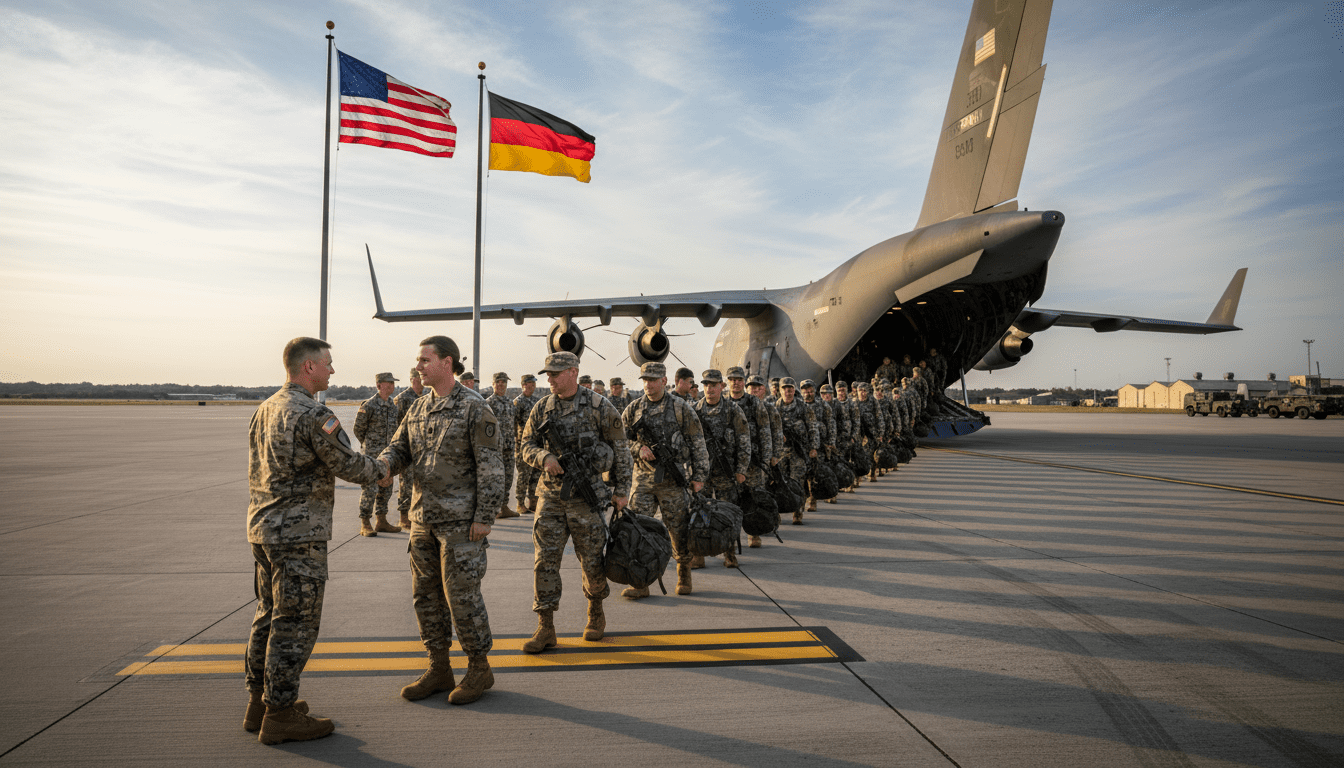
US troop withdrawal from Germany: Washington to remove 5,000 soldiers amid transatlantic row
US troop withdrawal from Germany: Washington plans to remove 5,000 soldiers within 12 months, cancel planned missile deployments and weigh security and economic consequences.
The United States has announced plans to withdraw roughly 5,000 service members from Germany over the next 12 months, a move tied to a recent diplomatic dispute and decisions in Washington. The announcement, delivered by Pentagon officials after public tensions between President Donald Trump and German Chancellor Friedrich Merz, also includes the cancellation of a planned deployment of medium‑range cruise missiles that had been discussed under prior administrations. German and NATO officials are assessing both the operational consequences for allied deterrence and the potential economic and political fallout for bilateral relations.
Washington orders 5,000 troops to leave within 12 months
Pentagon leadership said the reduction would unfold during the coming year, while President Trump indicated the figure could rise beyond the initially announced number. The administration frames the step as an exercise of sovereign force posture decisions, but officials acknowledged the announcement was prompted in part by the recent public exchange with Germany’s leadership. The timeline and exact units to be withdrawn were left deliberately broad in public statements, creating uncertainty about the scope and sequencing of the departures.
Units and capabilities targeted by the drawdown
Sources and defence analysts say the cuts are likely to affect combat formations rather than logistics or command hubs, with an armoured brigade combat team that has formed part of Operation Atlantic Resolve singled out in reporting. Separately, Washington signalled it will not proceed with the previously discussed stationing of medium‑range cruise missiles and certain advanced sea‑ and air‑launched systems that had been envisaged for deployment in Europe. That abandonment alters plans agreed under earlier administrations to plug capability gaps until European partners fielded equivalent systems.
Bases in southern Germany likely to see reductions
Most US forces in Germany are concentrated in the south and southwest, and military communities in Bavaria and Rhineland‑Palatinate could see the most immediate effect. Installations commonly mentioned in defence planning — Grafenwöhr, Vilseck and Hohenfels — host training and combat units that could be trimmed, while Ramstein and Stuttgart retain central command and support roles. Officials stressed there is no public indication yet that entire bases will be closed, and that critical facilities such as the Landstuhl medical centre and regional headquarters would remain strategically important.
Legal limits and deployment thresholds shaped the options
Any significant repositioning of US forces in Europe must navigate statutory and policy constraints set by Congress and the Department of Defense, including rules that prevent the Europe Command’s permanent force levels from falling below legislated thresholds for extended periods. Analysts note that a reduction of 5,000 troops would not breach the current ceiling established by recent congressional provisions, and rotational deployments offer additional flexibility to shift personnel without permanently lowering force ceilings. Still, the legal framework constrains rapid, large‑scale withdrawals and leaves room for Washington to convert announcements into bargaining leverage rather than irreversible moves.
Security implications for NATO and Germany’s defence posture
Military planners say a modest reallocation of combat troops can be absorbed without immediate collapse of deterrence, particularly given reinforcements sent to Europe after 2022 and rising defence spending among NATO members. However, the cancellation of planned medium‑range missile deployments removes a capability that Berlin and Washington had factored into future deterrence concepts and could complicate efforts to maintain a balance of forces on the alliance’s eastern flank. NATO officials warn that capability gaps created by cancelled deployments will need compensatory measures, whether through allied force contributions, accelerated European procurement or changes in basing and logistics arrangements.
Political and economic fallout for Berlin and the German regions affected
The troop reduction comes amid a sharp bilateral exchange in which the US president publicly criticised Germany’s leadership and announced additional economic measures, including higher tariffs on autos and heavy vehicles from the European Union. For regions hosting US troops — where bases support local economies through jobs, contracts and demand for services — the prospect of reductions raises concerns about lost income and social effects in towns that have long depended on allied presence. Berlin has responded cautiously, with ministers urging calm and underscoring the mutual benefits of cooperation at key hubs such as Ramstein, while also preparing for diplomatic and trade discussions.
Germany now faces a short window to translate uncertainty into strategic choices and contingency plans that stabilise both security arrangements and the local economies linked to US facilities. The federal government has reiterated the importance of allied cooperation and resilience, even as defence and diplomatic teams weigh how best to respond to changes announced from Washington.
