
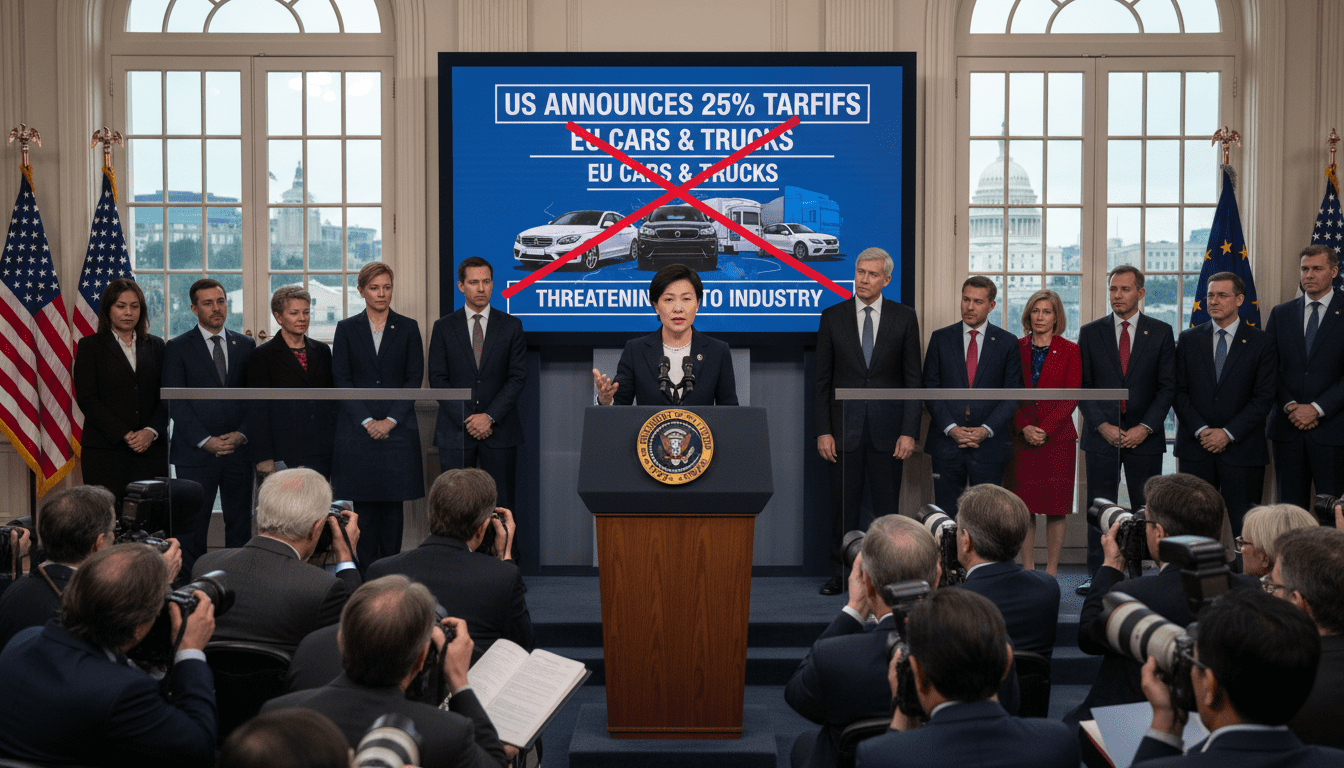
U.S. tariffs on EU cars set at 25% in presidential announcement, industry warns of major fallout
U.S. tariffs on EU cars announced by President Trump could reach 25%, risking heavy damage to European automakers, supply chains, and transatlantic trade if implemented.
The U.S. president announced on social media that he will raise U.S. tariffs on EU cars and trucks to 25 percent, escalating a dispute over compliance with a recently negotiated trade deal. The move, disclosed on his Truth Social account, singled out the European Union for alleged breaches of a full trade agreement and tied the tariff threat to production location, saying imports manufactured in the United States would be exempt.
Market data underline the stakes for the European auto sector, which exported 668,000 passenger cars to the United States in 2025, down from 772,000 the prior year. The export value fell from €39.3 billion in 2024 to €30.9 billion in 2025, according to figures from the European Automobile Manufacturers’ Association, highlighting an industry already under pressure before the tariff announcement.
President’s Announcement and Immediate Details
The president used his social platform to state the planned increase to a 25 percent tariff on cars and light trucks imported from the EU. He framed the measure as a response to what he described as non-compliance by the EU with terms of a bilateral trade deal.
The announcement did not specify the exact effective date or the procedural steps to be taken, nor did it cite the legal basis for imposing the higher duties. Officials in the relevant U.S. agencies had not released formal notices or initiated tariff adjustments at the time of the president’s statement.
Potential Impact on European Automakers
Industry analysts warn that a 25 percent levy would be highly disruptive for European manufacturers that rely on U.S. sales for key models. German firms such as BMW and Mercedes-Benz use U.S. plants for sizable parts of their SUV and crossover production, but continue to import flagship sedans and other models.
Porsche produces virtually no vehicles in the United States, while Volkswagen recently halted production of specialized electric models on U.S. soil, leaving those exports particularly exposed. The additional duties would raise landed costs and could force manufacturers either to absorb price increases, cut margins, or pass costs on to U.S. consumers.
Industry Leaders Call for De‑Escalation
Hildegard Müller, president of the German Association of the Automotive Industry, sharply criticized the announced tariff increase and warned of severe consequences for transatlantic relations. Industry groups in both Europe and the United States have urged Washington and Brussels to resume talks and seek a negotiated remedy.
Automakers have emphasized the integrated nature of modern supply chains and cautioned that tariffs could ripple beyond carmakers to parts suppliers and dealers, adding friction to a sector already contending with technology shifts and tightened profitability.
Legal and Procedural Uncertainties
Observers note that the announcement leaves several legal questions unresolved, including what statutory authority would be used to impose the new duties and how the administration plans to justify the move under U.S. trade law. Past tariff actions by the administration invoked national security and other emergency provisions, but those bases have faced judicial scrutiny.
The EU Parliament had previously paused ratification of the summer trade accord after the U.S. Supreme Court invalidated a large portion of earlier tariffs imposed unilaterally. That legal backdrop complicates both sides’ options and has already spawned litigation related to the new tariff threats.
Possible Effects on U.S. Consumers and the Wider Economy
Higher import duties typically translate into higher retail prices for affected goods, and experts say U.S. buyers of European models could face notable price hikes. Beyond consumer prices, tariffs could prompt retaliatory measures from the EU and unsettle industries that trade with transatlantic partners.
Some companies might accelerate plans to expand production in the United States to sidestep duties, but such investment shifts take time and may not be feasible for all models or brands. Short-term disruptions to inventory flows and dealer networks are a more immediate risk.
Next Steps and Diplomatic Signals
With no formal tariff implementation steps announced by U.S. agencies, attention has turned to whether Washington and Brussels will engage in urgent diplomacy to prevent escalation. Industry representatives have urged rapid, high-level talks and adherence to the negotiated accord to resolve alleged compliance issues.
In the absence of clear procedural moves, legal challenges to any eventual tariff increase are likely, adding another layer of uncertainty for manufacturers and traders on both sides of the Atlantic.
The coming days will determine whether the announcement remains a political lever in negotiations or solidifies into enforceable policy, with European automakers, trade officials and consumers watching closely for formal notices, legal filings and diplomatic responses.
