
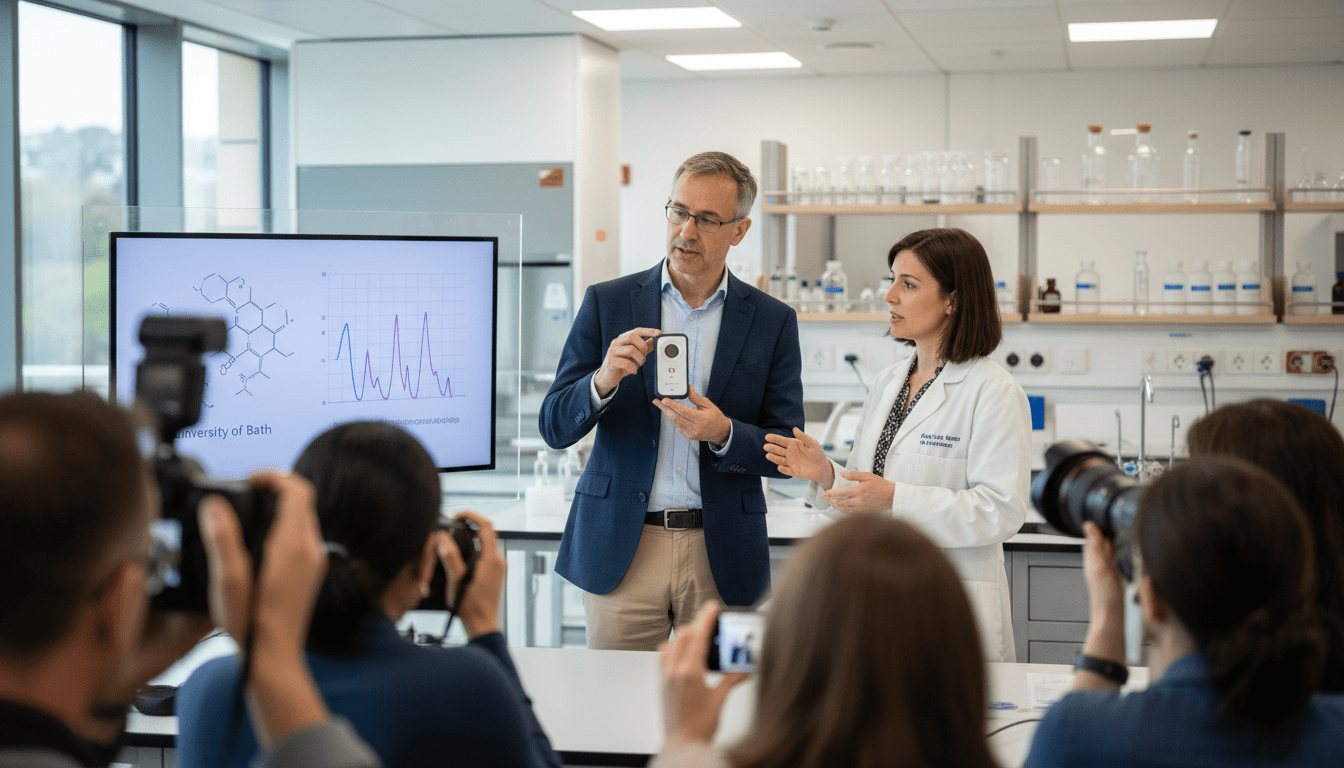
University of Bath unveils portable drug-detection device to identify fentanyl and benzodiazepines
University of Bath’s portable drug-detection device identifies trace benzodiazepines and synthetic opioids on site; trials underway in the UK, Norway and NZ.
A team at the University of Bath has produced a portable drug-detection device capable of identifying dangerous street drugs and their concentrations at very low levels, and the device is now being trialled by services in the UK, Norway and New Zealand. The prototype combines fluorescence and reflectance spectroscopies with a deep-learning library to flag trace contaminants such as synthetic opioids and benzodiazepines. Developers and partner services say the on‑the‑spot analysis could accelerate warnings and improve harm‑reduction work where people are at risk of unknowingly consuming ultrapotent mixtures.
University of Bath develops field-ready tester
The system was created by researchers in Bath’s Department of Life Sciences and described in Analytical Chemistry. It is designed to be portable and inexpensive, offering rapid readouts that show both the identities and the relative concentrations of ingredients in a sampled substance. Project lead Professor Chris Pudney and his group envision deployment in settings where illicit drugs are commonly used and in services that support dependent users.
Police and treatment services use device to issue faster warnings
Devon & Cornwall Police began using a unit acquired in June 2024 to fast-track analysis of suspicious substances linked to severe overdoses. That capability allowed investigators to issue a local drug warning within 36 hours after a fatality tied to oxycodone tablets that were later found to contain a nitazene, according to the force’s drug expert witness. Officials say the device has shortened the time between a suspected incident and community alerts that can reach treatment providers and service users.
Community drug-checking pilots expand internationally
The Loop, a community-based drug-checking service operating in Bristol, has used the device alongside other analytical tools since its licensing in 2024, reporting improved information sharing with local treatment partners. In New Zealand, where drug checking is explicitly legal, the device was used to test hundreds of samples during a two-week initiative involving three frontline services. Norway’s Association for Safer Drug Policies has also been trialling the spectrometer as part of broader community checking programs in the Nordic region.
How the device detects trace fentanyls and benzodiazepines
The instrument works by shining light on a sample and recording two complementary responses: the light emitted by the sample (fluorescence) and the light reflected from it (reflectance spectroscopy). These optical signatures are compared against a curated library of nanoparticle spectroscopy (NPS) patterns using a deep‑learning model trained to distinguish substances present at low concentrations. That combination enables detection of compounds that standard portable infrared spectrometers can miss, particularly ultrapotent synthetic opioids and low‑level benzodiazepine contamination.
Advantages over existing mobile technologies
Unlike many current field instruments, the Bath device is intended for operation by non‑specialists; the team stresses it produces results with a simple button press rather than requiring a trained chemist. It reports not only which substances are present but also gives an estimate of potency, enabling services to assess risk more precisely. Developers and users argue those features make it suitable for high-volume screening at festivals, night venues and in clinical or outreach settings where rapid, actionable information is needed.
Evidence from trials and early users
Frontline partners have highlighted instances where faster analysis changed local practice or prompted warnings to at-risk populations. KnowYourStuffNZ and New Zealand drug‑service partners said the new spectrometer may enhance their ability to give clients quicker, more accurate guidance. In the UK, police and service leads describe improved collaboration and more timely communication of hazards after incorporating the device into their workflows.
Potential impact on harm reduction and policy
Researchers and harm‑reduction advocates say a reliable, low-cost portable drug-detection device could shift prevention strategies from blanket abstinence messages toward targeted risk mitigation. Professor Pudney argues that making precise composition data available at the point of use empowers people to make safer choices and supports clinicians and outreach workers in delivering tailored advice. However, deployment at scale will intersect with regulation: in the UK community handlers require Home Office licences to legally possess controlled substances for testing, a barrier that differs between jurisdictions.
The developers acknowledge the prototype still needs further validation and wider field evaluation, but they stress the technology fills a specific gap in detecting very low‑concentration contaminants. If trials continue to show reliable performance, the device could become a routine tool for drug‑checking services and emergency responders aiming to reduce overdose harm.
Early adopters say faster, on‑site detection could shorten the time between dangerous events and public health responses, while giving users clearer information about what they intend to consume. As the drug supply continues to change, proponents argue, portable, robust tools that reveal both identity and potency are likely to play an increasing role in efforts to prevent fatal overdoses.
