
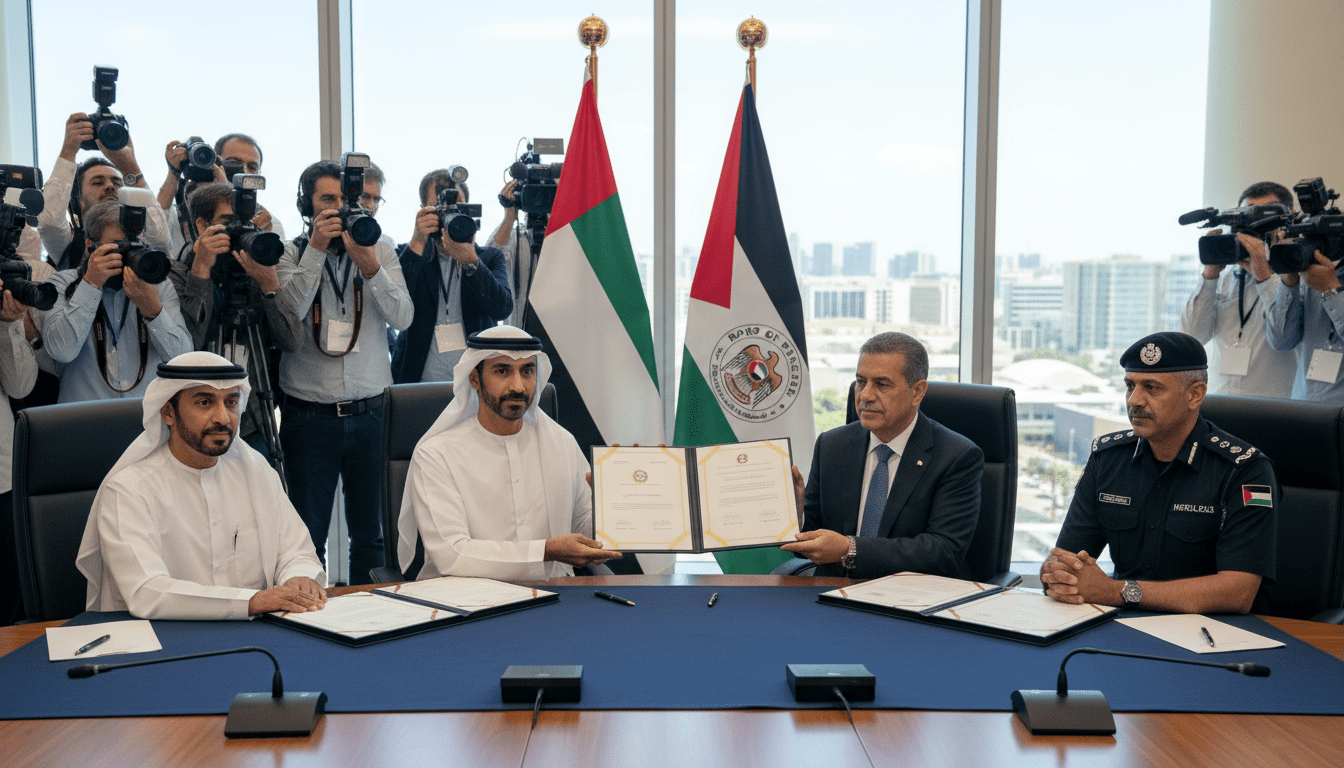
UAE Disburses $100m to Board of Peace to Fund Palestinian Police for Gaza
UAE disburses $100m to the US-backed Board of Peace to fund training of a Palestinian police force for Gaza; recruits to be vetted and trained in Egypt and Jordan.
The United Arab Emirates has disbursed $100 million to the US-backed Board of Peace to finance the creation and training of a Palestinian police unit destined for the Gaza Strip, diplomatic sources told reporting outlets. The funding marks the largest single transfer to the Board since its formation and is intended to underwrite recruitment, training and initial deployment preparations for a locally staffed police service.
Details of the $100m transfer
Diplomatic sources said the $100m was transferred to the Board of Peace following earlier pledges from nine member states that together committed roughly $7 billion, and a further $10 billion pledged by the United States at a donor conference in February. Board officials have framed the cash injection as seed funding to accelerate the recruitment and training pipeline ahead of wider stabilization efforts.
A US official and a Middle Eastern diplomat told reporters an Emirati security firm has been contracted to assist in putting together the force, with a target of roughly 27,000 officers. The arrangement places emphasis on rapid scaling of personnel while using regional training hubs to prepare recruits for service in Gaza.
Training locations and recruitment plan
Sources indicate recruits will be trained in Egypt and Jordan, with preliminary instruction focused on policing, civil order and disciplinary codes. Training is expected to combine classroom instruction, field exercises and vetting procedures coordinated with international partners supporting the Board.
Palestinians who previously served as civil servants in Gaza will be eligible to apply for positions, officials said, though selection will hinge on security vetting and capacity assessments. Organizers describe the recruitment as part of a phased approach to restore local law enforcement in heavily damaged areas.
Vetting arrangements and Israeli oversight
According to diplomatic reporting, candidates from Gaza will be subject to vetting by Israel’s internal security agency before final approval for service in the Strip. Board representatives have said vetting is intended to reduce security risks, though the arrangement has raised questions among Palestinian officials and regional actors over sovereignty and control.
Board high representative Nickolay Mladenov has said the vetting process has proceeded for thousands of civilian police candidates, while also warning that discipline and prioritization will be essential in a fragile security environment. The interplay between local recruitment and external security checks will be a central operational and political challenge.
Authority and role of the National Committee for the Administration of Gaza
The proposed police force will operate under the National Committee for the Administration of Gaza (NCAG), a transitional technocratic body led by Palestinian technocrat Ali Shaath. Shaath has described Gaza as severely damaged, with acute humanitarian needs and fragile law and order, arguing that a disciplined interim force is necessary to stabilize daily life.
NCAG officials say the body exercises authority on an interim basis and that its stated end state is to restore a reformed Palestinian Authority capable of governing both Gaza and the West Bank. The committee’s mandate includes coordinating the police buildup, delivering public services and working with international partners on reconstruction and security.
International Stabilization Force and troop commitments
US proposals introduced in September outlined a temporary International Stabilization Force (ISF) to work alongside the new Palestinian police. Several Board of Peace members, including Indonesia, Morocco, Kazakhstan, Kosovo and Albania, have publicly committed troops to the ISF, according to diplomatic sources tied to the Board’s planning.
The ISF is intended to provide security guarantees while the local police assume daily law-enforcement responsibilities, particularly in areas that remain heavily damaged or strategically sensitive. Coordination between the ISF and the NCAG will be critical to disarmament efforts and the consolidation of weapons under a single civilian authority, officials have said.
Regional reactions and political implications
The UAE’s major donation comes amid broader diplomatic tensions in the region. Abu Dhabi’s February proposal to build a compound for Palestinians in areas of Gaza under Israeli military control drew criticism from several regional actors and Palestinians who view such plans as steps toward de facto partition. Those plans are said to have complicated relationships among board members and other Arab states.
The funding move also highlights competing visions for Gaza’s future: some international partners see a phased security transition as the pragmatic route to restoring services and enabling reconstruction, while critics argue that external control and heavy vetting could undermine Palestinian political authority and aspirations for sovereignty.
Reports and statements accompanying the transfer have underscored the fragility of the current ceasefire. Palestinian officials cited in reporting say that since the ceasefire on 10 October a number of killings and security incidents have occurred, and they place the broader death toll in Gaza at figures reported by local authorities. Board and NCAG leaders emphasize that restoring disciplined, civilian-controlled policing will be necessary to protect civilians, facilitate humanitarian access, and create conditions for longer-term political solutions.
The coming months will test whether the $100m transfer and the wider international architecture can move beyond planning into effective implementation on the ground, with recruitment, vetting, and coordination among the Board, NCAG, the ISF and regional governments shaping the practical and political outcomes in Gaza.
