
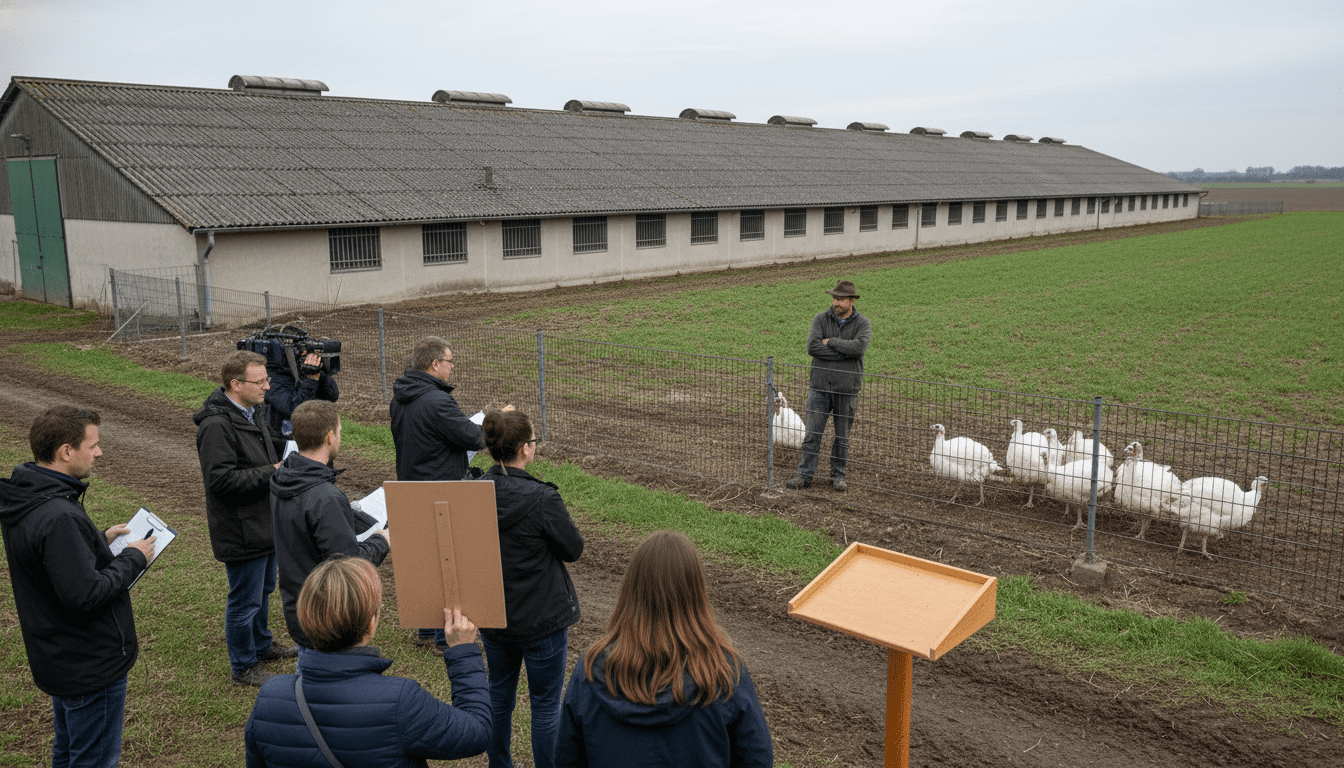
Germany Court Ruling Exposes Gap in Turkey Farming Regulation
Federal administrative court upholds that conventional turkey housing can breach animal welfare law, spotlighting the absence of binding turkey farming regulation in Germany.
A landmark decision by Germany’s Federal Administrative Court has affirmed that common practices in turkey farms can violate the national Animal Welfare Act, renewing debate over the country’s turkey farming regulation. The ruling, handed down on April 23, 2026 (case 3 C 2.25), found that the conditions in a large-scale turkey operation did not provide animals with adequate opportunities for rest and social behaviour, and that authorities may require stricter measures even where no specific statutory rules exist. (bverwg.de)
Court Ruling and Legal Basis
The Federal Administrative Court confirmed an earlier regional judgment that a Baden-Württemberg turkey farm’s housing of birds in large, unstructured sheds was incompatible with the duty to keep animals “appropriately” according to their species and needs under the Animal Welfare Act. The court emphasized that economic considerations cannot automatically outweigh demonstrable deficits in animal welfare. (bverwg.de)
Judges also scrutinized industry guidelines known as the 2013 “Puteneckwerte” and concluded those voluntary benchmarks were not sufficient as the sole standard for assessing compliance. The ruling clarified that voluntary industry codes may inform oversight but do not replace regulatory or legal scrutiny where animals’ basic needs are compromised. (bverwg.de)
Conditions Found at the Farm
Court documents described a setting in which male turkeys were kept in groups exceeding 5,000 birds per production cycle in largely unstructured barns, with only minimal enrichment such as a few straw bales and no adequate elevated resting places. The judges found such configurations substantially impair the turkeys’ ability to express normal resting and social behaviour. (djgt.de)
Although the case concerned a single operation, legal advisers and animal welfare groups note that the facts mirror practices in many conventional turkey houses nationwide, prompting concern that the judgment could have wide-reaching implications for routine housing methods. (djgt.de)
Voluntary Eckwerte and Regulatory Shortcomings
Germany currently relies largely on voluntary, industry-developed “eckwerte” (benchmark values) and programmes for turkey husbandry rather than a specific, binding statutory framework tailored to turkeys. Critics argue that these voluntary standards lack the legal force and scientific detail necessary to guarantee welfare across diverse farm systems. (landwirtschaft.de)
The court’s judgment underlined that where statutory regulation is silent, authorities still retain the power—and the duty—to demand conditions that meet the Animal Welfare Act’s requirements, effectively limiting the protective reach of voluntary guidelines. This interpretation places pressure on local regulators to assess housing practices case by case. (bverwg.de)
Industry, Associations and Government Reactions
Producer groups warned that the ruling, while addressing specific facts, creates legal uncertainty for many farmers and called for uniform, practicable rules at the national and EU level. The German Association of Turkey Producers has urged policymakers to develop clear, science-based standards to avoid an inconsistent patchwork of administrative decisions. (fnp.de)
Animal welfare organisations and some regional authorities welcomed the decision as a necessary enforcement of statutory protections, arguing it empowers oversight bodies to insist on meaningful improvements in barn design, enrichment and stocking density. Several state-level animal protection officers issued statements urging a review of current husbandry practices. (tierschutz.hessen.de)
Possible Legal and Policy Consequences
Legal experts say the ruling could prompt more frequent administrative interventions and a rise in litigation as authorities reassess existing permits and farm inspections against the Animal Welfare Act’s general obligation to accommodate species-typical needs. The decision does not itself create a new regulatory code, but it tightens the interpretive standard judges and regulators will apply. (bverwg.de)
Policymakers face choices between codifying binding national rules for turkey husbandry, harmonising standards at EU level, or strengthening monitoring and enforcement of voluntary schemes. Ministers and parliamentary committees are expected to revisit the issue in the coming months to clarify both legal requirements and support measures for farmers. (fnp.de)
Practical Impacts on Farms and Animal Welfare
For many producers, compliance may require relatively modest structural changes such as increased provision of elevated perches, better stall subdivision and enrichment to reduce stress and aggression among birds. However, some improvements could entail significant investment in retrofitting older buildings or reducing stocking densities, with economic implications for margins and supply chains. (landwirtschaft.de)
Retailers and voluntary welfare initiatives could also alter sourcing criteria in response to the ruling, increasing demand for certified or higher-welfare turkey products. Observers note that market signals, combined with clearer regulation, would likely accelerate changes on farms more than litigation alone. (initiative-tierwohl.de)
The Federal Administrative Court’s decision has brought the lack of a specific turkey farming regulation into sharp relief and signalled that the courts and regulators will not accept voluntary benchmarks as a substitute for demonstrable animal welfare. As authorities, producers and lawmakers weigh next steps, farmers and consumers can expect renewed scrutiny of housing practices and rising calls for clearer, enforceable standards.
