
Tour de France 2026: Stage-by-stage guide from Barcelona opener to Champs-Élysées finale
Tour de France 2026: Stage guide from Barcelona to the Champs-Élysées, including double Alpe d’Huez, key climbs, contenders, teams and broadcast details.
The Tour de France 2026 began on July 4, 2026, in Barcelona and will conclude on July 26, 2026, on the Champs-Élysées in Paris. The race fields 184 riders across 23 teams and covers a total of 3,321 kilometres with more than 54,000 metres of climbing. This report provides a stage-by-stage overview, highlights the decisive mountain tests and outlines the principal contenders and team line-ups.
Race itinerary and key statistics
The route comprises 21 stages divided into seven flat stages, four hilly tests and eight mountain days, with five summit finishes scheduled. Riders will face two time trials: a 19.6 km team time trial to open the race in Barcelona and a 26.1 km individual time trial between Évian-les-Bains and Thonon-les-Bains. The race crosses 29 départements and includes two rest days on July 13 and July 20, giving teams brief windows to regroup.
Overall distance and vertical gain make the 2026 edition particularly demanding, with organisers scheduling repeated high-altitude assaults and two separate finishes atop Alpe d’Huez. That configuration increases the likelihood of major time swings in the final week, elevating the importance of team support and tactical management over three weeks.
Start in Barcelona with Montjuïc team time trial
The Grand Départ in Barcelona on July 4 begins with a rare opening team time trial over 19.6 kilometres. Teams must ride together on a course that finishes with the Montjuïc ascent and a final ramp to the Olympic Stadium. Time losses on that opening day could immediately reshape general classification ambitions and force some leaders into early recovery mode.
Because the first day is a team performance, squads with strong time-trial depth have an early advantage in placing a rider in the yellow jersey. The Spanish start also marks another edition staged outside France, underlining the Tour’s international reach and the significance organisers place on demanding, spectator-friendly openers.
Double Alpe d’Huez and decisive mountain sequences
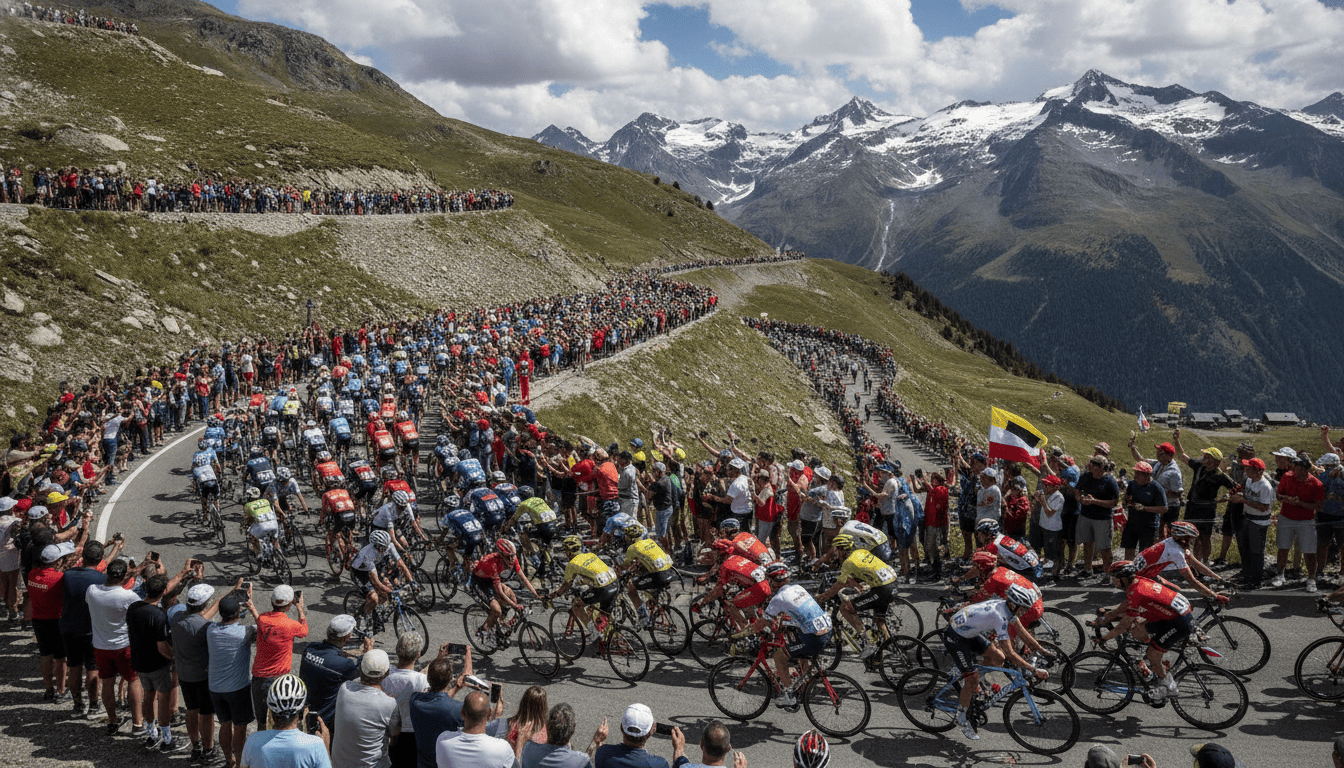
Alpe d’Huez appears twice, first on Stage 19 from Gap and again on Stage 20 from Le Bourg d’Oisans, bringing the famed 21 hairpins back into decisive position. The Stage 19 ascent arrives after a relatively short day of intense climbing, while Stage 20 follows a route that includes the Col de Sarenne and traverses areas less familiar as ascent lines. Together, these stages concentrate climbing difficulty where gaps are likeliest.
Riders will be tested not only by gradients but by accumulated fatigue: the combination of a high-altitude king stage and a second Alpe d’Huez finish creates a crucial double-header that could decide the podium. Teams aiming to protect their leaders will be forced into sustained defensive work across alpine roads and through national park terrain.
King stage with Col du Galibier on July 25
The designated king stage takes place on July 25, 2026, and features roughly 5,450 metres of elevation across about 171 kilometres. The course climbs the Col de la Croix de Fer and Col du Télégraphe before reaching the Col du Galibier at 2,624 metres, a 17.7-kilometre ascent averaging 6.9 percent. After the Galibier riders face the Col de Sarenne and finish with a final climb to Alpe d’Huez.
That sequence concentrates the highest, steepest and most sustained challenges in a single day, providing the clearest opportunity for a decisive GC move. Riders able to climb strongly at altitude will have the best chance to carve out the margins necessary to challenge for overall victory.
Favorites and the GC showdown
The general classification contest centres on the expected duel between Tadej Pogačar and Jonas Vingegaard, a rivalry that has shaped recent editions. Pogačar arrives as the 2025 winner and has been strong in one-day classics and week-long tours this season, while Vingegaard brings Grand Tour pedigree and notable stage victories. Both riders are flanked by high-quality support and will be watched closely on the alpine days.
Other names to follow include Remco Evenepoel, Florian Lipowitz and France’s young hope Paul Seixas, all of whom have shown form on climbs and time trials. Each presents a different threat: some can attack on steep ramps, others aim to limit losses in the mountains and exploit time-trialling ability as the race unfolds.
German interest and the Vogesen stage near the border
From a German perspective, attention will focus on the July 18 Vogesen stage that starts in Mulhouse, just 20 kilometres from the German border. Florian Lipowitz, who stood on the podium last year, will likely find vocal home support along the route that includes Grand Ballon, Ballon d’Alsace and Col du Haag. That 155-kilometre test includes three first-category climbs and roughly 3,800 metres of ascent.
Several German riders are present in key roles across the peloton, including domestiques and stage hunters, while classics specialists and sprinters will target flatter days. John Degenkolb is racing what may be his final Tour, and younger riders such as Georg Steinhauser, Max Kanter and Michel Hessmann make their debuts, adding further national interest.
Teams, captains and broadcast coverage
Twenty-three teams field 184 riders and bring multiple potential leaders, including UAE Team Emirates with Tadej Pogačar, Team Visma-Lease a Bike with Jonas Vingegaard and Red Bull – Bora-hansgrohe with Remco Evenepoel and Florian Lipowitz. Several squads combine Grand Tour experience with stage-winning punch, while others will chase breakaways and intermediate classifications. Team tactics and depth will be decisive across the three weeks.
Broadcast arrangements make the race widely accessible: Germany’s ARD will provide daily coverage, Eurosport will transmit in free-to-air windows, and streaming platforms including Discovery, HBOMax and DAZN offer extended footage and live streams. Fans can follow stage action from early starts through summit finishes and the traditional finale on the Champs-Élysées.
With the race moving into its final days, the focus will tighten on climbing days and time-trial performances that can tilt the general classification. The combination of early time-trial pressure, repeated high-mountain tests and two finishes on the iconic Alpe d’Huez ensures that Tour de France 2026 will be decided as much by team strength and tactics as by individual climbing legs.
