
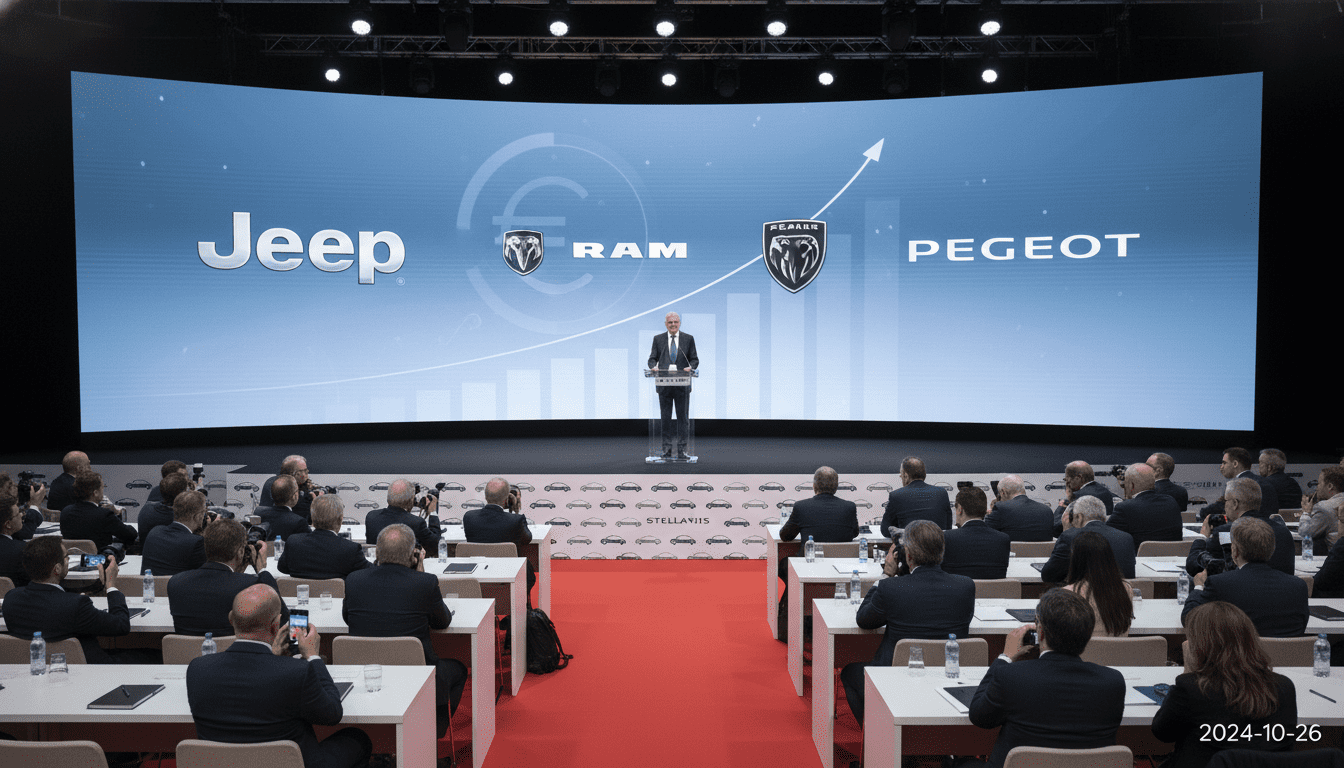
Stellantis strategy 2030 — €60bn overhaul centers on Jeep Ram Peugeot and Fiat
Stellantis strategy 2030: automaker unveils €60 billion plan, prioritizes Jeep, Ram, Peugeot and Fiat, seeks €6bn annual savings and global production shifts.
Stellantis presented a sweeping strategy through 2030 at its Auburn Hills headquarters, unveiling a €60 billion investment plan aimed at stabilizing the group and refocusing its brand portfolio. The Stellantis strategy 2030 places Jeep, Ram, Peugeot and Fiat at the core of global growth while reclassifying Opel as a regional brand, and commits 70 percent of future spending to those priorities and commercial vehicles. Management announced aggressive platform consolidation, partnerships with international manufacturers and targeted cost savings intended to return the company to stronger profitability.
Brand priorities and Opel’s new role
Stellantis said it will concentrate new products and technologies first within the four “global” brands that management views as having the largest reach and profit potential. Opel, along with other names such as Chrysler, Dodge, Citroën and Alfa Romeo, is now defined as regional and will draw from global platforms rather than lead them. The company signaled that DS will be developed as a specialist marque under Citroën and Lancia will sit under Fiat leadership, while Maserati will remain in the portfolio with plans for two new electric models.
Investment allocation and model roadmap to 2030
The group outlined a split of the €60 billion commitment with roughly €24 billion earmarked for global platforms, powertrains and new technologies and €36 billion for brand and product investments, 60 percent of which will flow to North America. Stellantis expects to offer more than 60 new models by 2030, including a mix of conventional, mild hybrid, full hybrid, plug-in hybrids and battery-electric variants, and has added 24 new full-hybrid models to its roadmap. Opel’s CEO announced that the brand will launch four new models by 2030, including renewals of the Corsa and Astra and an expanded presence in the compact SUV segment.
Cost reduction targets and production shifts
The plan includes a pledge to cut annual costs by €6 billion by 2028 without closing plants, but it also calls for a reduction in European production capacity of about 800,000 vehicles while ramping up capacity in the United States. Stellantis said it will reduce the number of platforms and drive architectures, targeting that half of its models will be built on only three platforms by 2030 and consolidating Europe’s passenger car range onto a single flexible architecture. Executives framed the capacity realignment as a necessary step to rebalance investment and serve the markets where returns are expected to be strongest.
Strategic partnerships with Chinese and global automakers
A central component of the Stellantis strategy 2030 is a suite of alliances aimed at lowering engineering costs and accelerating market entries, particularly in China and North America. The company confirmed a joint development and production arrangement with Leapmotor — in which Stellantis holds a 20 percent stake — to build an Opel-branded electric vehicle, and expanded cooperation with Dongfeng to co-produce models in China and in select European plants. Stellantis also announced a North American product and manufacturing cooperation with Jaguar Land Rover and broader market collaboration with JLR’s parent Tata for India, South America, the Middle East, Africa and the Asia-Pacific region.
Investor response and union concerns
Financial markets reacted negatively to the announcement, with Stellantis shares falling more than 5 percent in Milan on the day of the presentation and the stock showing a larger year-to-date decline, reflecting investor skepticism about the pace and ambition of profit recovery. Trade unions in Europe voiced alarm at the planned €6 billion savings and the potential loss of European volume; Italian union representative Ciro D’Alessio warned that the announcements raise serious concerns for workers and communities. Unions pointed to sharp regional market shifts in recent years, noting that Stellantis brands’ market share fell markedly in Italy and France while Germany saw a smaller decline and South America experienced significant gains.
Stellantis will now face the practical challenge of translating the Stellantis strategy 2030 from plan to execution, balancing heavy investment in a narrow set of global brands with the need to maintain market positions and workforce stability across Europe. Investors, unions and national governments will watch the roll-out closely as the company seeks to shrink platform complexity, introduce dozens of new models and shift production footprints over the coming five years.
