
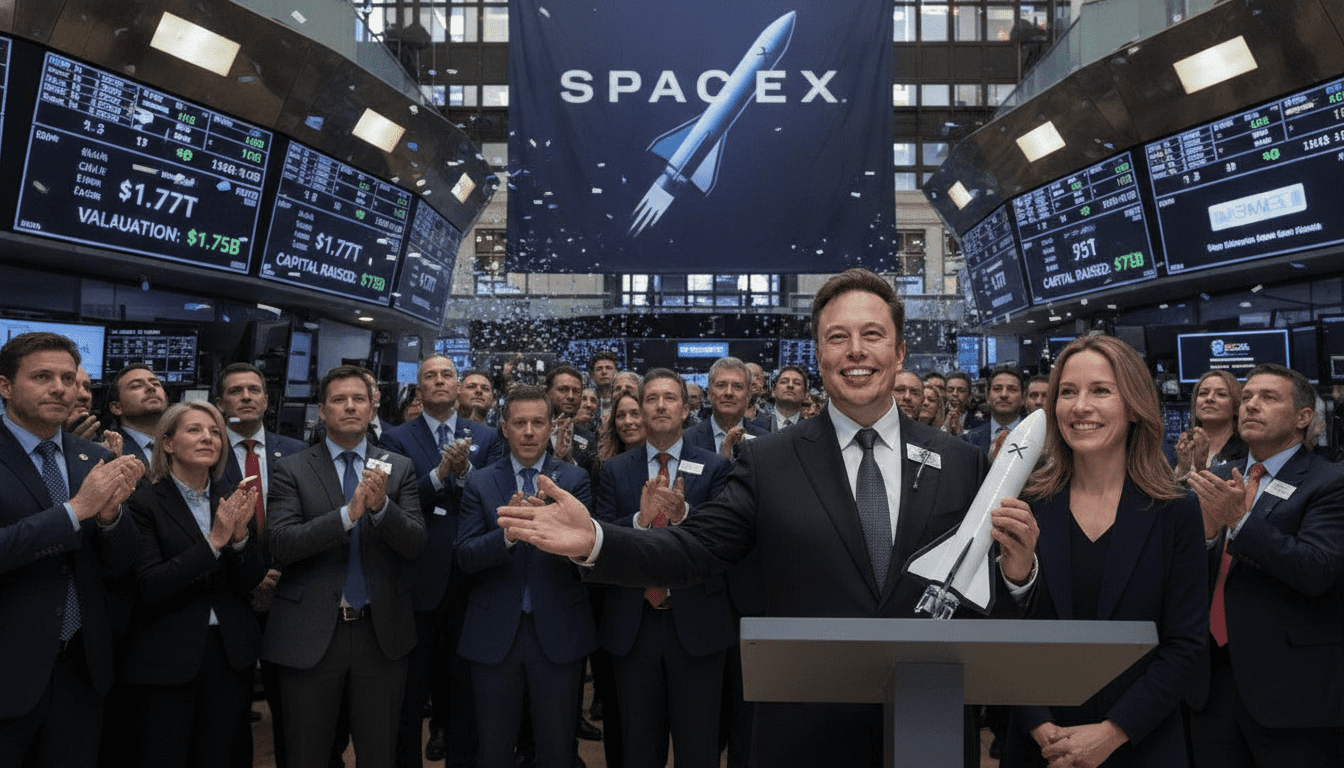
SpaceX IPO Rockets Onto Nasdaq with $1.77 Trillion Debut Valuation
SpaceX IPO surges onto Nasdaq with a $1.77 trillion opening valuation, raising $75 billion and setting multiple records for a public debut.
On Friday, June 12, 2026, the SpaceX IPO began trading on the Nasdaq, opening at a valuation of $1.77 trillion and immediately establishing a new benchmark for first-day market value. The debut raised roughly $75 billion from investors, the largest capital haul ever recorded at a company’s public offering. The offering combined SpaceX’s launch and satellite operations with its affiliated artificial intelligence and social media units, creating an unusually broad corporate profile for a single listing.
Record-breaking debut on Nasdaq
SpaceX’s entry set the highest opening-day market capitalization on record, surpassing previous debut highs and reshaping expectations for flagship technology offerings. Market participants noted the pace and size of orders for the initial allocation, which outstripped historical IPO demand patterns. Observers compared the magnitude of the valuation to the largest global corporations, underlining how the offering immediately placed SpaceX among the world’s most valuable public companies.
The scale of the debut also revived debates about valuation metrics for complex conglomerates that blend hardware, services, and software. Analysts highlighted the difficulty of applying standard multiples to a company that operates launch vehicles, global broadband satellites, an AI research arm and a major social platform under one corporate umbrella. The Nasdaq listing therefore raised new questions about how investors price long-term growth across disparate technology sectors.
Capital raised and investor demand
The $75 billion in fresh capital raised at the IPO eclipses the previous record set by Saudi Aramco in 2019 and sets a fresh historical benchmark for public offerings. Underwriters reported exceptionally high participation from institutional buyers, sovereign wealth funds and retail channels that together pushed subscription levels far beyond typical IPO ranges. That level of demand allowed SpaceX to set its initial share price at a level that produced the $1.77 trillion market capitalization on debut.
Deal documents and market commentary indicated that the capital will support a mix of continued vehicle development, expansion of satellite broadband capacity, and funding for the affiliated xAI and social-media operations. Investors said they were attracted to SpaceX’s integrated business model and the perceived scarcity of companies with comparable vertical control over space infrastructure and downstream services. The record funding raise also increases the company’s financial flexibility for near-term investments and longer-term research programs.
Implications for Elon Musk and major shareholders
The IPO materially alters the wealth position of SpaceX’s largest stakeholders, most notably Elon Musk, whose stake will be valued at levels that place him among the richest individuals globally. Company filings and market estimates indicate Musk’s post-listing net worth will exceed the combined annual gross domestic products of Denmark and Norway. That projection has drawn attention from both wealth watchers and policymakers concerned with the concentration of economic power tied to single individuals.
Beyond Musk, the offering created new public shareholders with substantial influence over corporate governance, while existing private investors realized immediate, tradable stakes. The presence of a large public float also raises the prospect of more regular market scrutiny, quarterly disclosures and proxy voting dynamics that could shift strategic priorities over time. For regulators and institutional owners alike, the transformation from private to public ownership signals a new phase for oversight and engagement.
Business lineup: rockets, Starlink, xAI and X
SpaceX entered the market as more than an aerospace manufacturer; it listed a portfolio that includes orbital launch services, the Starlink satellite broadband constellation, an affiliated AI research unit (xAI) and the social-media platform X. Each division brings different revenue models and risk profiles, complicating near-term forecasting but offering diversified long-term upside. Investors will now evaluate the company on a consolidated basis while tracking the performance of each business line in quarterly reports.
The aerospace operations benefit from recurring government and commercial launch contracts, while Starlink aims to expand subscriber revenue globally through satellite broadband. xAI presents a high-growth, capital-intensive research trajectory, and X adds advertising and platform monetization dynamics. Analysts noted that combining these units under one publicly traded entity makes SpaceX a unique case study in modern conglomeration and will test investors’ tolerance for cross-subsidization between capital-heavy infrastructure and higher-margin digital services.
Market reaction and analyst outlook
Trading on the first day produced significant volume and immediate price sensitivity as investors digested the scale and mix of the company’s businesses. Several brokerage research teams issued preliminary notes emphasizing both the strategic potential and the valuation risks inherent in such a sprawling enterprise. Some analysts praised the company’s technological leadership and long-term addressable markets, while others cautioned that execution across multiple domains and regulatory scrutiny could weigh on returns.
Market strategists also signaled potential implications for related sectors, including satellite manufacturing, launch services, AI development and digital advertising. Competitors and suppliers may face renewed pressure to clarify their own growth narratives as capital reallocates in response to SpaceX’s public-market entry. For passive funds and index managers, decisions about sector and index inclusion will shape demand profiles over the coming quarters.
What comes next for SpaceX hinges on integration of its businesses, delivery against ambitious technical roadmaps, and management of investor expectations. The company’s board and leadership now face the task of balancing near-term financial reporting with long-range investments that have traditionally characterized private aerospace ventures.
The SpaceX IPO marks a watershed moment for the aerospace and technology industries by combining unprecedented capital formation with a singular corporate scope. Market participants will watch upcoming earnings cycles and regulatory filings for signs that the company can convert its record opening valuation into sustained public-market performance.
