
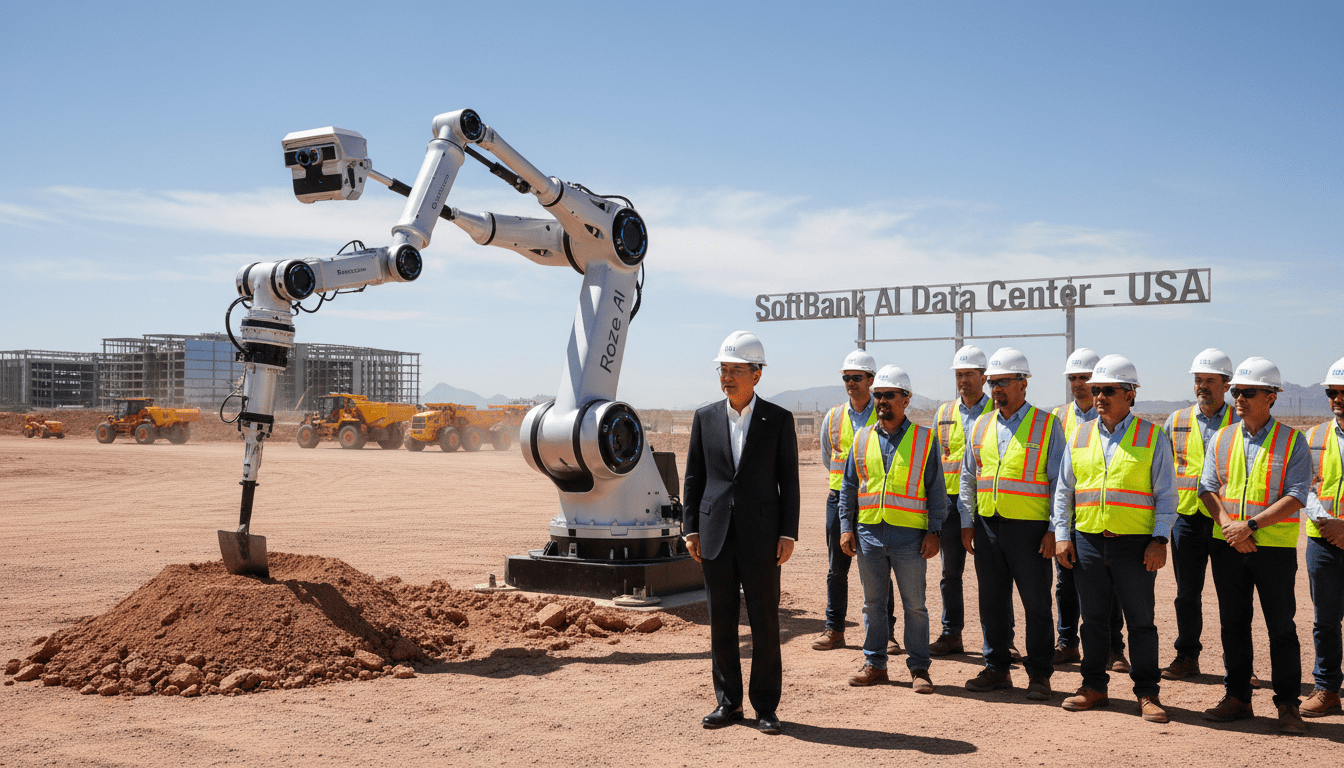
SoftBank unveils Roze AI to automate U.S. data center construction
SoftBank plans Roze AI to use robotics and AI to automate U.S. data center construction, boost efficiency, and pursue an IPO targeted for H2 2026 soon.
Roze AI, a new SoftBank business, aims to automate large-scale data center construction using robotics and artificial intelligence to speed delivery and cut costs. The company is being positioned as a platform to deploy autonomous machines on construction sites and streamline the logistics of building server farms. SoftBank has already begun preparing Roze AI for a public listing, with executives reportedly targeting the second half of 2026 for an IPO.
SoftBank forms Roze AI to automate data center construction
Roze AI will be structured as a standalone company within SoftBank’s broader industrial technology portfolio. The new entity is intended to combine robotics, AI-driven planning tools, and modular construction techniques to reduce the time and labor intensity of data center projects.
SoftBank’s move reflects growing corporate demand for cloud capacity and the high capital intensity of building hyperscale server facilities. By focusing on the construction phase, Roze AI seeks to address a bottleneck that can delay the deployment of compute infrastructure.
Roze AI’s proposed use of robots on construction sites
A central component of Roze AI’s strategy is the deployment of autonomous robots to perform repetitive or hazardous tasks on-site. These machines are expected to handle duties such as material movement, basic assembly, and precision placement that traditionally require large labor crews.
Automation could also extend to digital site coordination, where AI systems optimize schedules, manage supply chains, and sequence work to minimize downtime. The integration of robotics and software aims to reduce both direct labor costs and the risk of human error in tight, technical environments.
IPO timetable and $100 billion valuation target
SoftBank has reportedly begun preparing Roze AI for an initial public offering, with some executives pushing for a listing in the second half of 2026. Ambitions for a high valuation have been discussed internally, with aspirational targets cited among senior leaders.
An accelerated listing timetable would allow SoftBank to unlock capital and present Roze AI as an investable standalone growth company. But achieving a large valuation will depend on demonstrable revenue growth, clear unit economics for automated construction, and market confidence in the business model.
Internal skepticism and governance concerns
Not all executives within SoftBank are uniformly enthusiastic about the speed and scale of the Roze AI plan. Questions have been raised about the realism of the proposed valuation and the compressed timeline for a public debut. These internal debates reflect a broader tension at the firm between bold, high-conviction investments and cautious, governance-driven oversight.
Concerns center on the technological readiness of large-scale construction robotics and the sector’s capacity to adopt such change quickly. Executives are also weighing capital allocation amid other high-profile ventures in SoftBank’s portfolio that have produced mixed returns.
Industry rivals and automation momentum
Roze AI enters a marketplace already seeing renewed interest in industrial automation from major technology figures and venture-funded ventures. Other investors and founders are pursuing similar strategies to modernize manufacturing, logistics, and construction using AI as the coordinating layer. The competitive landscape includes both established equipment makers pivoting to autonomy and startups bundling AI with capital-intensive renovation programs.
For data center operators, the appeal of automation is straightforward: faster project completion and lower operating disruption during buildouts. Vendors and contractors who adapt to integrated robotics workflows are likely to win a larger share of projects as developers prioritize speed and repeatability.
Potential market impact on data center development
If Roze AI succeeds at scale, it could reshape economics across the data center supply chain by compressing build timelines and reducing dependence on scarce skilled labor. Shorter project durations could accelerate capacity expansion for cloud providers and enterprise customers, influencing pricing and site selection strategies. However, widespread adoption will require demonstrations of safety, regulatory compliance, and clear return-on-investment metrics.
The broader impact may include a shift in labor demand toward higher-skilled roles focused on robotics oversight, software integration, and facility commissioning. This transition could create new career pathways even as it diminishes some traditional construction roles.
SoftBank’s launch of Roze AI underscores the industry’s pivot toward combining AI with physical automation to tackle costly infrastructure bottlenecks. The coming months will be crucial as the company moves from concept to operational pilots and prepares for potential market scrutiny ahead of a planned IPO in H2 2026.
