
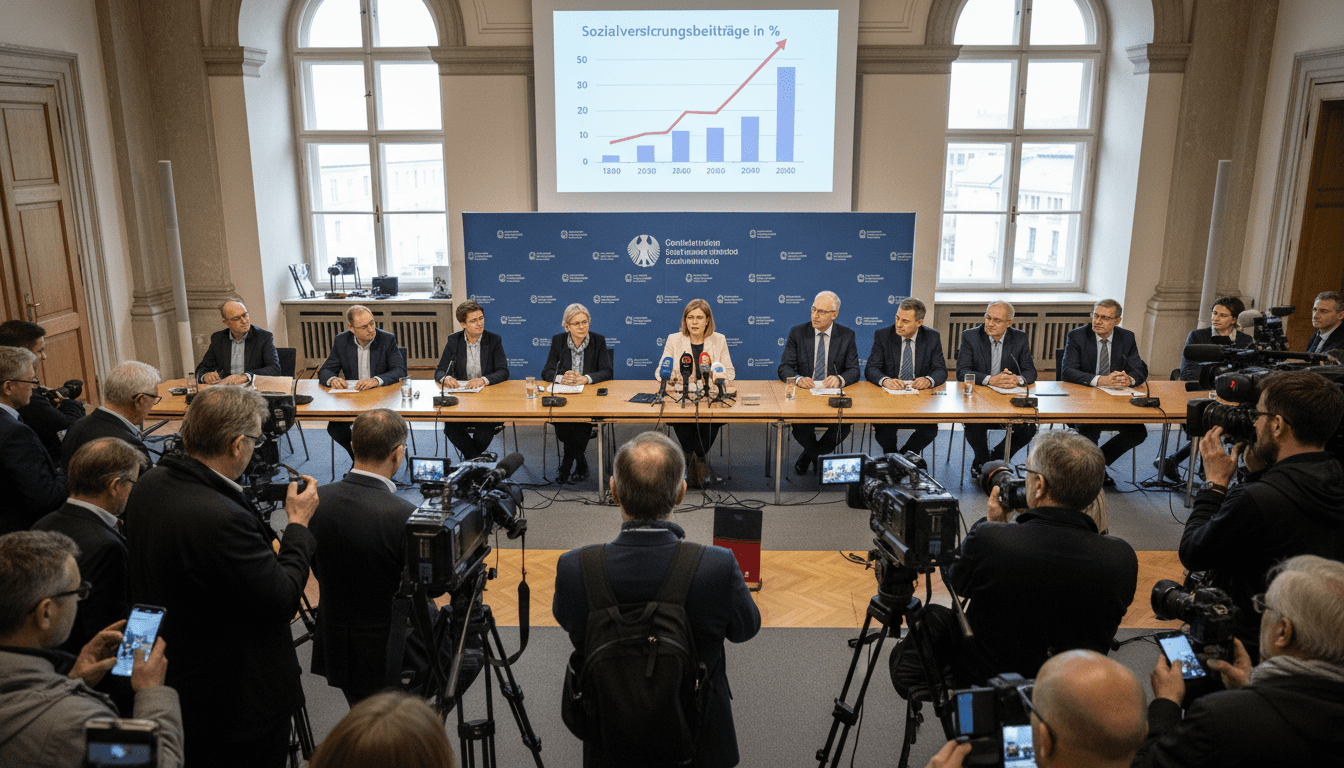
Wirtschaftsweisen warn social contributions in Germany could approach 50% by 2040
German Council of Economic Experts warns social contributions in Germany could near 50% by 2040, urging urgent reforms to stabilise wages and competitiveness.
The German Council of Economic Experts (Wirtschaftsweisen) warned in its spring report released on May 27, 2026 that social contributions in Germany could rise sharply in coming decades. The report projects that, without structural reform, the combined burden of employer and employee social insurance payments may approach 50 percent of gross wages by 2040. This projection raises immediate concerns for household net incomes, business labour costs and the country’s international competitiveness.
Main findings of the spring report
The council’s analysis points to a widening gulf between gross and net wages driven by rising contributions to health, pension and long-term care insurance. Demographic pressures — an ageing population and a growing proportion of retirees — are identified as primary drivers of increasing benefit spending and higher contribution rates. The advisers stress that the trend is not inevitable if policy makers implement targeted reforms to distributional rules and benefit definitions.
The report highlights that the fiscal and social insurance systems are becoming more interdependent, which amplifies the economic effects of demographic shifts. As contribution rates rise, employers face higher labour costs while workers see a shrinking share of gross pay reach their pockets. The combination risks slowing hiring, depressing take-home pay and putting upward pressure on prices as firms seek to preserve margins.
Projected trajectory toward nearly 50 percent
Using medium-term demographic and macroeconomic assumptions, the council’s baseline scenario shows a marked increase in contribution rates over the next two decades. The advisers estimate that aggregated social insurance levies — including employee and employer shares — could climb toward the 45–50 percent range of gross labour costs by 2040 in the absence of policy change. The projection is framed as a warning: it reflects current rules and expected population dynamics rather than an unavoidable outcome.
The calculation aggregates statutory pension, statutory health insurance and long-term care levies, and assumes continuing upward pressure on benefits and healthcare costs. Small variations in productivity growth, employment rates or migration flows would alter the precise number, but the council judges the upward trend robust across scenarios. That leaves a narrow window for corrective action to alter the trajectory.
Economic implications for firms and workers
Rising social contributions would erode take-home pay and increase employer wage bills, compressing real incomes and potentially reducing labour market participation. Employers may respond by slowing hiring, automating processes or shifting labour to non-standard contracts to limit contribution liabilities. For households, higher payroll levies would reduce disposable income and could dampen consumption growth, with knock-on effects for investment and GDP.
The council warns that higher contribution levels can also weaken Germany’s appeal as a location for international investment, particularly for labour-intensive industries. Small and medium-sized enterprises could be disproportionately affected because they have less scope to absorb rising labour costs. The advisers argue that failing to address the structural drivers risks long-term loss of competitiveness and a weaker trajectory for economic growth.
Recommended policy responses from the advisers
To stabilise the system, the Wirtschaftsweisen call for a combination of benefit reforms, spending prioritisation and revenue-side measures aimed at fairness and sustainability. Specific proposals include a review of the definition of care dependency to target long-term care resources more efficiently. The council also recommends exploring greater alignment between civil servant health coverage and the statutory system to broaden the contribution base.
Beyond technical adjustments, the report urges reforms that promote labour force participation, productivity growth and migration policies that moderate demographic pressures. Policymakers are encouraged to phase in changes transparently and to protect vulnerable groups through targeted support rather than across-the-board contribution increases. The council underlines that incremental steps taken now will be less costly and disruptive than larger corrections later.
Political context and government response
Government officials have acknowledged demographic challenges and announced intentions to enact reforms, but the council notes limited concrete progress to date. The advisers say that announced measures have so far fallen short of the scale needed to change the projected contribution path materially. With the projection drawing public attention, pressure will mount on coalition partners to translate promises into legislation ahead of upcoming budget cycles.
Opposition parties and business groups have seized on the report to press for faster action and clearer prioritisation of reforms. Labour organisations, meanwhile, caution against any measures that would shift burdens from employers or the state onto low- and middle-income households. The competing priorities set the stage for contentious negotiations over adjustment mechanisms and distributional safeguards.
Short-term options and long-term trade-offs
In the near term, the council suggests a mix of measures that can be implemented quickly, such as revising eligibility criteria for long-term care benefits and tightening indexation rules for certain entitlements. Over the longer horizon, structural reforms that promote productivity and broaden the contribution base — for example through greater inclusion of previously exempt groups — are presented as necessary but politically sensitive. The advisers stress the importance of sequencing reforms to minimise social disruption while preserving the system’s solidarity.
The report makes clear that every policy choice implies trade-offs between equity, stability and economic growth, and that delaying decisions will magnify those trade-offs. Transparent communication and a clear timeline for reform will be essential to build public trust and to allow households and businesses to plan for change.
The council’s spring analysis is a call to action: without credible reforms, social contributions in Germany risk rising to levels that would significantly reshape labour markets, household incomes and the competitive landscape. Policymakers now face a choice between early, measured adjustments and larger, more painful corrections further down the line.
