
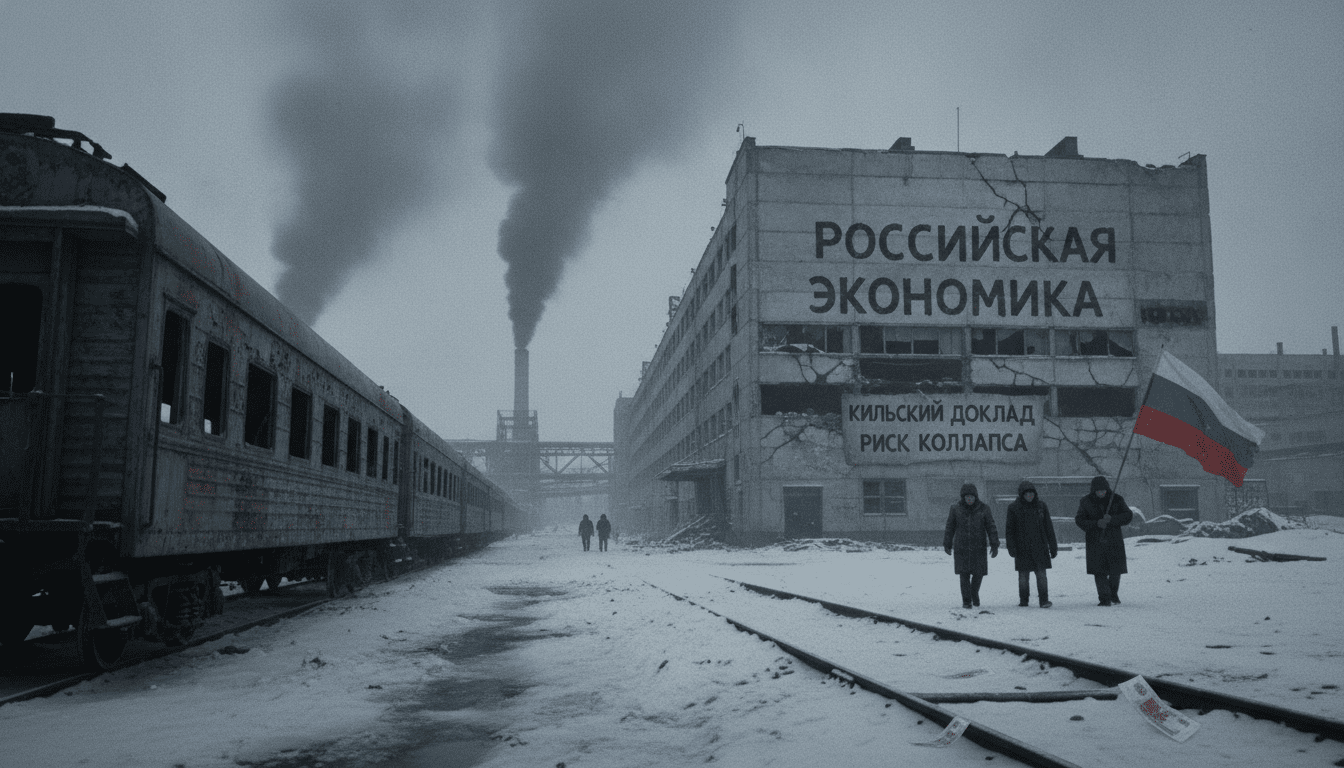
Russian economy in “end stage,” Kiel report warns of possible collapse
Kiel Institute report warns the Russian economy may be entering an “end stage,” driven by slowing growth, depleted reserves, rising deficits and deepening dependence on China.
A new joint report from the Kiel Institute for the World Economy and the Stockholm Institute of Transition Economics warns that the Russian economy is in an “end stage” and could face a severe collapse if current trends continue. The analysis, released on Thursday, says official growth figures may overstate reality, fiscal buffers have been heavily drawn down and investment outside defence priorities has nearly stalled. The authors argue that these pressures, combined with growing dependence on China and the outsized role of oil and gas revenues, create mounting risks for Moscow’s economic resilience.
Kiel report frames economy as being in an “end stage”
The report’s headline finding is stark: economists characterize the Russian economy as reaching an “end stage,” with a non-negligible risk of systemic collapse. The Kiel team emphasizes that ongoing military spending and targeted credit expansion into defence-related sectors are masking broader economic malaise. Analysts caution that what remains of productive capacity is concentrated in a few prioritized areas, leaving the wider economy vulnerable to shocks.
Official growth forecasts under scrutiny
Russian authorities recently revised their 12-month growth projection downwards to 0.4 percent from a prior estimate of 1.3 percent, a shift the report describes as possibly still too optimistic. The authors flag signs of labor shortages and supply bottlenecks that could further squeeze output. They also raise “serious doubts” about the accuracy of official statistics, noting that understated inflation would imply even weaker real growth than reported.
Investment collapse outside military priorities
Outside the defence sector, the report documents an almost complete halt in new capital formation. Business investment has dried up for non-military industries, and foreign trade volumes have fallen to their lowest level in about 15 years. The analysis points to a rapid credit expansion concentrated in arms-related firms, deteriorating corporate balance sheets and mounting pressures on bank capital that together undermine the quality of financial assets.
Falling fiscal buffers and a widening deficit
The Kiel economists say Russia’s fiscal and financial buffers have been largely depleted. The National Welfare Fund, which held the equivalent of about 6.5 percent of GDP when the 2022 invasion began, has seen its liquid resources fall sharply and now amounts to a fraction of that earlier level. At the same time, war-related spending is rising and the budget deficit has widened; recent government figures show the shortfall grew faster than planned in the first months of the year, although higher VAT receipts and energy sales have provided temporary relief.
Growing economic dependence on China alters leverage
A dedicated chapter in the report examines Russia’s increasingly asymmetric economic relationship with China. Western sanctions have pushed Moscow to rely more heavily on Beijing for both civilian and dual-use technologies, electronics and machinery. That dependence, the report argues, allows China to set terms and extract concessions, including discounts on raw materials and energy, while constraining Russia’s bargaining power and long-term autonomy.
Energy revenues remain the decisive variable for war financing
Despite temporary boosts from higher oil prices tied to geopolitical tensions, the report stresses that oil and gas revenues remain the single most important determinant of how long Russia can sustain its military campaign. Export receipts have rebounded in some months but remain well below year-earlier levels in aggregate, reflecting sanctions, market rerouting and physical damage to terminals. The authors conclude that a sustained decline in energy income would rapidly shrink Moscow’s fiscal room and magnify political and economic stresses.
Policy recommendations and Western leverage
The Kiel team argues that Russia’s rising economic vulnerability could open a window for more effective Western policy measures. They recommend tighter enforcement of existing sanctions, the introduction of targeted tariffs on remaining trade flows such as LNG, chemicals and fertilisers, and the channeling of proceeds to support Ukraine. Institute leaders caution, however, that timing and coordination will be critical and that geopolitical unpredictability complicates forecasting.
Experts cited in the report caution against simplistic collapse narratives, noting that exile economists and other analysts see a range of fiscal and financing options that could delay severe downturns. Still, the Kiel authors underline that without meaningful changes in external pressure and internal economic management, significant contractions are a realistic prospect within the next year. They stress that any assessment must account for the interplay of depleted reserves, constrained investment, and the decisive role of energy markets in sustaining both the budget and the broader economy.
Russian economy watchers will now be watching fiscal announcements, energy revenue flows and China trade patterns for signs that either validate or undercut the report’s dire assessment.
