
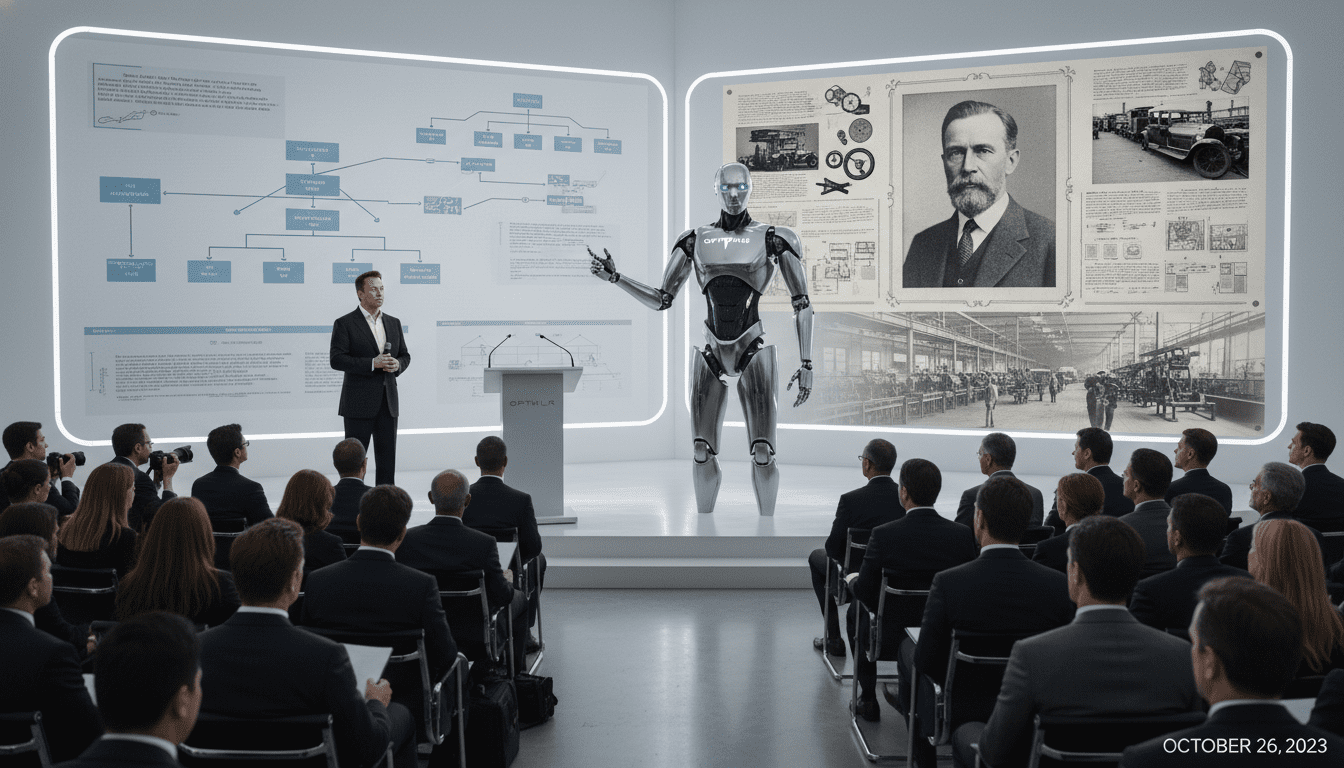
Optimus Robot Frames ‘Muskism’ as a New Industrial Model, Authors Argue
Quinn Slobodian and Ben Tarnoff say the Optimus robot symbolizes a shift from Fordism to a vertically integrated, state-linked “Muskism” that reshapes production.
The Optimus robot sits at the center of a provocative new argument that tech entrepreneur Elon Musk’s industrial approach could mark a systemic change in how goods are made and services delivered. Slobodian and Tarnoff, writing about what they call “Muskism,” position Optimus not just as a prototype humanoid but as a strategic keystone in an economy steered toward vertical integration and heavy state-corporate interdependence. Prototypes of the Optimus robot have been publicly shown since 2022, and proponents say its deployment could replace or augment many repetitive, hazardous and routine tasks across factories, homes and care settings.
Optimus Robot: Capabilities and Current Status
The Optimus robot is described as a humanoid, general-purpose machine designed to perform repetitive or dangerous jobs that humans now do. Tesla has showcased prototypes since 2022 and highlights the device’s AI-driven mobility and manipulation abilities, drawing parallels with the company’s autonomous vehicle systems. At present the robot is not commercially available, and Tesla continues development while demonstrating incremental advances in hardware and control software.
Industry analysts view Optimus as emblematic rather than purely technical: the machine’s marketing and strategic positioning matter as much as its sensors or actuators. If the robot achieves broad reliability, manufacturers foresee its use transporting parts on assembly lines, assisting in light assembly tasks, and performing household chores like cleaning and basic caregiving duties. Observers caution, however, that widespread industrial adoption depends on cost, safety certification, and integration with existing production systems.
From Fordism to Muskism: Reframing Industrial History
The book’s authors argue that Muskism represents a departure from the Fordist model of mass production, which centralized repetitive human labor on assembly lines to drive scale and mass consumption. Fordism depended on standardized products, specialized tasks and a labor model in which wages supported a mass market for those same goods. Muskism, by contrast, emphasizes automation, localized vertical integration and the replacement of much human labor with algorithmically controlled machines like the Optimus robot.
This reframing suggests industrial evolution is not merely an extension of previous models but a distinct reconfiguration of production, labor relations and corporate strategy. Where Fordism relied on social arrangements such as collective bargaining and wage-led consumption, Muskism is presented as hinging on technological substitution and an engineered reduction of workforce dependency. The shift raises questions about employment models and the social frameworks that historically enabled mass consumption.
Vertical Integration and Reshaping Supply Chains
A central tenet of the Muskism thesis is a move away from globally dispersed supply chains toward tighter, vertically integrated production hubs. The idea is to localize more manufacturing activities under one corporate roof to reduce vulnerability to geopolitical disruption or logistical bottlenecks. Optimus robot deployment fits that logic by enabling on-site automation of tasks that once required large, segmented workforces.
Advocates argue that localized, automated factories would be more resilient and faster to retool, with robots handling monotonous tasks and a smaller human workforce providing oversight. Critics counter that vertical integration can increase corporate concentration and reduce the flexibility that diversified supplier networks provide. The debate touches on national security, trade policy and corporate risk management as well as labor economics.
Corporate-State Symbiosis in Muskism
The book frames Muskism as a model sustained by an explicit symbiosis between powerful firms and government agencies. Examples cited include government reliance on private aerospace contractors for launch services and lunar mission components, where firms like SpaceX have become critical national vendors. That relationship, the authors argue, underpins both the scale and the political leverage of companies pursuing Musk-style expansion.
Public contracts and state-funded procurement can accelerate technological deployment and de-risk corporate investment, but they also bind firms to political priorities and government timelines. The dynamic raises questions about accountability, industrial policy and the distribution of economic rents when private platforms and state missions become intertwined. For companies betting on robots like Optimus, government demand could prove decisive in moving prototypes into mass use.
Labor, Distribution and Social Consequences
The implications for labor markets are among the most contested aspects of the Muskism thesis. Widespread use of humanoid robots could displace routine jobs while creating demand for oversight, maintenance and AI supervision roles. How those shifts affect wages, job quality and social welfare depends on policy choices and corporate practices, the authors note.
Historically, social mechanisms such as collective bargaining moderated the social cost of industrial transformations by securing wages and benefits for workers. In a model that relies heavily on automation and concentrated corporate power, the means of redistribution and protection are less obvious. Policymakers will confront pressures to design safety nets, retraining programs and regulatory frameworks that address both productivity gains and potential job losses.
Industrialists and some technologists argue that robots like Optimus could reduce dangerous work and free people for less repetitive, higher-skill pursuits. Skeptics reply that technological promise alone does not produce equitable outcomes without deliberate governance and public investment in workforce transitions.
The debate about Optimus and the larger “Muskism” thesis places a single product prototype at the center of a broader conversation about capitalism’s next phase and how societies allocate the gains from automation. As Tesla and other firms refine humanoid robotics, observers will watch closely for evidence that such machines can scale safely, cost-effectively and in ways that either complement or replace existing labor structures.
