
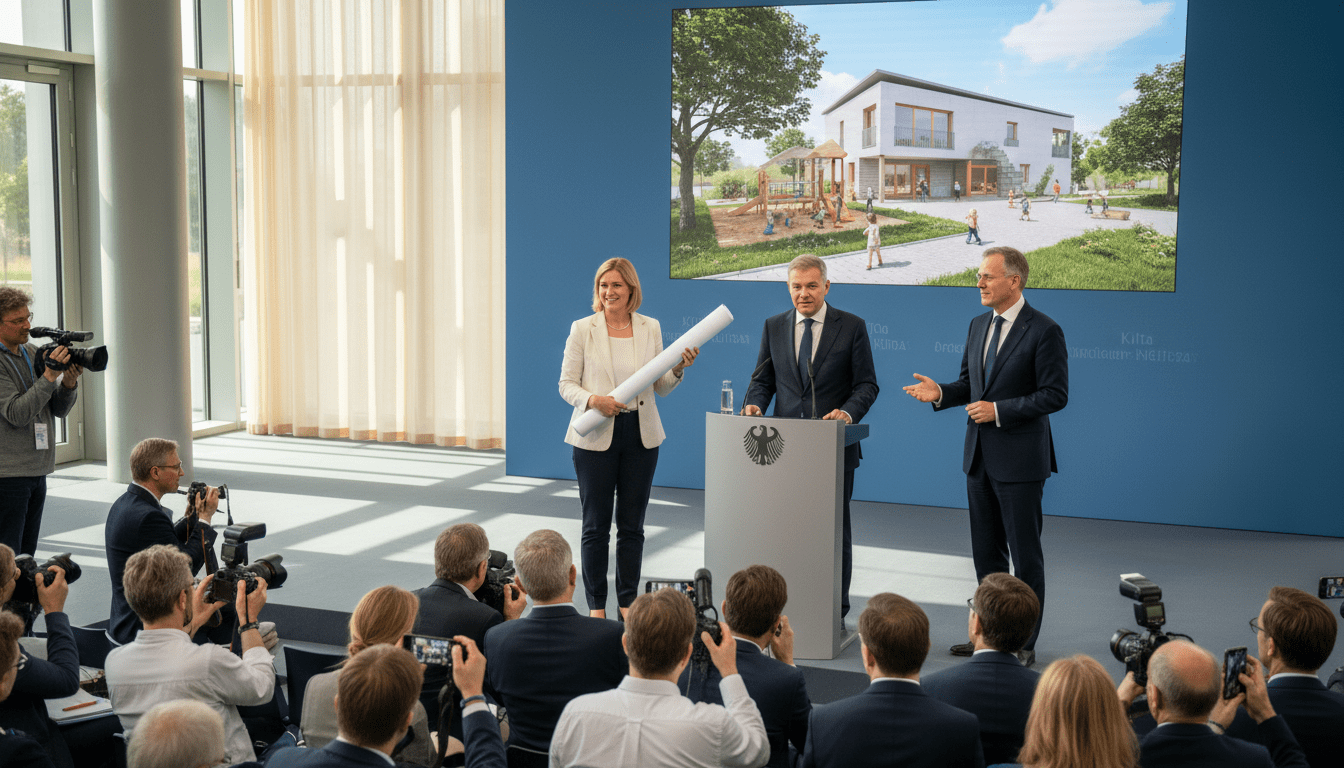
Germany launches €4bn childcare investment plan for Kitas from 2026 to 2029
Germany unveils a €4bn childcare investment plan (2026–2029) to back construction, renovation and digital upgrades in Kitas, prioritizing low-income communities.
The federal government and state premiers have agreed a new administrative accord that establishes a €4 billion childcare investment program in Germany, effective retroactively from January 1, 2026 through 2029. The program is intended to finance construction, expansion, renovation and modern equipment for day-care centres (Kitas), with an emphasis on digital infrastructure and energy-efficiency measures. Federal Education Minister Karin Prien said the package is designed to direct funds where need is highest and to support financially weak municipalities and providers.
Federal and state accord unlocks dedicated funding
The administrative agreement between the federal government and the Länder creates the legal and procedural basis for distributing funds to local authorities and operators. The accord formalises how the federal tranche from the special “Infrastructure and Climate Neutrality” fund will be used to support childcare infrastructure. The arrangement also sets the program’s time frame and indicates that Länder will adopt their own implementation rules to allocate the money.
Officials emphasised that the agreement responds to a demand from state leaders to allow flexible use of federal infrastructure funds, including for higher education and research projects. Nevertheless, federal ministers have pushed for a substantial share to be channelled into Kitas to strengthen early education.
Source of funds and scope of eligible measures
The €4 billion comes from the federal special fund “Infrastruktur und Klimaneutralität,” which is part of a broader €100 billion capital envelope available to the Länder for public investments. The federal contribution is explicitly earmarked for physical and technical improvements in childcare settings, but states may complement it with resources from their own portion of the larger fund. Eligible uses include new builds, expansions, conversions, comprehensive renovations, modern furnishings and digitalisation measures, as well as energy-related upgrades.
The retroactive eligibility starting 1 January 2026 means projects begun earlier in the year can qualify for reimbursement or co-financing, subject to each state’s criteria and application deadlines. This retroactivity aims to accelerate work already planned by municipalities and providers.
Priority for financially weak municipalities and high-need facilities
Minister Karin Prien said a central objective is to steer a large share of the funds toward financially weak municipalities and facilities serving children who grow up under difficult conditions. The federal ministry framed early education spending as a high-return investment, arguing that resources devoted to quality childcare yield social and economic benefits over time.
States will be asked to design selection criteria that reflect local need, including demographic pressures, existing shortfalls in places, and the socio-economic profile of the children served. Municipalities and providers in disadvantaged areas should therefore expect prioritised access under most Länder schemes.
Application process and state-level implementation
After the signature of the administrative agreement, each Land will publish its own funding guidelines and open application windows for municipalities, city districts and childcare providers. Those application procedures will determine the exact documentation required, funding rates and co-financing rules. Operators will typically be able to apply for funds for construction, refurbishment, equipment purchases and digital upgrades.
Project evaluation and approval will rest with the Länder, which also handle contracting and disbursement. Observers say the state-level approach allows tailoring to regional priorities but may produce uneven rollout speeds across Germany depending on administrative capacity.
Aims for staff conditions, digitalisation and energy efficiency
Beyond increasing the number of places, federal officials emphasised that the programme targets improved working conditions for childcare professionals and modern, healthy facilities for children. Funding can be used to create safer, better-ventilated spaces, accessible layouts and improved staff rooms that support retention. Digital investments may include administrative systems, learning technologies and connectivity to support pedagogical work.
Energy-related measures — such as insulation, efficient heating and renewable installations — are eligible under the climate-neutrality remit of the special fund. The dual focus on quality and climate aligns with broader public investment priorities.
Context and expected impact on provision
The federal government notes that since 2008 five targeted investment programmes for childcare have provided €5.4 billion and helped create more than 750,000 additional childcare places. The new €4 billion tranche is framed as a continuation of that long-term push to expand both capacity and quality across the sector. Authorities expect the fresh funding to accelerate planned building projects and upgrades, particularly where local budgets are constrained.
Stakeholders emphasise that physical investment alone will not resolve staffing shortages or improve quality without parallel investments in training and remuneration. Still, municipal leaders and provider associations have welcomed the additional resources as a significant opportunity to modernise facilities and expand access.
The federal-state agreement now moves to the implementation phase, with Länder publishing their calls for proposals and municipalities preparing applications to translate the funding into concrete construction and refurbishment projects.
