
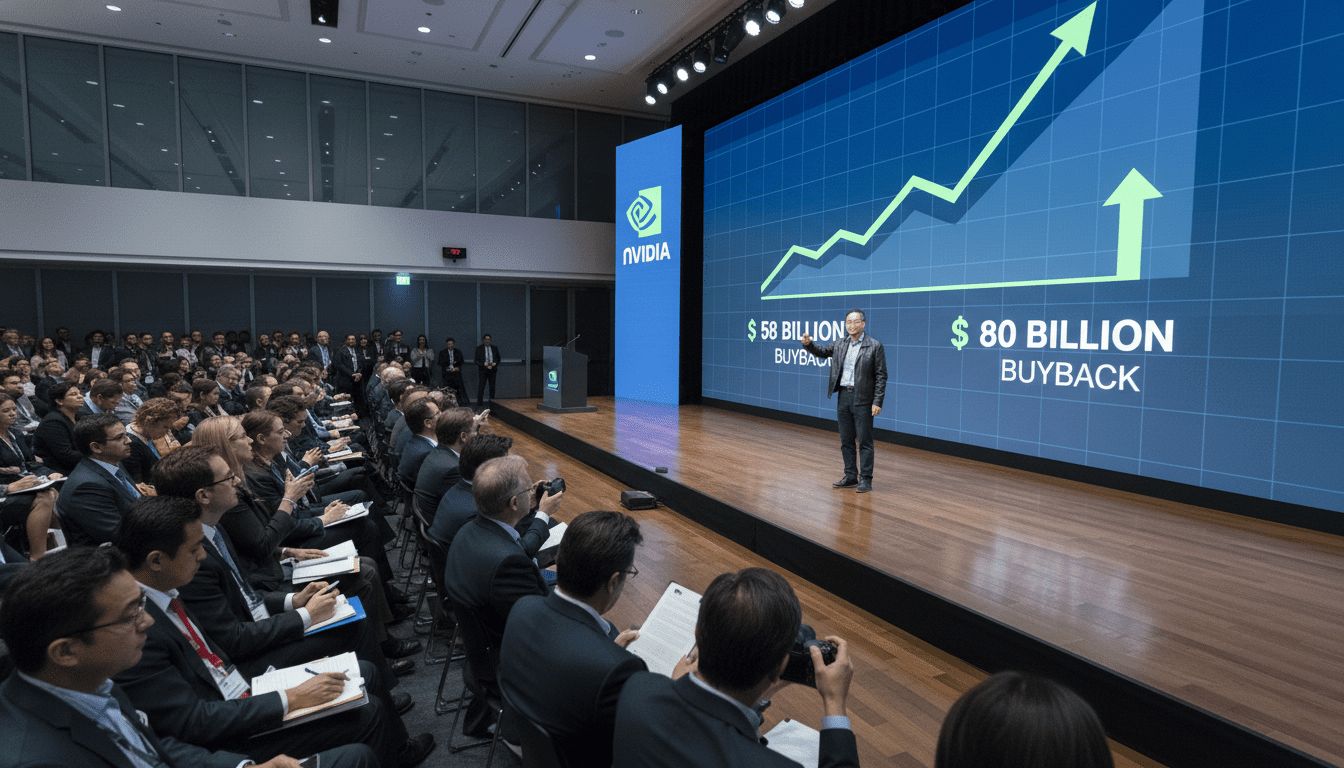
Nvidia earnings surge with $58 billion quarterly profit and $80 billion buyback
Nvidia earnings jump as the chipmaker posts nearly $58 billion net income and $81 billion revenue, raising guidance and announcing an $80 billion buyback amid soaring AI demand.
Nvidia reported a blockbuster quarter as demand for its artificial intelligence hardware and software accelerated across cloud and data-center customers. The company posted nearly $58 billion in profit and $81 billion in revenue, well above analyst expectations and signaling robust momentum for Nvidia earnings this year.
Quarterly results and guidance
Nvidia’s reported profit of about $58 billion represented a year‑over‑year increase of roughly 211 percent and a sequential rise of 36 percent. Revenue came in at $81 billion, up nearly 85 percent from the prior year and 20 percent versus the previous quarter, while management guided to roughly $91 billion for the current quarter.
The company said every major financial metric exceeded professional market forecasts, underscoring stronger‑than‑expected demand for AI infrastructure. That outperformance set the stage for the company’s additional capital return and dividend actions announced alongside results.
Shareholder returns and dividend increase
Chief executive Jensen Huang announced an $80 billion expansion of the company’s share‑repurchase program and a dramatic rise in the quarterly dividend. The board approved a boost of the dividend to $0.25 per share from $0.01, a move aimed at returning excess cash to investors while sustaining investment in product and software development.
The buyback and dividend increase signal confidence in long‑term cash generation from AI‑driven demand for GPUs and related systems. Investors typically view such capital‑return measures as a sign that company leadership expects continued robust profitability.
GPU technology and the AI pivot
Nvidia’s resurgence rests on its graphics processing units, which the company has adapted to handle the matrix and tensor calculations at the core of modern AI workloads. Jensen Huang has long steered the company toward AI, repurposing the GPU architecture that made Nvidia prominent in the 1990s for deep learning and large‑scale model training.
Beyond silicon, Nvidia has broadened its offering with a software stack and model tooling designed to accelerate deployment across cloud providers, enterprises and research institutions. That integrated approach has helped the company secure contracts with major internet firms, universities and hyperscale data‑center operators.
Market reaction and sector ripple effects
Nvidia shares rose in response to the results, climbing approximately two percent in Wednesday trading, and helped lift other semiconductor and AI‑related stocks. Companies such as Marvell Technology, Intel and Micron Technology also gained as investors reassessed demand prospects for AI infrastructure.
Analysts and portfolio managers said Nvidia’s results functioned as a bellwether for the technology sector, testing whether AI revenue growth can justify lofty valuations amid macroeconomic pressure. “The quarterly numbers from Nvidia arrived at an important time for markets,” said James Demmert of Main Street Research, citing investor appetite for reassurance about AI’s revenue potential.
Macro backdrop and bond market concerns
The strong earnings came even as U.S. Treasury yields remained elevated, a factor that has pressured equity valuations more broadly. The yield on the ten‑year U.S. Treasury was reported near 4.584 percent, close to a 16‑month high, reflecting ongoing inflation concerns and speculation about further Federal Reserve tightening.
Equity indices moved higher alongside Nvidia’s report, with the Dow, S&P 500 and Nasdaq all recording gains on the same day. Market participants said positive tech earnings can offset some negative sentiment from rising yields, but that durability will depend on whether several large firms continue to deliver comparable growth.
OpenAI IPO plans and investor appetite for AI names
In parallel to Nvidia’s results, reports surfaced that OpenAI is preparing a confidential filing for a U.S. initial public offering and is targeting a potential September listing. The San Francisco‑based AI developer was last cited with a private valuation near $852 billion, and major banks were reported to be working on a prospectus.
A high‑profile IPO by a leading AI software company would test investor demand for AI exposures beyond hardware suppliers. Market watchers said the combination of strong hardware earnings and prospective large software listings could reshape investor allocations to the AI ecosystem.
Nvidia’s results underscore how rapidly demand for AI compute has scaled and why the company has become central to investors’ view of the sector’s growth prospects. The company’s guidance, capital returns and commentary from management will be watched closely by markets as a barometer for the sustainability of AI‑driven revenue growth across the technology industry.
