
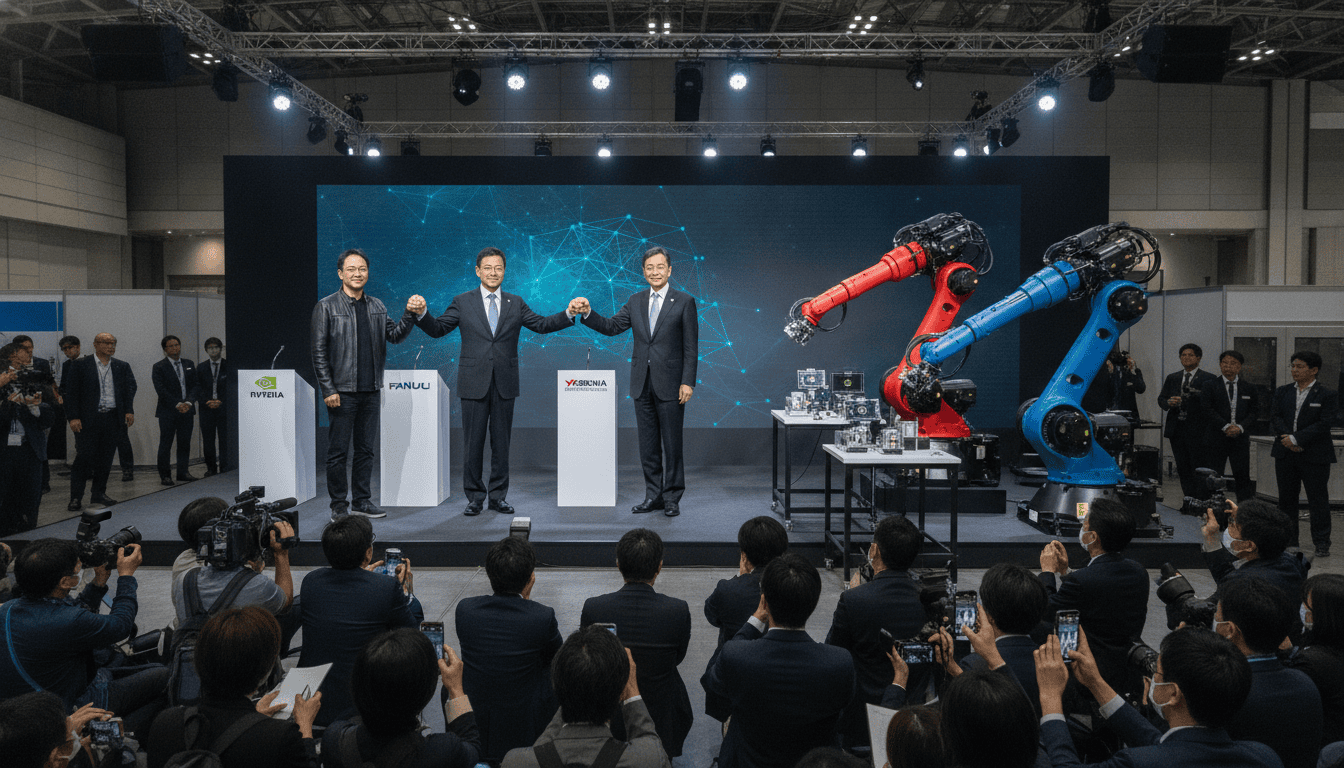
Nvidia Announces Robotics AI Partnership with Fanuc and Yaskawa in Japan
Nvidia unveils a robotics AI partnership with Fanuc and Yaskawa in Japan, aiming to make industrial robots smarter, more adaptable and easier to deploy.
Nvidia has said it will work closely with leading Japanese machine builders Fanuc and Yaskawa to integrate advanced artificial intelligence into industrial robots, a move company executives described as pivotal for factory automation. The Nvidia robotics AI partnership seeks to combine the chipmaker’s AI compute and software tools with decades of robotics engineering from Japanese manufacturers. Company representatives framed the effort as a way to shorten deployment time, expand robot capabilities and enable more flexible production lines.
Nvidia frames collaboration at Tokyo event
Jensen Huang, Nvidia’s chief executive, outlined the collaboration during a public appearance in Tokyo, describing a shared vision for smarter machines in manufacturing. “Thanks to AI, robots will become intelligent, adaptable and easy to deploy,” he said at the event, emphasizing ease of use as a commercial priority. Nvidia positioned the initiative as both technical and strategic, aimed at accelerating adoption of AI-driven robotics across multiple industrial sectors.
Technical priorities: compute, perception and control
The partnership centers on integrating Nvidia’s AI compute stacks with the sensor suites and motion control systems that Fanuc and Yaskawa supply to factories worldwide. Engineers will focus on perception models that allow robots to recognize and react to complex scenes, and on control algorithms that translate AI decisions into safe, reliable motion. The companies also cited work to optimize inference at the factory edge so that latency-sensitive tasks run on local hardware rather than relying solely on cloud connectivity.
Implications for Japanese manufacturers and automation
For Japanese original equipment manufacturers, the collaboration offers a route to maintain technological leadership as global competition intensifies in factory automation. Fanuc and Yaskawa, both long-established suppliers of industrial arms and controllers, can use AI to expand the range of tasks their systems can handle without extensive reprogramming. That could reduce the need for custom integration projects and lower the barrier for smaller plants to adopt advanced robotics.
Potential benefits for productivity and flexibility
Industry analysts say coupling AI with robotics control could shorten setup times for new production runs and enable machines to handle variability in parts and process conditions. Smarter perception and adaptive control mean robots could switch between different tasks or compensate for irregularities without human intervention. The expected outcome is higher uptime, reduced scrap rates and faster changeovers—advantages that are particularly valuable in automotive, electronics and consumer-goods manufacturing.
Workforce, safety and regulatory questions
Bringing more adaptable robots into factories raises questions about workforce reskilling and safety certification, officials from the companies acknowledged in Tokyo. Companies will need to invest in training technicians to manage AI-enabled systems and in new safety validation processes to certify behavior that can change dynamically. Regulators and industry groups will likely scrutinize how adaptive control and machine learning are tested and proven safe before widespread industrial deployment.
Market dynamics and global competition
The announcement underscores a broader shift as semiconductor firms, software developers and machine builders form tighter alliances to address manufacturing challenges. Nvidia’s move to partner with Fanuc and Yaskawa signals an effort to embed its AI platform more deeply into industrial ecosystems, potentially influencing procurement and supplier choices worldwide. Competitors in robotics and automation are expected to respond by deepening their own partnerships or accelerating development of comparable software and compute offerings.
Rollout strategy and next steps
Executives said initial work will focus on pilot programs with early customers, combining lab validation with live trials on production floors to refine models and safety layers. The companies plan iterative deployments, aiming to demonstrate specific use cases such as flexible parts handling, visual inspection and collaborative assembly before scaling more broadly. Partners indicated that technical roadmaps and commercial terms would be disclosed over time as pilots yield outcomes and customer feedback.
The partnership brings together a leading AI chipmaker and established robotics suppliers to address a core industry challenge: making robots easier to deploy while expanding what they can do on the factory floor. As pilots progress, manufacturers, integrators and regulators will watch closely for evidence that AI-driven robotics can deliver measurable productivity gains without compromising safety or workforce stability.
