
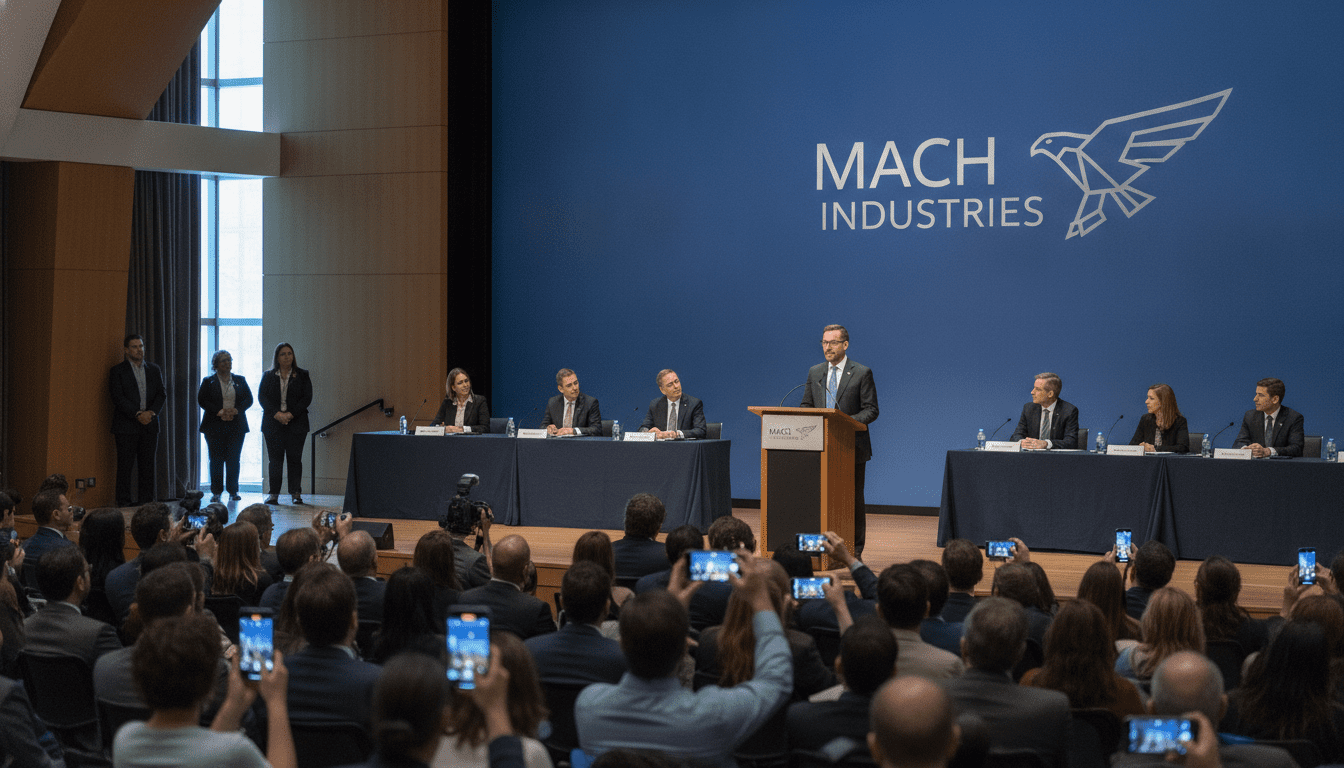
Mach Industries Raises $300M at $1.8B Valuation While Racing Six Weapons Programs
Mach Industries secured $300M in June 2026, reaching a $1.8B valuation as it advances six weapons programs and accelerates plans for mass production and supply-chain control.
Mach Industries closes $300M Series C and expands funding to $485M
Mach Industries announced a $300 million Series C in June 2026, bringing total capital raised to roughly $485 million and valuing the company at $1.8 billion. The financing arrives as the startup pursues six simultaneous weapons programs that it says are moving through the middle stages of defense procurement. Investors backing the raise include prominent venture firms such as Sequoia, Khosla Ventures and Ribbit Capital.
The cash injection consolidates a rapid growth trajectory that began with an experimental garage prototype and has moved into government testing ranges. Company leadership says the new funds will accelerate testing, manufacturing preparations and component purchases. Mach’s next challenge will be translating prototypes into scalable production.
Founder Ethan Thornton frames the threat and the company strategy
Ethan Thornton, who left MIT at 19 to pursue defense work, has framed Mach Industries’ mission around an urgency to counter pacing threats from near-peer adversaries. Raised in Burnet, Texas, in a family with deep military ties, Thornton has repeatedly argued that unmanned systems will shape future conflicts. That conviction underpins Mach’s decision to pursue multiple platform types rather than a single flagship product.
Thornton acknowledges the difficulty of running parallel programs but rejects narrow specialization as insufficient for the scale of modern security challenges. He describes the effort as a strategic, multi-product “chess game” against adversaries that will require hundreds of differentiated systems. This rationale drives Mach’s portfolio approach and its emphasis on rapid iteration.
Six weapons programs span aircraft, missiles and stratospheric systems
Mach’s public roadmap lists six main efforts: a vertical-takeoff strike aircraft, a long-range anti-ship missile, two stratospheric platforms, a low-cost surface-to-air interceptor tailored to defeat drones, and a newly announced 40-foot naval logistics-and-strike aircraft. The Navy-oriented aircraft is the largest leap for the company, weighing roughly 4,000 pounds with near-vertical takeoff capability and a declared range exceeding 1,000 miles while carrying a 1,000-pound payload. Until now Mach’s largest vehicle had been about 13 feet long, highlighting the scale jump.
None of these platforms is yet in full-rate production, but Mach reports winning about 13 government contracts with several systems in the testing phase on ranges. Leadership says several programs could reach operational deployment by the end of 2026 and aims to push three into rate manufacturing within the same window. That timetable would require a dramatic ramp in production capacity and supply-chain throughput.
Supply-chain moves aim to compress timelines and sell components
Recognizing supply chains as the industry bottleneck, Mach has invested in in-house and acquired capabilities to speed deliveries of critical parts. The company says it built and fired two jet engines from first principles in approximately eight months, a process that traditionally takes years in legacy defense programs. In May, Mach acquired Exquadrum, a 24-year-old solid rocket motor maker, for $50 million to shore up internal propulsion supply.
Mach now reports that component sales—engines, motors and subsystems—account for about half of its revenue, signaling a dual commercial strategy of selling parts as well as finished platforms. Executives argue that controlling key inputs shortens program timelines and creates recurring revenue while they scale vehicle production.
Competitive landscape: Anduril, Shield AI and the race for scale
Mach’s multi-product approach places it in direct comparison with peers that have chosen different paths, including Anduril, Shield AI and Saronic. Anduril, the larger benchmark for defense startups, recently raised multi-billion-dollar rounds and secured expansive Army enterprise deals that entrenched its position across several procurement lines. By contrast, Shield AI and Saronic have been rewarded for narrower focus, each raising multi-billion valuations on a smaller set of product families.
Thornton frames the competition as non-zero-sum, pointing to the sheer volume of ordnance and systems required to deter or deny adversary advantages. He notes that U.S. procurement strategy often preserves multiple suppliers per category, reducing the likelihood of a single monopoly. Still, Mach faces the practical challenge of proving that a hardware-first, portfolio-driven approach can match the market traction and contracting achievements of better-capitalized rivals.
Internal governance and the founder’s management style
Thornton describes an active internal feedback culture designed to stress-test leadership decisions and avoid executive echo chambers. The company holds open forums where employees can question executives directly, an initiative Thornton credits to the chief operating officer and runs personally for extended Q&A sessions. He says these forums expose assumptions and help realign priorities as engineering, sales and manufacturing needs shift.
The founder also reserves several hours daily for strategic planning and “war-gaming” scenarios, reflecting a hands-on approach to anticipating operational bottlenecks. That cadence acknowledges Thornton’s view that the hardest problems evolve over time—from engineering to sales to mass production—and require different problem-solving modes as the company grows.
Mach Industries has positioned itself as a rapid innovator attempting to compress defense timelines by pairing aggressive R&D with supply-chain consolidation. Whether the company can move multiple systems from testing to full-rate manufacture within its stated timeframes will be the decisive factor in validating its portfolio strategy.
