
Lumumba Vea Denied U.S. Visa, Misses DR Congo Match as Superfan’s Absence Raises Questions
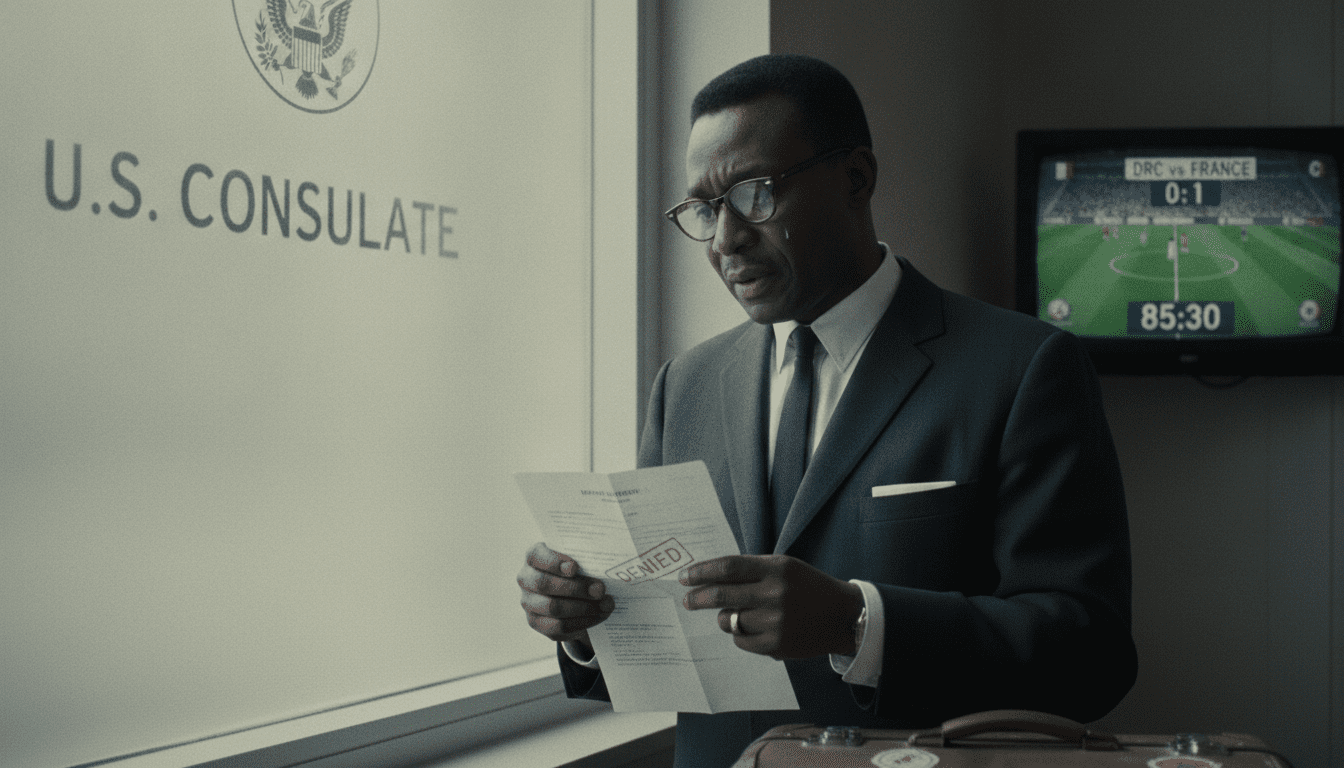
Lumumba Vea denied U.S. visa and missed DR Congo’s Atlanta appearance, stirring debate over health rules and political symbolism at the World Cup.
Lumumba Vea barred from Atlanta after visa refusal
Michel Kuka Mboladinga, known widely as Lumumba Vea, was not present for DR Congo’s crucial match in Atlanta after U.S. authorities declined to issue him a visa. He had attended the team’s opening fixture in Mexico but was absent for the 3-1 victory over Uzbekistan when the squad advanced. Organizers and the Congolese delegation confirmed his absence, which left a conspicuous void among the fans who had made him a fixture at recent matches.
Visual tribute to Patrice Lumumba in stadiums
Mboladinga had become instantly recognizable by dressing as Patrice Lumumba, the Congolese independence leader, standing on a platform among supporters with his arm raised and palm outward. His outfit — a jacket, tie and trousers in the colors of the national flag — was designed to evoke a living statue of the man who became a symbol of anti-colonial struggle. The image of Lumumba carries heavy historical resonance in Congo and beyond, and the fan’s staging turned the stadium into a space of political memory as well as sport.
Authorities point to health restrictions as a reason
U.S. officials cited public-health concerns tied to an Ebola outbreak in the Democratic Republic of Congo as a primary factor behind tightened entry rules for some travelers. While health restrictions have been invoked by authorities, observers noted the optics of keeping a high-profile, politically themed supporter away from a globally televised match. The visa refusal was not accompanied by a detailed public explanation, leaving room for speculation about whether public-health protocols or diplomatic sensitivities weighed more heavily in the decision.
Team performance underscored despite his absence
DR Congo’s players showed they could deliver on the pitch without their prominent supporter, with the 3-1 win over Uzbekistan securing progression to the knockout stage. Match footage and stadium screens briefly displayed images resembling Lumumba, and other fans adopted similar dress, suggesting the symbolism persisted in his absence. Coaches and team officials emphasized the squad’s focus on preparation and tactics, but supporters and journalists highlighted how the fan’s persona had become part of the team’s World Cup narrative.
Political symbolism at a tournament that aims to be apolitical
The presence of a Lumumba impersonator at World Cup matches highlighted tensions between FIFA’s stated separation of sport and politics and the realities of global events. Some analysts argued that invoking Patrice Lumumba — a figure whose 1961 assassination remains a point of international controversy — inevitably introduces political meaning into a stadium setting. Others maintained that personal tributes and cultural expression are part of fan culture, and that a living tribute can serve to educate new audiences about historical figures without converting a match into a political rally.
Commercial visibility and viral attention
Following his public appearances, Lumumba Vea’s image spawned viral video spots that presented Mboladinga as a commercial testimonial, including advertisements for personal-care products. Those clips circulated widely online and in some broadcast segments, illustrating how a stadium persona can cross into mainstream media and marketing. The ads drew mixed reactions: some viewers saw them as playful and effective outreach, while others questioned whether commercializing a historical figure’s likeness was appropriate.
Multiple Lumumbas appear as imitation spreads
Mboladinga’s performances inspired imitation, with several fans and entertainers adopting similar costumes and gestures at venues and online. Stadiums briefly featured different people portraying Lumumba on big screens, multiplying the presence of the iconography even when the original performer was absent. That proliferation suggested the image had taken on a life of its own and raised questions about who speaks for historical memory when multiple versions of a symbol circulate in public spaces.
DR Congo now faces England in the knockout rounds without the physical presence of Lumumba Vea, but the visual and narrative imprint he left remains part of the tournament record. The team’s next steps will be judged primarily on results, while conversations about the intersection of sport, health policy and political symbolism are likely to continue as the World Cup proceeds.
