
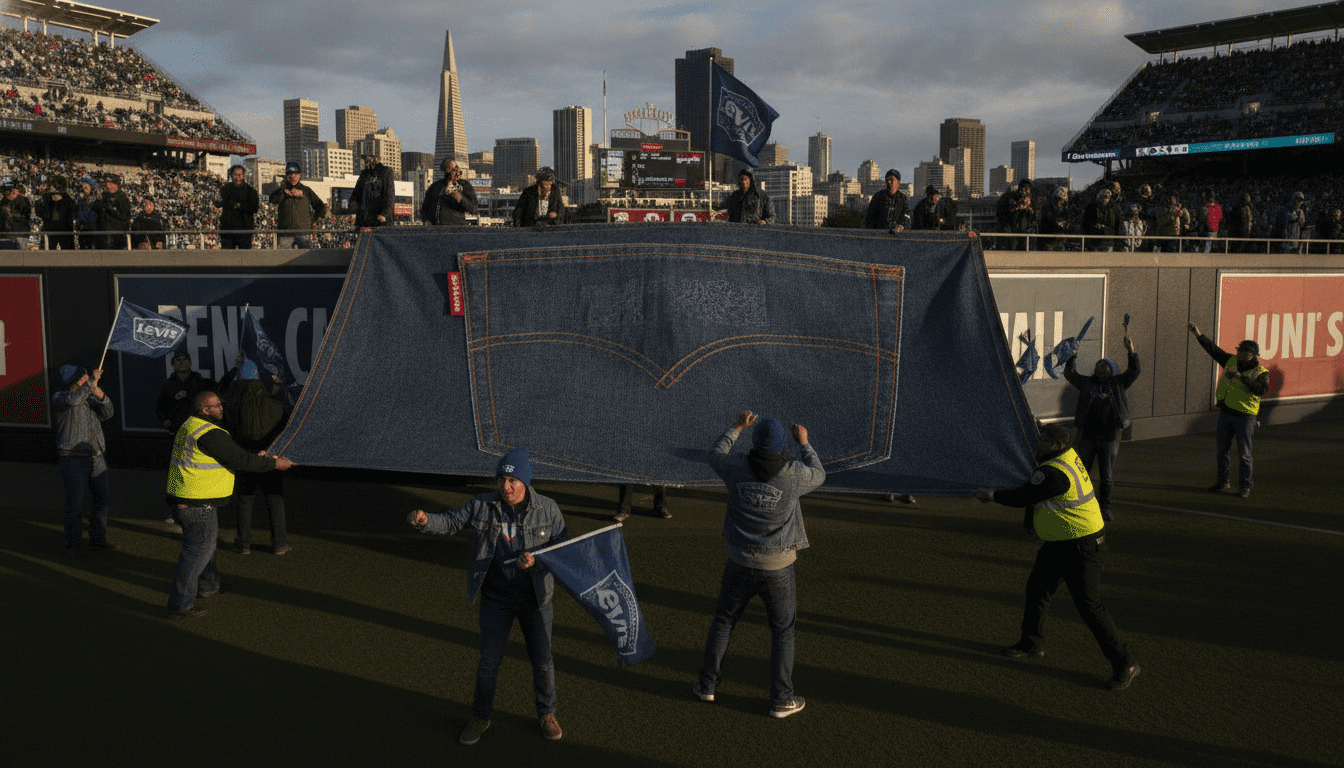
Levi’s covert World Cup advertising surfaces at Bay Area stadium amid covered signage
Levi’s covert World Cup advertising appeared at a Bay Area stadium this week, with covered logos and an Instagram post linking the brand to the venue. Photographs from inside the arena show the stadium name obscured and large white drapes masking corporate signage, a move that has drawn attention given FIFA’s strict “clean stadium” rules during the tournament. The apparent campaign raises questions about how non-sponsor brands are navigating high-profile World Cup exposure.
White cloth and muted signage at Bay Area venue
Photographs from the stands show the familiar nameplate of the Bay Area stadium largely concealed beneath white fabric, leaving only the generic word “Stadium” visible in large letters. Video boards, seating signage and concession-branding also displayed patches of plain covering, creating a deliberately neutral look that simultaneously highlights the absence of usual corporate marks. The scene has prompted viewers to scrutinize whether the coverings are a routine compliance measure or part of a more calculated publicity effort.
Instagram post links brand to the arena
An Instagram post from a widely followed account — one with more than ten million followers, according to visible metrics — posted a welcoming message from the “beautiful [redacted] stadium,” which social media users quickly linked to the covered venue. The juxtaposition of the social post and the on-site coverings has been read by observers as a coordinated attempt to draw attention to the brand without overt stadium signage. That social-media link has been central to reporting and public discussion of what many are calling a subversive marketing tactic.
FIFA “clean stadium” policy and sponsorship rules
FIFA’s tournament regulations require non-sponsor branding to be concealed inside host venues, a measure intended to preserve the value for official partners who pay for exclusive exposure. Stadiums hosting World Cup matches have routinely masked trademarks, logos and ancillary branding not cleared by tournament rights-holders. The recent coverings follow that pattern, but the simultaneous social-media amplification means the visual restraint did not prevent attention — it arguably redirected it online.
Levi Strauss & Co.’s historical ties to the site
The stadium in question has a long-standing association with Levi Strauss & Co., whose name has been attached to the venue for years through naming-rights agreements tied to the local NFL franchise. That historical connection complicates the optics when the facility’s usual Levi’s branding is visibly silenced during an event that saturates global attention. Even with logos covered inside the arena, the site’s identity remains tied to Levi’s in the public mind, which may be precisely why observers are reading the actions as intentional brand signaling.
Commercial workarounds and sponsor boundaries
Marketers operating around major sporting events often seek creative ways to generate buzz within the constraints set by rights-holder agreements. In this instance, social-media messaging combined with muted, yet suggestive, on-site imagery operates as a workaround that stops short of traditional in-venue advertising. Legal and commercial advisers frequently caution that such strategies can provoke scrutiny from tournament organizers if perceived as evading exclusivity provisions, and rights-holders may challenge any use of the event environment that appears designed to circumvent sponsorship rules.
Reactions from fans and local observers
Fans inside the arena and followers online produced a mix of bemusement and criticism, with some praising the cleverness of the apparent stunt and others urging tournament authorities to take a harder line. Social feeds filled quickly with commentary about the price of concessions, the sightlines from the stands and the conspicuous blanking-out of familiar logos. Local commentators noted the tension between civic pride in hosting marquee matches and the commercial realities that govern what is visible to a global television audience.
Potential responses from organizers and brands
Tournament organizers have traditionally responded to perceived breaches of sponsorship exclusivity with reminders of contractual obligations and, in some cases, penalties or removal of material deemed problematic. Brands implicated in unconventional campaigns often issue limited statements saying they comply with relevant rules while emphasizing fan engagement and cultural ties. Levi Strauss & Co. has not, at the time of publication, issued a detailed public explanation tied to the photographs and social posts circulating today, and organizers have not announced enforcement actions in response to the specific imagery.
The episode underscores how social media and physical signage together can shape a brand narrative even when formal advertising channels are restricted. Observers say the lines between permissible presence and covert promotion grow blurrier as companies experiment with indirect visibility during high-stakes sporting events. The coming days may reveal whether organizers treat this instance as a compliance matter or simply another reminder that global sports events are as much cultural spectacles as controlled commercial platforms.
