
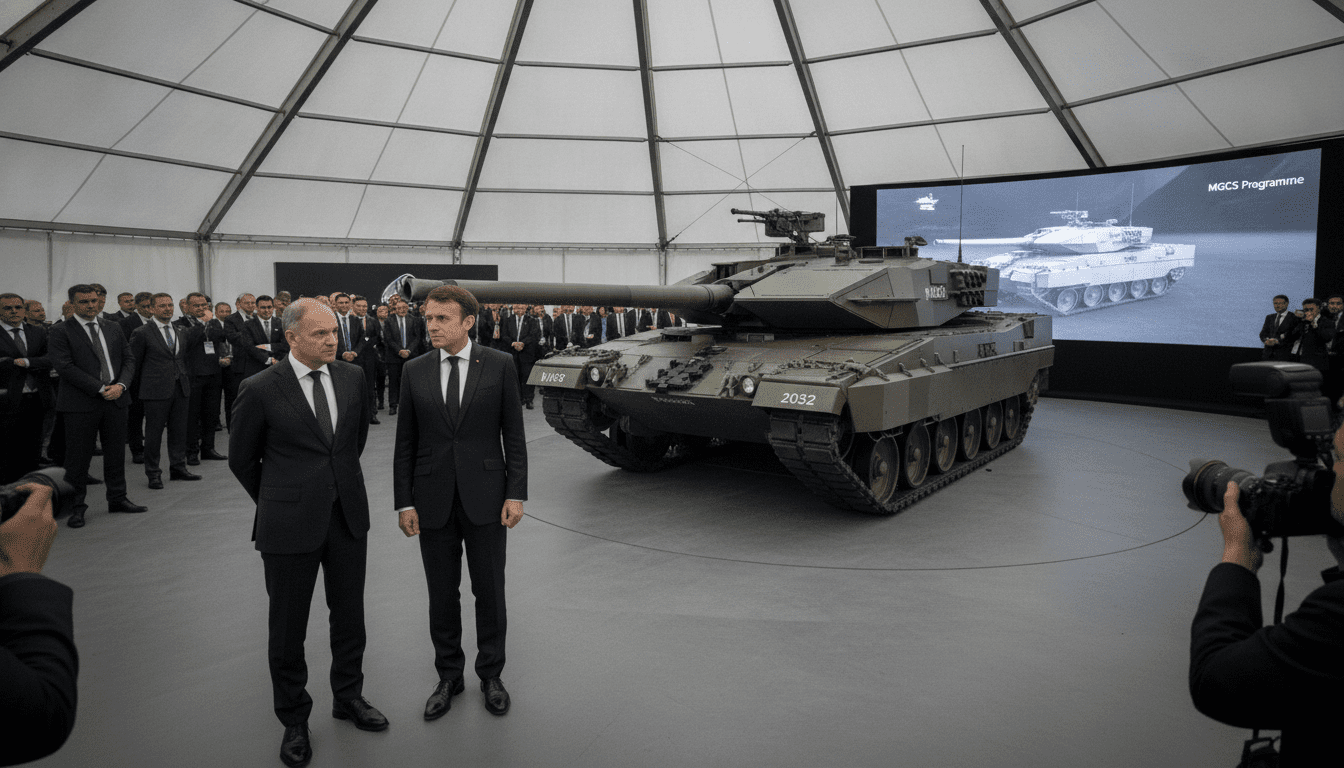
MBT Vision 2032 unveiled at Eurosatory as a possible Leopard 2 successor
German joint venture PSM unveils MBT Vision 2032 concept at Eurosatory, sparking debate over the Leopard 2 successor and the future of Franco‑German tank cooperation.
Germany’s PSM Projekt System & Management GmbH presented the MBT Vision 2032 concept at the Eurosatory defence exhibition in Paris, positioning the design as a potential Leopard 2 successor for the early 2030s. The miniature model, shown under a modest tent amid major industry stands, immediately reignited debate about national bridging solutions and the stalled Main Ground Combat System (MGCS) programme. Industry participants said the concept builds from Leopard 2 foundations while promising new technologies such as unmanned turrets and upgraded drivetrain components.
Concept presented quietly but strategically at Eurosatory
The MBT Vision 2032 model appeared at a small PSM stand rather than a marquee booth, drawing attention for its symbolic significance more than its size. PSM, a joint venture of KNDS Deutschland and Rheinmetall, framed the concept as a demonstration of how a future battle tank could look and operate in the 2030s. Organisers and company representatives emphasised that the model is a proposal intended to inform political decisions rather than a locked industrial programme.
Tensions with MGCS and Franco‑German coordination
The MBT Vision 2032 revelation underscores widening divergences with the Franco‑German MGCS project, which originally aimed to replace both the Leopard 2 and the French Leclerc under a harmonised requirement set. MGCS has slid timelines and evolved from a concrete development plan into a longer‑term technology programme, with an expected in‑service date now moving into the 2040s. Officials and industry executives say that differing national needs and industrial politics have complicated alignment and pushed governments to consider national bridging solutions for the 2030s.
Industry players and political stakes behind the concept
Key industrial actors are central to the debate: KNDS, the product of a previous consolidation between German and French manufacturers, sits alongside Rheinmetall and suppliers such as Renk in discussions about future components. PSM’s MBT Vision 2032 is being advanced as a cooperative German offering that would nonetheless reflect national preferences, while Rheinmetall is also developing a separate Panther main battle tank. Political decisions will ultimately determine whether any bridging tank proceeds to procurement, and regulators have already cleared joint development by the consortium for certain projects.
Technical direction of MBT Vision 2032 and bridging role
PSM and its partners say the MBT Vision 2032 would incorporate technologies from the Leopard 2 platform augmented by new systems: an optionally unmanned turret, more powerful transmissions and heightened interoperability with drones and robotic systems. The concept is pitched explicitly as a bridge to later, more ambitious programmes rather than as a final replacement for MGCS. Suppliers are reportedly testing modular components that could be shared across national variants, allowing faster fielding of improved armour and lethality for allies requiring near‑term capability upgrades.
French response and parallel national plans
In Paris, French authorities and KNDS presented their own bridging ideas, including a full‑size demonstrator combining German chassis elements with a French‑designed turret and new gun systems. French defence planning has been moving to secure an independent interim solution funded within national programme budgets to avoid capability gaps. French ministers and industry sources have signalled impatience with MGCS delays and insist on fielding upgraded systems that can operate seamlessly with networked drones and robotic assets.
Commercial competition and government influence
The emergence of MBT Vision 2032 highlights competitive dynamics in Europe’s defence industry and the role of state shareholders in shaping consolidation outcomes. Executives have criticised government intervention that can slow cross‑border mergers, while state participation in key defence firms complicates market‑driven consolidation. Observers note that the mix of private companies and state‑backed incumbents increases pressure on political leaders to choose between multinational programmes and faster national procurement options.
The MBT Vision 2032 concept has shifted the debate from a single, unified successor project toward a mix of national bridging solutions, parallel industrial developments and a long‑term Franco‑German research effort under MGCS. As governments weigh procurement timelines, budget commitments and interoperability needs, the path to a Leopard 2 successor appears likely to be plural and politically contested rather than singular and harmonised.
