
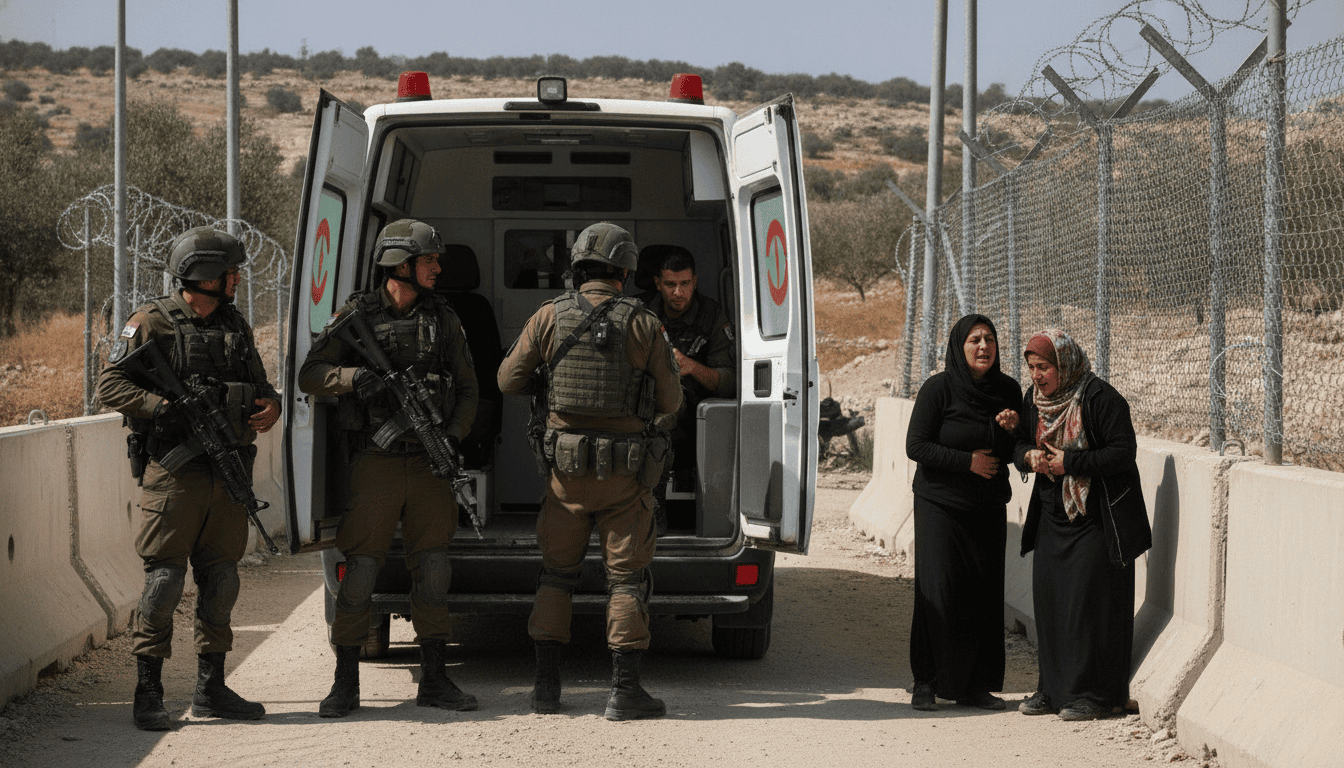
Palestinian Woman Loses Unborn Child After Ambulance Blocked at Awarta Military Checkpoint
A Palestinian woman from Qaryut lost her unborn child after Israeli forces prevented an ambulance from crossing the Awarta military checkpoint, Wafa reported, in an incident that local medics say illustrates growing risks to emergency care in the occupied West Bank. The ambulance officer, identified as Bashar al-Qaryuti, told Wafa the crew was stopped at the gate as the woman, in her sixth month of pregnancy, bled heavily and required urgent transfer.
Incident at Awarta military checkpoint
Local emergency responders say the ambulance was halted at the Awarta military checkpoint, south of Nablus, when soldiers refused to permit passage for the medical team. The delay, according to the ambulance officer’s account, lasted long enough that the woman’s condition deteriorated despite attempts by the crew to stabilize her inside the vehicle.
Witnesses and the ambulance officer reported that a member of the medical crew was detained at the site, and that soldiers conducted a search of the pregnant woman even while she was severely bleeding. The account, provided to Wafa, says the woman’s pregnancy was in its sixth month at the time of the incident.
Ambulance crew account
Bashar al-Qaryuti, the Qaryut ambulance officer, said the soldiers hindered the work of the medical team and refused to allow them to pass through the gates to reach a referral hospital in Nablus. He described frantic efforts by the crew to obtain permission and to communicate the urgency of the woman’s condition.
According to the crew’s testimony, team members repeatedly sought to explain that the patient required immediate transfer for specialist care. The detainment of one crew member and the protracted search of the pregnant woman, medics said, compounded the delay and reduced the patient’s chances of survival for the fetus.
Medical outcome and hospital response
Medical staff at the receiving hospital and the ambulance team reported that the woman lost her unborn child after the delay at the checkpoint. The loss was attributed by the ambulance crew to the interruption in timely transfer and to the stoppage of vital medical interventions while the vehicle was held at the gate.
Local health officials, speaking to the news agency that first published the account, emphasized the specific vulnerability of pregnant women when ambulances are held at checkpoints. In this case, medics said the woman was left in critical condition and required urgent treatment for severe bleeding when she eventually reached hospital care.
Checkpoint procedures and equipment shutdown
Crew members said soldiers ordered the ambulance engine switched off while the vehicle remained at the checkpoint, which caused onboard medical support equipment to cease functioning. The shutdown of suction devices, oxygen supply and other life-sustaining equipment inside the vehicle, they reported, left the patient without continuous support during a crucial interval.
The ambulance officer’s account highlighted how administrative and security procedures at fixed military gates can have immediate clinical consequences. Medics stressed that any interruption to powered medical equipment inside an ambulance can rapidly worsen outcomes in obstetric emergencies.
Community reaction and calls for accountability
Residents of Qaryut and local health authorities condemned the incident and called for an investigation into the obstruction of emergency medical services at the Awarta checkpoint. Community leaders described the case as part of a broader pattern of impediments to movement that they say endanger civilians’ access to timely healthcare.
Humanitarian groups and municipal officials in the Nablus governorate have, in recent months, repeatedly flagged the impact of closures and checkpoints on emergency response times. The family and local representatives have urged relevant authorities to review the circumstances that led to the delay and to take measures to prevent similar tragedies.
Israeli military spokespeople were not immediately quoted in the initial accounts provided to Wafa; official responses to specific checkpoint incidents are not always released at the time local agencies publish eyewitness reports. Observers note that inquiries into emergency denials at checkpoints typically involve multiple agencies and can be slow to produce public statements.
The loss of the unborn child in Qaryut underscores the intersection of security procedures and medical urgency at fixed checkpoints like Awarta, where medics say administrative controls can mean the difference between life and death for vulnerable patients. Local emergency teams continue to press for guaranteed, rapid passage for ambulances and for protocols that prioritize medical evacuation to reduce the risk of future avoidable fatalities.
