
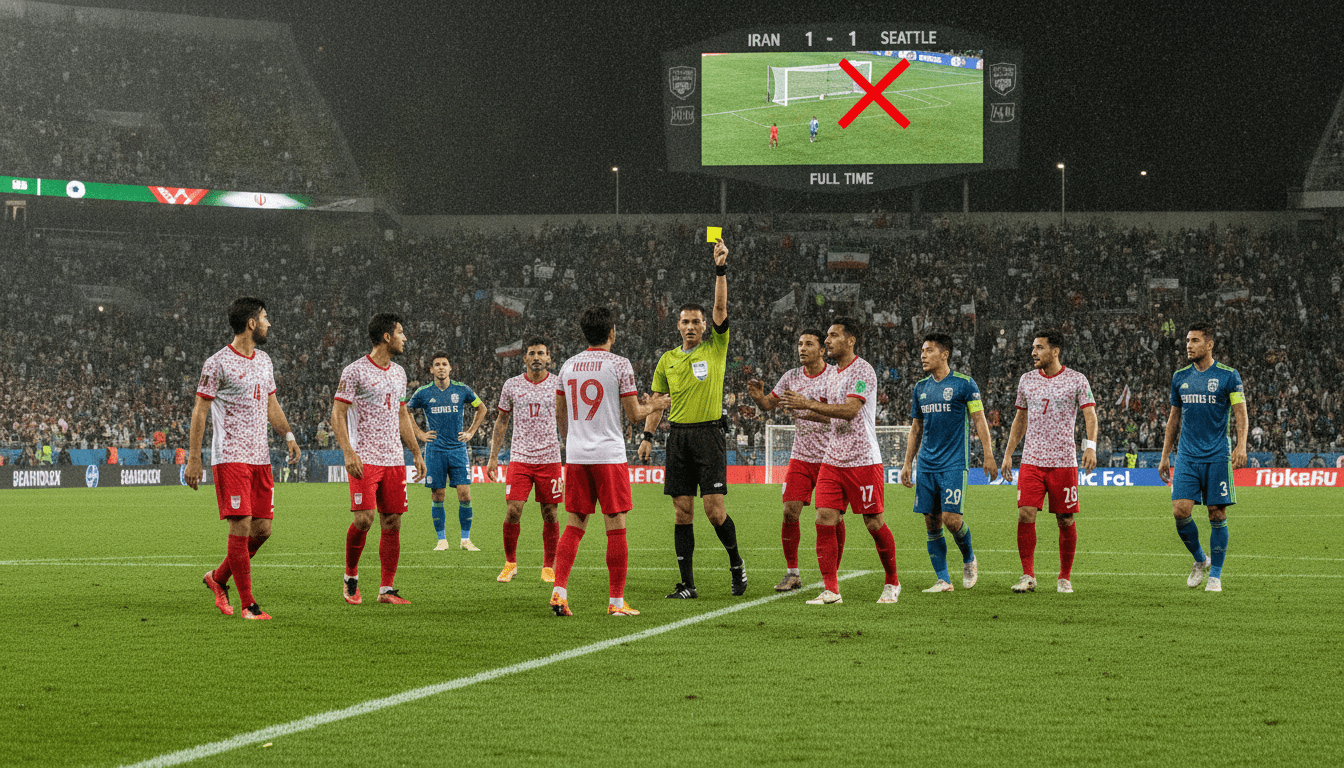
Iran World Cup hopes survive chaotic 1-1 draw with Egypt after late VAR reversal in Seattle
Iran World Cup campaign remains alive after a dramatic 1-1 draw with Egypt at Lumen Field, where a late VAR offside call wiped out a potential Iranian winner.
The Iran World Cup campaign in Seattle ended in heartbreak and unresolved questions as the national team drew 1-1 with Egypt on Friday. A late goal by Shoja Khalilzadeh was disallowed by VAR for a marginal offside, leaving Iran dependent on other results to reach the knockout stage. The match played out against a tense political backdrop and heavy logistical constraints for the Iranian delegation.
Late VAR call overturns jubilant scenes
In the closing minutes Iran appeared to have snatched a dramatic victory when Shoja Khalilzadeh converted a scramble in Egypt’s box and celebrated wildly with teammates and staff. The jubilation lasted barely a minute before VAR intervened, ruling Khalilzadeh marginally offside and annulling the goal. That decision extinguished a passionate response from the Iranian bench and left players and supporters stunned on the pitch.
The match had already been volatile: Mehdi Taremi’s header hit the crossbar shortly before the disallowed goal, and Saeid Ezatolahi struck the woodwork in stoppage time. Those near-misses compounded the sense of what might have been for Iran and underlined how fine margins decided the outcome.
Early exchange set the tone for a tense encounter
Egypt struck first inside five minutes after an initial save by Alireza Beiranvand was followed up by Mahmoud Saber, putting the visitors ahead. Iran responded quickly: Mehdi Taremi was awarded a penalty but his effort was saved, and the rebound sequence soon produced a Ramin Rezaeian equalizer in the 14th minute. That goal settled Iran temporarily and allowed the team to assert itself in phases of the match.
Throughout the game both sides created clear chances, but a combination of goalkeeping interventions and narrow misses kept the score level until the chaotic finale. The late flurry of action — the disallowed goal and Ezatolahi’s near-miss — made the draw feel like a loss for the Iranian players and many fans.
Political tensions framed the sporting spectacle
The match unfolded amid heightened geopolitical tensions after the U.S. Central Command reported strikes on Iranian military targets earlier the same day. That development cast a long shadow over the fixture, influencing security measures and the broader atmosphere in and around Lumen Field. Iranian players and officials repeatedly referenced the political context after the game, saying the team had been competing under unusually fraught circumstances.
Supporters inside the stadium displayed a mixture of national and political symbols, with both state flags and pre-revolutionary banners visible, alongside placards remembering protesters and victims linked to unrest in Iran. The presence of demonstrators against the Iranian regime and reports of booing during the national anthem heightened the event’s political overtones.
Stadium scene blended diasporas and Pride messaging
Seattle’s crowd reflected a diverse mix of diasporas and identities, with Iranian and Egyptian supporters mingling in front of the stadium and celebrating together at times. Organizers had designated the match as a “Pride Match,” a move criticized by the Iranian and Egyptian football federations but embraced by many spectators who displayed rainbow colors in the stands. The resulting atmosphere alternated between convivial fan interaction and sharply political displays.
Players noted the cordial interactions among many supporters even as tensions bubbled at moments, and images from the evening showed groups waving varied flags, including Palestinian emblems and religious banners. For many fans present, the match offered a space where sporting and social identities intersected in visible ways.
Qualification outlook hinges on other results
Iran’s draw leaves the team still alive as a possible best third-placed qualifier, but the path to the round of 16 now depends on multiple outcomes elsewhere. With Belgium and Egypt confirmed as the top two in Group G, Iran sits outside automatic qualification and must wait for results in other groups to fall in its favor. Scenarios cited by team officials include specific results involving Congo, Uzbekistan, Austria, Algeria and Croatia that would alter Iran’s standing among third-placed teams.
Team captain Mehdi Taremi and his teammates acknowledged the uncertainty and appealed for luck and support, stressing that Iran has never progressed past the group stage at a World Cup. The players framed the remaining possibilities as narrow and contingent, underlining how much the tournament’s progression can hinge on matches far from Seattle.
Travel restrictions and logistical headaches linger for Iran
Beyond the pitch, Iran’s campaign has been marked by travel complications and visa limitations that the squad says hampered preparation and recovery. The team faces an immediate return trip to its tournament base in Tijuana, Mexico, and staff described lingering problems with obtaining visas for officials, media and logistical support. Coach Amir Ghalenoei complained after the match that the squad had been treated harshly in administrative matters and that delays had cost valuable recovery time.
Players voiced fatigue not only from the game but from months of uncertainty surrounding travel and tournament arrangements, saying those issues contributed to the emotional toll after the final whistle. The delegation’s constrained mobility and reliance on a patchwork travel plan have become part of the narrative surrounding Iran’s World Cup experience.
Iran’s players left Lumen Field with mixed emotions: relief that their campaign remains mathematically alive, but the acute frustration of a squandered late chance and broader obstacles that have complicated their tournament. The team will now await a combination of results elsewhere while regrouping for the logistical return to their base, knowing that both fate and geography will decide whether their World Cup journey continues.
