
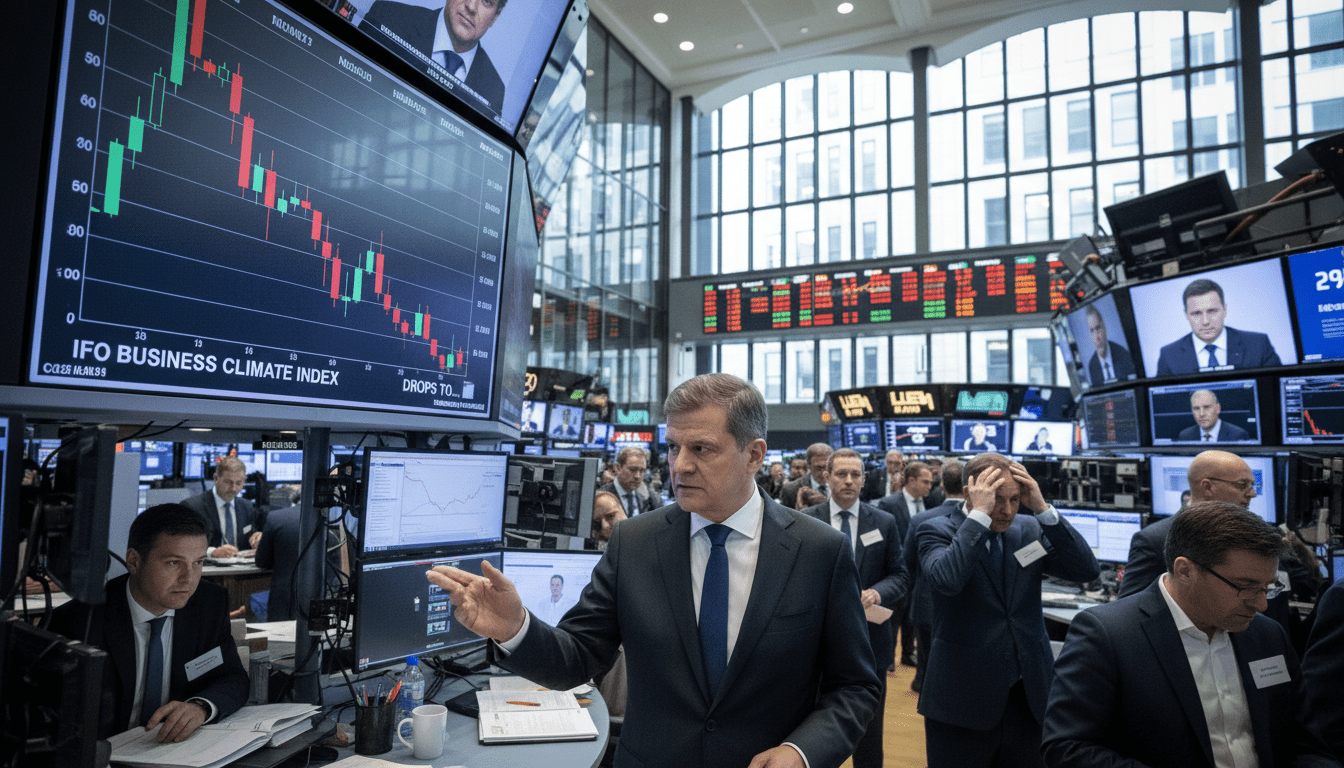
ifo business climate index falls to pandemic-era low as Iran war and Hormuz blockade hit German firms
IFO business climate index falls to 84.4 in April, lowest since COVID; Iran war and Hormuz blockade trigger energy shocks, supply bottlenecks and weaker demand.
The ifo business climate index fell to 84.4 points in April, down from 86.3 in March, marking the weakest reading since the coronavirus pandemic and signaling a sharp deterioration in corporate sentiment. The decline reflects companies rating both their current situation and future expectations more pessimistically amid the Iran war and the ongoing blockade of the Strait of Hormuz. The Munich-based ifo Institute surveyed roughly 9,000 firms for the monthly reading, which company representatives and economists say underlines mounting economic risks for Germany.
ifo index shows broad-based decline across measures
The ifo Institute reported that both the assessment of current business conditions and the expectations component contributed to the drop in the index. Firms across industry, services and retail revised down their outlooks, pushing the composite index to a level last seen during the pandemic slump. If sustained, the slide is seen by analysts as evidence that external geopolitical shocks are overcoming earlier recovery momentum.
Businesses point to supply disruptions and cost pressures
Respondents cited disruptions to supply chains and rising input costs as immediate concerns following the blockade of the Strait of Hormuz. Several manufacturers specifically mentioned interruptions to shipments and delays in critical inputs, intensifying pressure on production schedules. At the same time, higher global energy prices are feeding into procurement costs and squeezing margins across sectors.
Manufacturing and chemicals notably affected
Manufacturing companies reported a pronounced deterioration, with the chemical industry singled out as facing difficult conditions ahead. Producers warned that raw material availability and freight constraints were already altering production plans and investment assessments. The combination of weaker external demand and higher logistics costs is prompting some firms to delay or scale back production increases.
Logistics and retail sectors under strain
Logistics firms reported acute strain from transport bottlenecks and rerouted shipping flows caused by the Hormuz blockade. Retailers said that consumers were becoming more cautious, dampening sales even as inventories adjusted to new supply patterns. Inflationary pressure on household budgets was cited as a factor reducing discretionary spending and hurting turnover in many stores.
Energy shock amplifies growth risks for 2026
Economists warn that the energy-price shock tied to the Iran conflict is a key driver of the sentiment slump and could erode growth in 2026. Commerzbank’s chief economist Jörg Krämer estimated that prolonged disruptions through the Strait of Hormuz could shave roughly 0.4 percentage points off growth, increasing recession risk if oil flows remain curtailed. Under a scenario in which the passage reopens after about three months, growth for 2026 could be around 0.6 percent, according to his projection.
ifo leadership and survey directors signal stagnation ahead
ifo President Clemens Fuest described the crisis in the Middle East as hitting the German economy hard and said hopes for a near-term upswing have faded. Klaus Wohlrabe, who heads the institute’s surveys, said the data point toward an initial phase of stagnation in economic activity rather than a sharp rebound. Together, the institute’s leaders framed April’s reading as an early warning that geopolitical spillovers are now constraining domestic demand and production.
A continued deterioration in the ifo business climate index would likely feed into revised official forecasts and prompt renewed scrutiny from policymakers and corporate managers. Firms are weighing contingency plans for procurement and energy use, while economists monitor whether sentiment weakness translates into measurable declines in investment and hiring. The April reading serves as a snapshot of mounting uncertainty: if tensions ease and supply lines reopen, pressures may ease, but prolonged disruption would deepen strains on growth and employment.
