
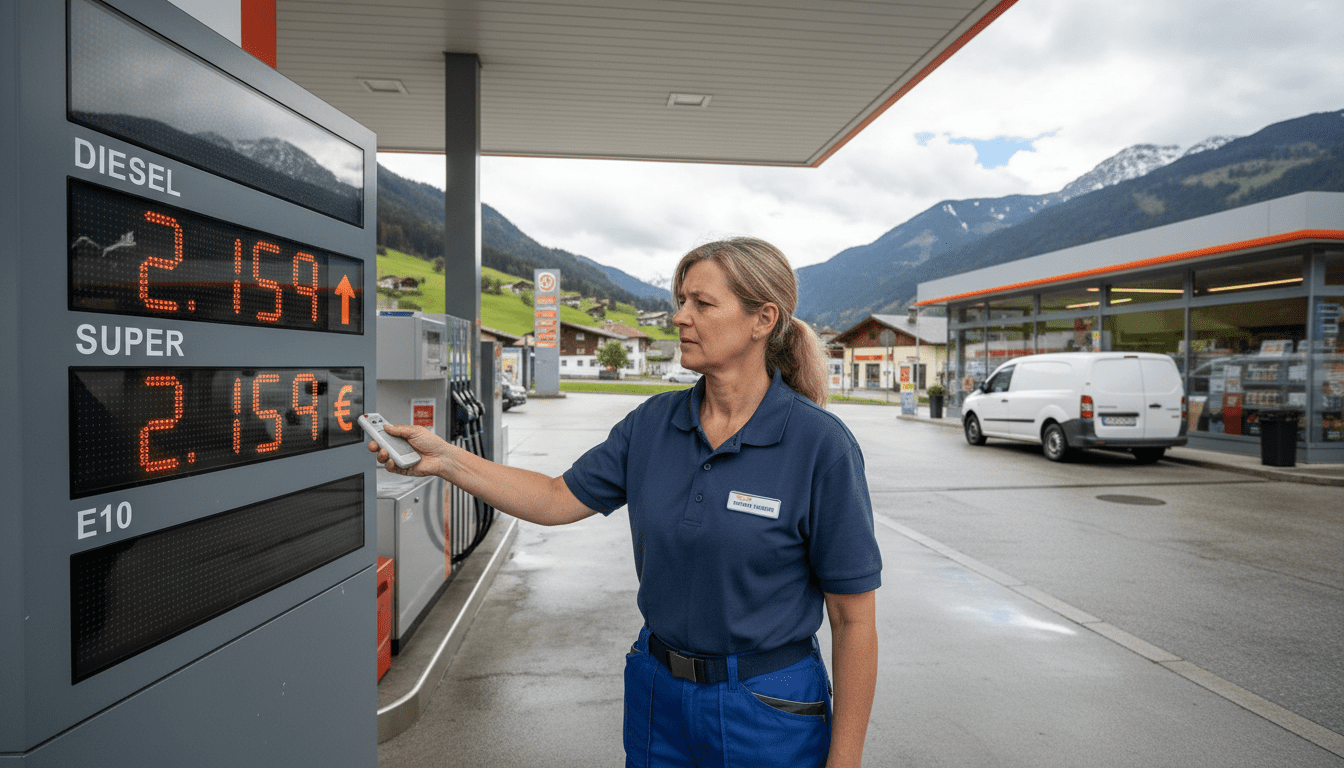
Fuel prices shift daily as East Styria station owner manually “juggles” diesel rates
In East Styria a station operator recalculates fuel prices several times a day, manually tracking nearby competitors to set diesel at €2.107 per litre.
Maria Huber begins each day between six and seven in the morning by powering up a PC and pulling competitor rates into a spreadsheet, then transcribing the figures by hand before changing the yellow digits on her station’s display. The process determines the diesel price at her pumps — €2.107 per litre on a recent Friday morning — and is repeated frequently as local conditions change. That hands-on approach to fuel prices highlights the micro-level management behind retail filling stations in smaller Austrian markets.
Morning routine at the pump
Huber’s procedure is precise and repetitive: she enters postal codes — including 8224 for the nearby town of Kaindorf bei Hartberg — into an online price tool, records the results on paper, and performs calculations to decide her next posted price. The final number is the result of balancing wholesale costs, expected margins, and tactical undercutting or matching of nearby stations.
She calls the activity “juggling” and performs it up to three times a day, often adjusting prices again in the afternoon as rival outlets update their displays. For Huber, constant monitoring and control are essential to keep her station competitive and to protect a slim profit margin on diesel sales.
Manual calculation and the ‘juggling’ method
The manual nature of Huber’s work contrasts with the automated pricing systems increasingly used by larger chains, and she insists on keeping her process private. She blocks questions about a so-called “magic formula,” saying only that the calculation must be exact to avoid costly errors on the forecourt.
On the day in question her diesel price was five cents lower than the overnight setting, a small but meaningful shift that can influence driver decisions and daily turnover. Such incremental moves are standard in tight local markets, where a few cents’ difference can move significant volumes of fuel between stations.
Local competition shapes pricing moves
In rural and semi-rural areas like Oststeiermark, stations compete against a handful of nearby outlets rather than national clearing prices, which makes real-time local intelligence crucial. Operators watch each other closely and react quickly to undercutting or to changes in fuel deliveries and wholesale invoices.
The price Huber posts is therefore not just a reflection of wholesale costs but also a tactical response to the behavior of immediate rivals, customer patterns, and the limited elasticity of demand in a region where motorists rely heavily on personal vehicles.
Effects on drivers and purchasing patterns
Frequent price updates create a dynamic environment for motorists who may time purchases to benefit from lower midday or evening prices. Some drivers develop habits of checking multiple stations or using mobile apps to find the cheapest options within a short drive.
For many customers, a few cents’ difference is not merely symbolic: it can change where people choose to fill up, particularly for regular commutes or for larger vehicles where the savings accumulate. Smaller stations like Huber’s therefore face constant pressure to balance competitiveness with the need to keep operating costs covered.
Technology trends and the future of station pricing
While Huber relies on manual inputs and a paper ledger, the broader industry is moving toward algorithmic pricing tools that can aggregate competitor data and update displays automatically. Those systems can respond to market moves in seconds, but they also raise questions about transparency and competitive behavior among small operators and larger chains.
Adoption of digital price-management tools depends on cost, trust, and regulatory comfort; for independent operators the upfront investment and perceived loss of control can be significant deterrents. At the same time, the manual model persists where human judgment and local knowledge still deliver an edge in an unpredictable market.
Margins, regulation and the small-station economy
Retail fuel margins are often narrow, making disciplined price setting and careful bookkeeping essential for station viability. Operators must account for wholesale prices, delivery schedules, tax rates, and non-fuel revenue streams such as convenience-store sales or service offerings to sustain a business.
Regulatory frameworks influence how prices are displayed and how frequently they can change, while consumer advocacy groups and local regulators may scrutinize patterns of price coordination in concentrated markets. For independent owners, the challenge is maintaining profitability without alienating customers or running afoul of competition rules.
The hands-on scene at Huber’s station in East Styria illustrates the granular work behind the numbers motorists see at the pumps, where each change in the yellow digits reflects a chain of decisions made to keep a small business afloat in a highly competitive, fast-moving market.
