
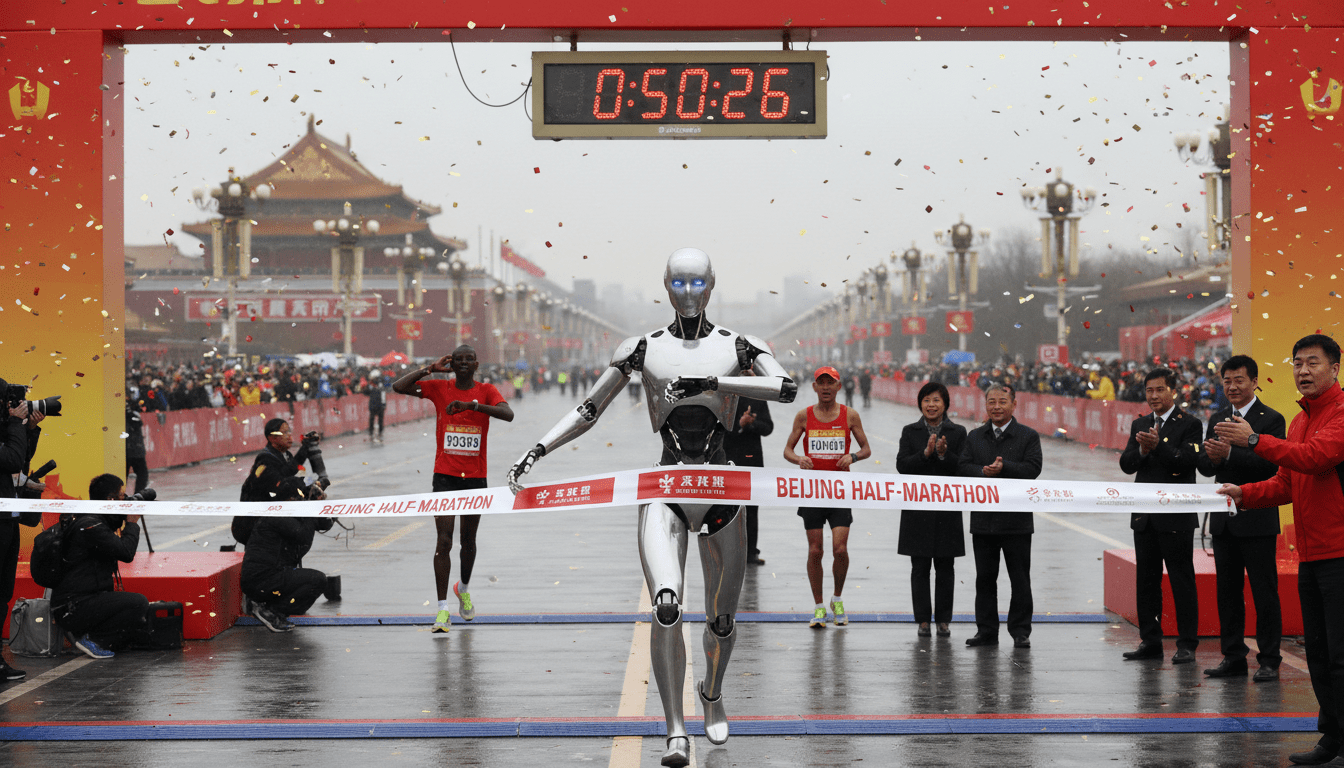
Honor-built humanoid robot wins Beijing half-marathon in 50:26, beating human record pace
A humanoid robot half-marathon in Beijing concluded with an Honor-built autonomous robot posting a winning time of 50 minutes and 26 seconds, outpacing the human half-marathon world record pace. The event, staged as a testbed for robotics mobility and autonomy, drew a field of both autonomous and remote-controlled humanoid competitors. Organizers used weighted scoring to determine the official winner, elevating the autonomous Honor entry above a faster remote-controlled counterpart.
Official result and scoring details
Race officials declared the autonomous Honor robot the winner after applying a weighted scoring system that favored independence of control. The autonomous machine finished in 50:26, while a different Honor unit recorded a faster raw time of 48:19 but was remote controlled and therefore ranked behind the autonomous competitor. Beijing’s E-Town tech hub and event statements confirmed the split between autonomous and teleoperated entries.
Organizers said the weighted system was intended to promote self-directed navigation and decision-making rather than pure speed under remote control. The approach influenced how the field was evaluated and drew attention to differing design priorities among teams and manufacturers.
Field composition and participation
Approximately 40 percent of the competing humanoid robots ran autonomously, with the remaining 60 percent operated remotely, event officials reported. The lineup included a mix of prototype platforms and commercially oriented designs, reflecting a broad set of engineering aims from balance and energy efficiency to sensor integration and path planning.
Not every entrant completed the distance, and the mix of autonomy levels produced a wide spread in performance. Several teams used the race as an endurance and reliability trial, prioritizing robust operation over outright pace.
Performance leap compared with previous year
This year’s top autonomous time represented a dramatic improvement over last year’s event, when the fastest robot took roughly two hours and 40 minutes to complete the course. Engineers credited iterative software updates, lighter mechanical frames, and improved battery management for much of the gain in speed and steadiness on the route.
Comparisons to human results drew immediate attention because the autonomous winning time was substantially quicker than the human half-marathon world record pace of 57 minutes set by Jacob Kiplimo. Organizers and participants cautioned, however, that robot-to-human comparisons are not apples-to-apples given different rules, safety equipment, and assistance models.
Course incidents and technical failures
The race saw a handful of notable mishaps, including one robot that fell at the starting line and another that collided with a roadside barrier. Such incidents underscored ongoing challenges in perception and dynamic balance when humanoid platforms operate in complex, real-world environments. Event medical and technical teams intervened quickly, and no human injuries were reported.
Mechanical wear and sensor calibration were also recorded as factors that affected several teams’ outcomes. Engineers said the competition environment — with variable light, surface transitions and narrow turns — exposed weaknesses that laboratory testing had not fully reproduced.
Industry reaction and broader implications
Manufacturers and robotics researchers hailed the event as evidence of rapid progress in legged locomotion and autonomy. Representatives from multiple companies said lessons learned on the course will inform next-generation control systems aimed at improving efficiency and reliability in everyday settings. The performances prompted renewed debate about appropriate comparisons between robotic and human athletic achievements.
Some observers on social media questioned the relevance of comparing robot times to human records, noting differences in body architecture, energy sources and regulatory constraints. Others viewed the results as a milestone for practical robotics, suggesting that faster, more autonomous humanoid platforms could accelerate applications from disaster response to logistics.
Final testing and next steps
Event organizers indicated that future editions will refine scoring criteria, introduce more standardized course conditions, and expand categories to separate experimental prototypes from production-intent machines. Teams already signaled commitments to focus on robustness and autonomous decision-making rather than raw speed alone.
For now, the Beijing humanoid robot half-marathon has delivered a headline-grabbing result and a wealth of technical data for the field. Engineers, policymakers and observers will watch closely as organizers and developers translate the race’s lessons into the next generation of humanoid capabilities.
