
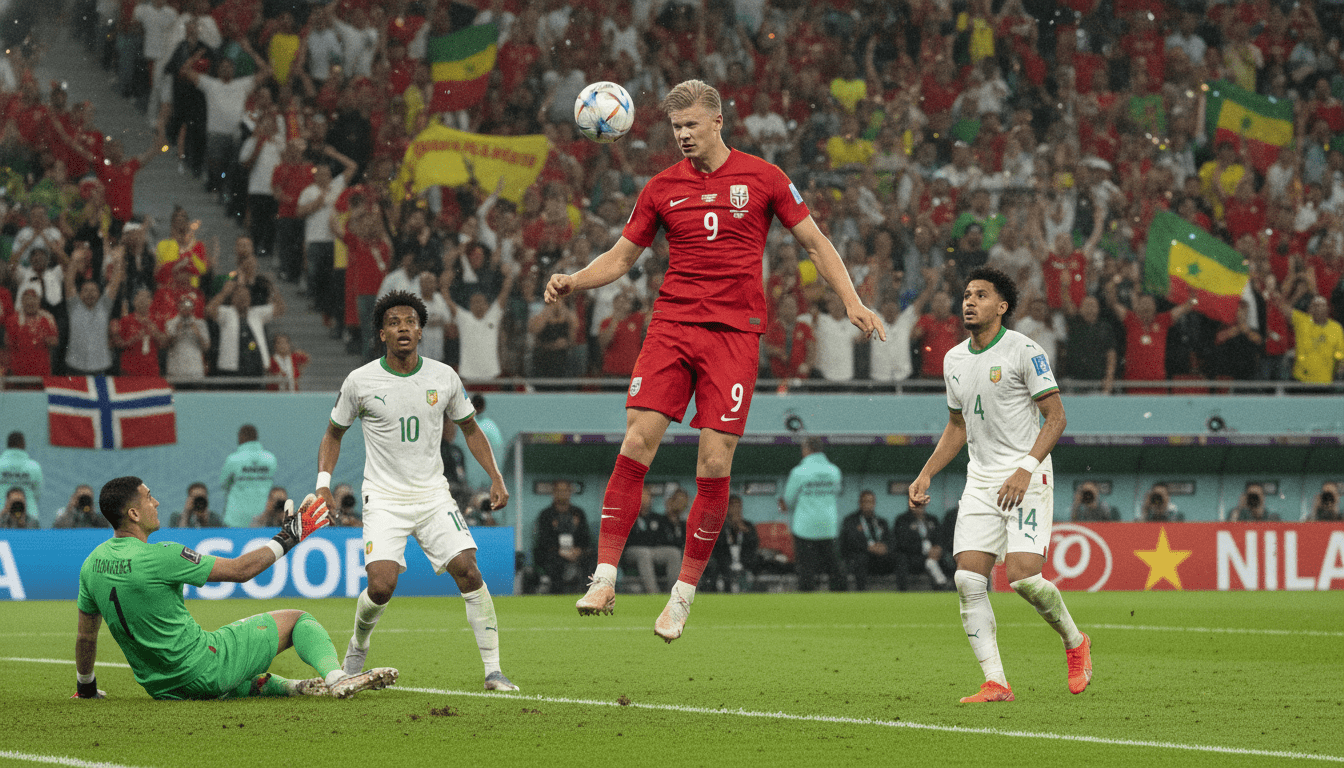
Senegal World Cup hopes dented as Haaland and Norway rally to 3-2 victory
Norway beat Senegal 3-2 as Erling Haaland starred; Senegal World Cup hopes shaken by unpaid bonuses, hotel food disputes and defensive errors under scrutiny.
Senegal World Cup hopes suffered a severe blow as Norway edged the West Africans 3-2 in a decisive group match dominated by Erling Haaland and by off-field turmoil that has dogged the team. The loss leaves Senegal facing a must-win final group game and deeper questions about preparation and governance. Coach Pape Thiaw insisted his side were not defeated as a nation yet, but acknowledged the situation was now complicated.
Haaland decisive in late first-half and early second-half strikes
Erling Haaland emerged as the decisive figure after a tense first half in which Norway had already threatened and Senegal had shown flashes of resilience. A Marcus Pedersen opener capitalized on a defensive mistake by Moussa Niakhaté, and Haaland then converted a chance shortly after halftime to put Norway further ahead. Haaland’s movement and finishing broke Senegal’s defensive resolve, and his third goal put the result beyond doubt before Ismaila Sarr’s late efforts narrowed the margin.
The Norwegian attack repeatedly exploited moments of indecision among Senegal’s back line, while goalkeeper Edouard Mendy was left exposed on several occasions. Norway’s coach described the closing minutes as the “longest minutes” of his life, underlining how nervy the match became despite the visitors’ lead.
Unpaid bonuses and Africa Cup fallout shadow preparations
Senegal’s campaign entered the World Cup already unsettled by a public dispute over unpaid bonuses stemming from the controversial Africa Cup final in January. That tournament ended in chaos after Senegal briefly left the pitch during the final; although the team won the shootout, administrative rulings ultimately altered the official outcome and left players and officials in disagreement. The resulting financial and reputational fallout has not been fully resolved.
Those unresolved tensions, officials and players concede, have filtered into the team environment. Delegation sources say the federation and state authorities failed to provide the steady organizational support typically needed for a smooth tournament build-up. Players and coaching staff reported logistical headaches that ranged from contractual uncertainty to disputes over match bonuses.
Complaints about hotel food and daily logistics
Compounding the financial dispute, players publicly complained about hotel catering and opted to order their own meals during the tournament. That decision was framed by team officials as a stopgap measure, but it underscored broader dissatisfaction with accommodations and daily logistics. Coaches said they attempted to keep focus on the pitch, but the continual noise off it made concentration harder to maintain.
Such operational frictions are particularly damaging when facing top-level opponents in tightly contested groups. Small, avoidable distractions can enlarge into decisive disadvantages over the course of a tournament, and Senegal’s staff acknowledged that organizational lapses had amplified the pressure on players.
Tactical errors and crucial on-field moments
On the field, Senegal produced moments of technical quality but could not avoid pivotal mistakes at the worst moments. A poor pass led directly to Norway’s opening goal and defensive reactions to counterattacks were sometimes slow or misjudged. Kalidou Koulibaly’s attempted intervention on a second-half move left space that Haaland exploited, and goalkeeper interventions failed to stem the tide on two occasions.
Ismaila Sarr’s two goals gave Senegal hope and demonstrated the team’s capacity to find the net under pressure. Yet the timing of Norway’s goals — immediately before and after halftime — proved decisive. Thiaw noted that the goals came at “unfavourable moments,” suggesting that a different sequence might have altered the final result.
Group standing, scenarios and the challenge ahead
The defeat places Senegal in a precarious spot in their group and means qualification scenarios are now tightly constrained. The team heads into its final match with the task of beating Iraq and improving its goal difference, while other results in the group could also determine which nations progress. The expanded 48-team format has amplified such permutations, rewarding teams that can avoid early chaos and capitalize on scheduling advantages.
Coach Thiaw must choose whether to chase an aggressive win to salvage progression on goal difference or adopt a more conservative approach to avoid conceding further damage to an already fragile campaign. Either course carries risks and underscores how off-field disruption can translate into tactical dilemmas on matchday.
Senegal’s recent World Cup history compounds the current disappointment, with narrow exits and knockout-stage challenges in previous tournaments raising expectations among supporters. This campaign’s combination of administrative disputes, logistical complaints and on-field lapses has turned those expectations into urgent questions about leadership and structure within the national setup.
The match highlighted both Senegal’s attacking potential and its vulnerability under pressure, leaving supporters and officials to weigh short-term remedies against longer-term reforms needed to stabilize the national program.
