
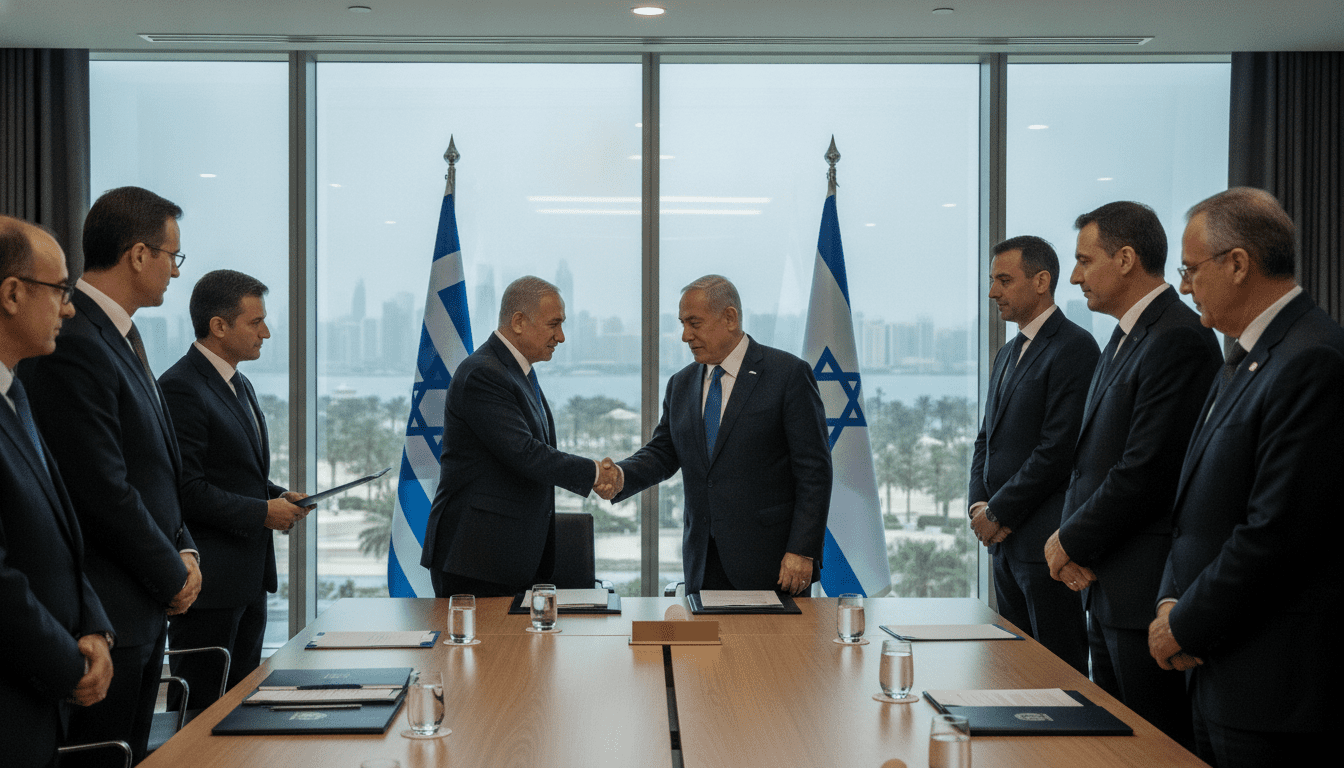
Greece-Gulf ties deepen as Athens fuses defence with Israel to counter Turkey
Greece-Gulf ties have expanded through defence pacts, energy projects and deep military integration with Israel, reshaping Eastern Mediterranean and Gulf strategic alignments.
Greece’s outreach to Gulf states has accelerated into a strategic pivot that blends defence cooperation, energy deals and closer security links with Israel. The shift—commonly described as a two-phase push—sees Athens using the Greece-Gulf ties to broaden its regional footprint while aiming to check Turkish influence in the Eastern Mediterranean and the Gulf. Key agreements, military deployments and infrastructure initiatives now form a dense web of cooperation stretching from Athens to Abu Dhabi and Riyadh.
Two-phase diplomatic push
Greece’s engagement with the Gulf unfolded in two distinct phases between 2016 and 2026. From about 2016 to 2021, Athens pursued an anti-Turkey alignment anchored with Israel and Cyprus and supported by partners such as France and Egypt. From 2023 into mid‑2026, the strategy shifted again, this time intensifying security ties with Gulf monarchies while deepening interoperability with Israeli defence forces and suppliers.
This progression reflects a diplomatic balancing act: economic and investment incentives have accompanied a harder-edged security agenda. Officials in Athens have framed these moves as mutual security and investment partnerships, while critics point to an outsized military integration with Israel that carries strategic implications for Gulf partners.
Strategic accords with UAE and Saudi Arabia
Bilateral accords signed in recent years have given Greece formal defence commitments with Gulf states. In November 2020, the Greek government concluded a broad strategic partnership with the United Arab Emirates, including a defence clause pledging mutual assistance if sovereignty or territorial integrity were threatened. A separate leap occurred in 2021, when Greece and Saudi Arabia formalized defence cooperation that included deployment of a Greek Patriot battery and joint air exercises.
Those agreements combined visible hardware transfers and regular high‑level military exchanges, transforming routine ties into standing security cooperation. Gulf capitals have sought Mediterranean partners who can provide logistics, basing options and diplomatic cover, and Athens has sought out investment and energy access in return.
Military integration with Israeli systems
The most consequential dimension of Greece-Gulf ties is Athens’s deep military integration with Israel. Greece’s Achilles’ Shield air‑defence programme—valued at roughly $3.5 billion—aims to knit Israeli systems into a layered national missile and counter‑drone network. Earlier this year Athens approved an additional roughly $750 million purchase of precision rocket artillery from Elbit Systems for units on the Turkish frontier.
Beyond purchases, Israeli firms train Greek pilots, Israeli technologies have been brought into Greek industrial capacity through acquisitions such as Israel Aerospace Industries’ 2023 purchase of Intracom Defense, and personnel exchanges have been regular. These moves have transformed what Athens calls partnership into a practical alignment of doctrine, equipment and command linkages.
Gulf recalibration toward Ankara
The Gulf response has not been uniform. Since the end of the 2017 Qatar crisis and the gradual normalization that followed, several Gulf states have quietly recalibrated relations with Ankara. Turkey’s status as the only Muslim‑majority NATO member with a significant defence industry, combined with its willingness to champion regional causes, has made it a substantive partner for some Gulf capitals.
That recalibration complicates Athens’s objective of enlisting the Gulf broadly against Ankara. Gulf strategy increasingly favors hedging between Ankara and other external actors, meaning Greek efforts to present a single bloc against Turkey have had mixed resonance across Riyadh, Abu Dhabi and Doha.
Energy, connectivity and the IMEC corridor
Athens has paired defence diplomacy with economic initiatives designed to increase its strategic indispensability to the Gulf. Greek proposals and projects tied to the India‑Middle East‑Europe Economic Corridor (IMEC), fibre‑optic links and energy corridors aim to position Greece as a gateway to Europe. IMEC, an initiative driven by partners including India and Israel and involving Gulf transit points, notably excludes Turkey and Egypt in its current contours, reinforcing Athens’s role as a routing hub.
For Gulf states, such projects promise alternative routes for trade, data and energy flows into Europe. For Greece, they offer investment, construction contracts and a stronger bargaining position in broader regional security conversations.
Security outreach during February 2026 escalation
When the conflict broadly described as the US‑Israel‑Iran escalation intensified in February 2026, Athens moved quickly to offer security assistance and diplomatic outreach in the Gulf. Greek Defence Minister Nikos Dendias conducted visits to the UAE, Qatar and Saudi Arabia in March and April 2026, presenting Greek facilities and planning as potential support nodes amid regional uncertainty.
Observers note a tension: Greek facilities and training are highly integrated with Israeli systems, which raises questions about the independence of Greek security guarantees offered to Gulf partners. Gulf decision makers must weigh whether assistance is Greek in nature, or effectively connectivity into Israeli defence architecture.
The expanded Greece‑Gulf ties now represent more than transactional energy deals; they are a complex mixture of defence dependence, economic opportunity and strategic positioning that will test regional alignments in the years ahead.
