
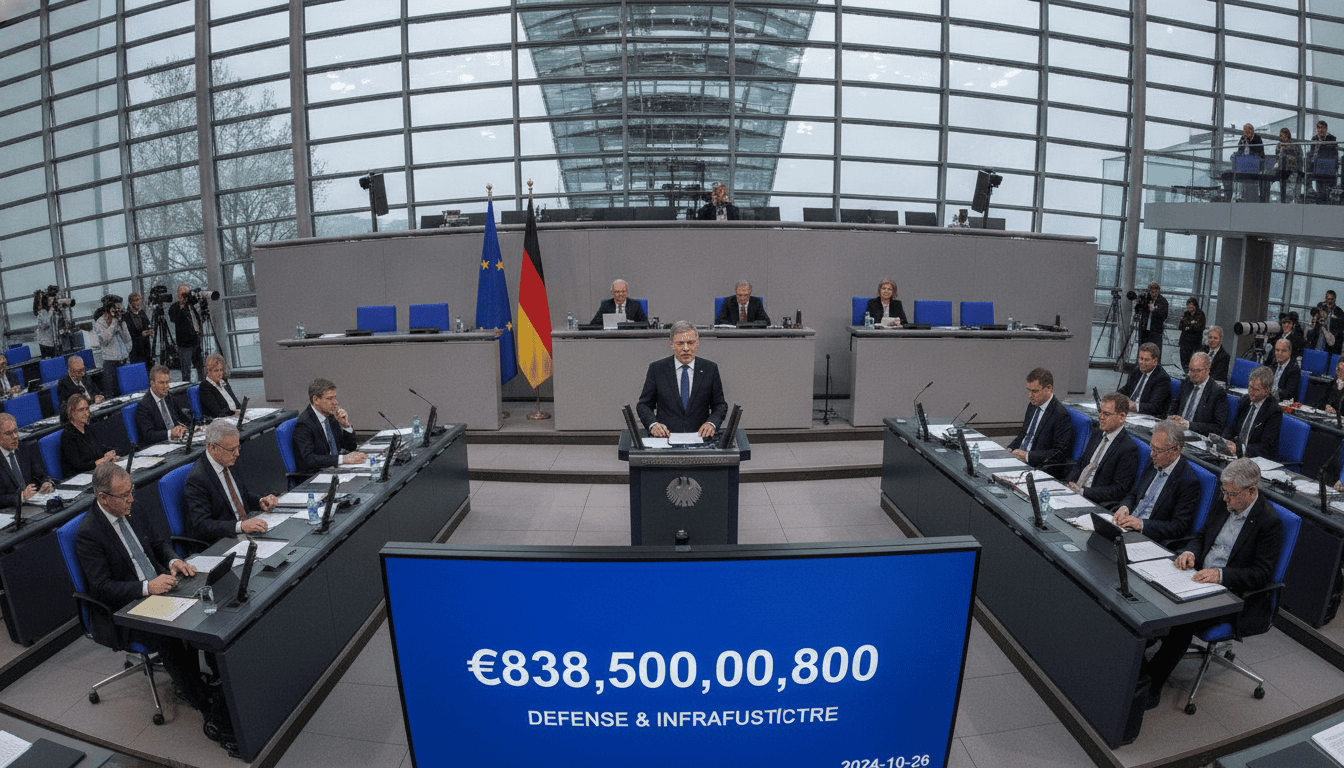
Germany’s borrowing plan of €838.5bn for 2027–2030 raises alarm over interest costs, procurement inflation and whether investments will deliver lasting benefits
Germany’s borrowing plan of €838.5bn for 2027–2030 has sparked debate about fiscal risks and the effectiveness of the large-scale investment programme. The government argues the funds are needed for defence and infrastructure, but analysts warn that rising interest payments and procurement inflation could undermine long-term value. With projected interest costs alone reaching into the tens of billions by 2030, questions about prioritisation and oversight are increasingly urgent.
Scale and fiscal burden
The government intends to borrow roughly €838.5 billion between 2027 and 2030, a sum comparable in purchasing power to the debt surge after German reunification. By 2030 the state’s interest bill is forecast to climb steeply, eating into a significant share of tax revenue and narrowing fiscal space for other spending.
Officials say borrowing now is justified to preserve Germany’s economic strength and security, but critics note that the era of near-zero interest rates is over. When borrowing costs rise, the case for large debt-financed programmes rests heavily on whether the investments generate returns that exceed servicing costs.
Why the government cites defence and infrastructure
Berlin has framed the borrowing package around two priorities: expanding defence capabilities and accelerating infrastructure and climate investments. Defence spending is set to grow markedly as the government aims to meet NATO-related targets and bolster military readiness after recent geopolitical shocks.
At the same time, the package includes hundreds of billions for transport, energy and digital projects intended to modernise the economy. Ministers argue the combined measures are necessary to deter external threats and to remove long-standing bottlenecks in domestic infrastructure.
Accounting shifts and transparency concerns
Economists and watchdogs have flagged creative accounting and intra-budget transfers as a major risk to fiscal credibility. Some items are being shifted between the special funds for defence and infrastructure and the traditional core budget in ways that make headline investment ratios appear better than they would under strict accounting.
Independent analyses suggest that, without such reclassifications, the statutory investment targets would be harder to claim. That has sown mistrust among opposition parties and some coalition members who warn that bookkeeping techniques could open room for non-investment consumption later on.
Procurement inflation and defence effectiveness
A substantial portion of the new borrowing is earmarked for defence, but defence procurement experts caution that quantity alone will not guarantee capability. Prices for specialised equipment — from hardened IT hardware to containerised fuel systems — have surged, sometimes doubling or worse between purchase cycles.
Lawmakers and defence specialists have pointed to a pattern of expensive, complex systems being prioritised over simpler, mass-producible materiel that has proven effective in recent conflicts. Calls are growing for a stricter, strategic procurement process and a permanent oversight body to prevent cost overruns and to ensure acquisitions match operational needs.
Infrastructure spending races against capacity limits
The infrastructure component of the programme is equally challenged by supply constraints. Planners aim to spend a large share of a twelve-year, €300 billion envelope in the first four years, creating demand spikes that push up construction costs and exhaust local capacities.
Projects cited as emblematic include rail modernisations where costs for signalling and bridge works have risen substantially and punctuality has not improved. Industry insiders say the rush to disburse funds risks inflating prices further and producing lower-quality outcomes when skilled labour, suppliers and administrative capacity cannot scale to match the cash flows.
Calls for prioritisation and stronger oversight
A number of economists and parliamentarians insist the central question is not how much to borrow but where to concentrate investments for maximum return. They argue that a transparent prioritisation framework, stronger procurement competition and a capacity plan for deliveries are prerequisites for success.
To that end, the finance ministry has set up a monitoring advisory panel charged with tracking the efficiency of spending. While some experts praised the methodological approach of initial reports, they cautioned that robust, operational controls and clearer criteria for project selection are still lacking.
The scope of the borrowing programme marks a turning point for German fiscal policy, but its success will depend on disciplined prioritisation, improved procurement practices and the ability to expand delivery capacity without fuelling unsustainable inflation. If those measures are not enforced, the large sums now planned could produce short-term headline spending at the cost of long-term fiscal resilience.
