
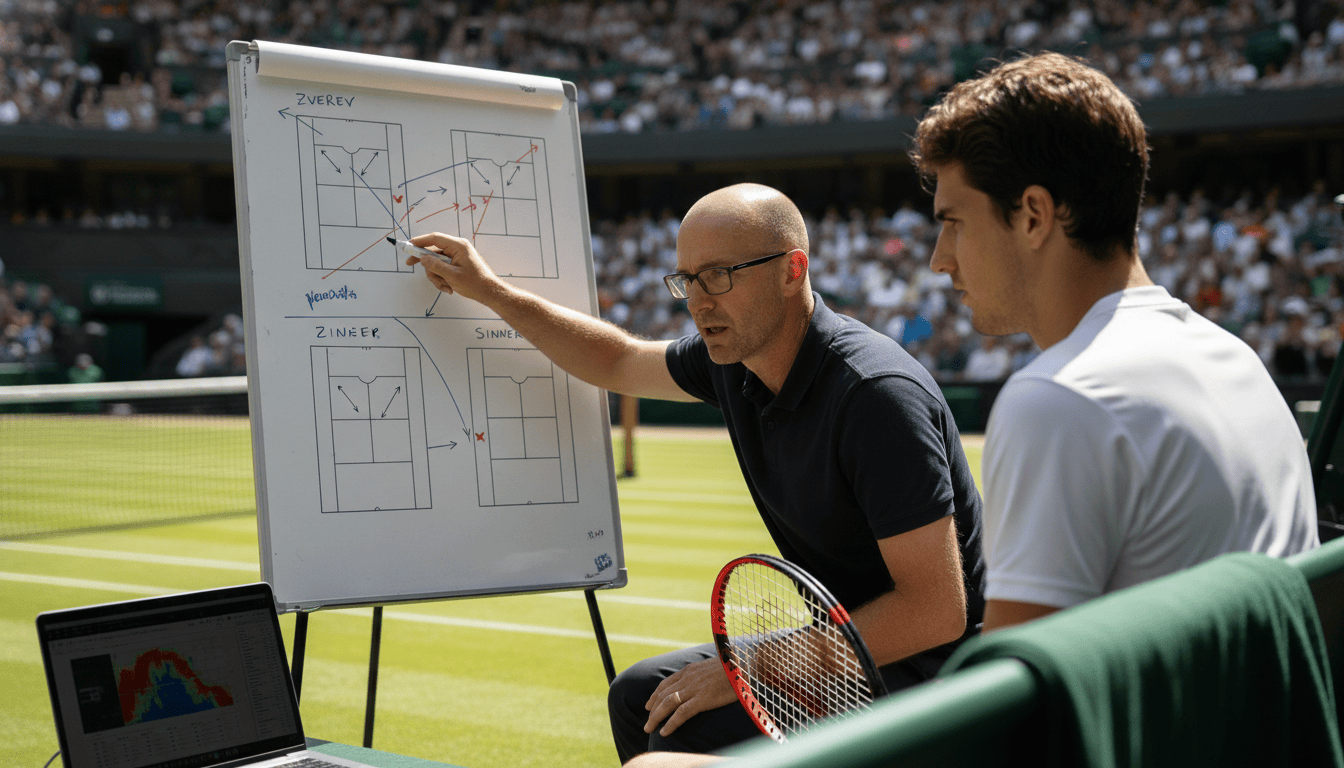
Craig O’Shannessy: How the Data Strategist Says Alexander Zverev Can Beat Jannik Sinner in the Wimbledon Final
Veteran data strategist Craig O’Shannessy lays out a tactical blueprint for Alexander Zverev to upset world number one Jannik Sinner in the Wimbledon final, arguing that targeted adjustments and serve-and-net aggression can tilt the match. O’Shannessy, an Australian who runs Brain Game Tennis from Austin and has advised top players including Novak Djokovic, says Zverev’s evolution at 29 makes him a more dangerous opponent on grass. His analysis combines match-pattern recognition, serve placement statistics, and video-driven strategies aimed directly at Sinner’s vulnerabilities.
Data Strategist Behind Top Players
Craig O’Shannessy has built a reputation as one of tennis’s leading data and strategy analysts, advising elite players and federations. He worked with Novak Djokovic for three years, consulted with the German pro Jan-Lennard Struff, collaborated with the Italian tennis federation, and currently assists Giovanni Mpetshi Perricard. O’Shannessy’s firm, Brain Game Tennis, blends video coding and statistical models to produce actionable plans for match preparation.
Anatomy of Zverev’s Changes at 29
O’Shannessy attributes Zverev’s increased threat level to refinements in serve reliability and tactical variety rather than wholesale stylistic reinvention. According to his analysis, Zverev’s serve patterns on grass show fewer double-faults, improved first-serve placement into corners, and a higher percentage of free points on first delivery. These metrics, O’Shannessy argues, reduce Sinner’s margin for immediate attack and allow Zverev to dictate more rallies.
Zverev has also added purposeful net approaches and slices to shorten points and disrupt baseline rhythm. O’Shannessy points to a deliberate shift in build-up play: Zverev mixes depth with low-bouncing slices to draw Sinner forward and creates shorter decision windows. That mix of power, spin and forward movement is central to the plan being recommended for the Wimbledon final.
Tactical Playbook for Facing Jannik Sinner
O’Shannessy outlines a concise set of tactical objectives for Zverev to implement on Centre Court. First, he emphasizes targeting Sinner’s movement on his backhand side with well-placed serves and follow-up patterns that neutralize Sinner’s inside-out forehand. Second, he recommends aggressive use of the serve-and-volley on key return games to take time away from Sinner’s rhythm.
Third, the strategy calls for selective shortening of rallies through slices and approach shots, forcing Sinner into uncomfortable half-court decisions. O’Shannessy notes that forcing shorter points increases the variance in outcomes, a statistical lever that favors the server with Zverev’s weapons when executed cleanly.
Evidence from Match Data and Video Analysis
O’Shannessy’s conclusions are drawn from a combination of coded match footage and rally-length distributions, not intuition alone. His team isolates common patterns — how often Sinner wins points after gaining forehand control, the locations where Zverev’s serve yields free points, and the court positions that produce forced errors. These patterns are translated into a prioritized game plan that Zverev’s camp can rehearse in practice.
The data also quantifies risk-reward trade-offs. For example, moving Zverev to a higher share of serve-and-volley plays increases his chance of quick point wins but raises vulnerability on low returns. O’Shannessy’s role is to specify the volume and timing of those choices so they fit grass-court conditions and the opponent’s tendencies.
Track Record That Lends Credibility
O’Shannessy’s advisory history lends weight to his assessments. Working with Djokovic exposed him to preparation at the sport’s highest level, where marginal gains are decisive. His past collaborations with national federations and touring pros show a consistent focus on converting pattern recognition into match-day routines. Players who adopt his recommendations typically receive clear, repeatable actions rather than abstract analysis.
That track record is important because execution under pressure separates theoretical advantage from match-winning change. O’Shannessy’s reports are designed to be distilled into a few concrete plays and practice drills that a player and coaching staff can implement in the days before a final.
Projected Dynamics for the Wimbledon Final
If Zverev follows the blueprint laid out by O’Shannessy, the final is likely to become a contest of rhythm disruption and tactical timing rather than a straightforward baseline slugfest. Expect Zverev to increase serve placement aggression, introduce more forward movement, and selectively deploy slices to shorten points. Sinner’s response will be equally crucial; his ability to take the ball early and redirect pace can neutralize those plans if Zverev’s first-serve percentage dips.
O’Shannessy stresses that margins will be small and situational execution decisive. On grass, short points and purposeful variations amplify small advantages. The analyst’s projection is straightforward: Zverev can win if he reduces unforced errors, finishes points early when Sinner is pushed off-balance, and maintains the tactical discipline to abandon aggressive plays when the numbers suggest higher risk.
The Wimbledon final will be a test of whether analytics-driven adjustments translate into on-court results, and whether a 29-year-old Zverev can convert data-crafted opportunities into championship points.
