
Cologne heatwave tests hospitals and economy as city rolls out cooling measures
Cologne heatwave drives urgent city responses after Germany records thousands of heat-related deaths this year, straining hospitals and public services.
Germany has seen an unprecedented human toll from extreme temperatures this year, with official tallies attributing roughly 7,900 deaths to heat, and the impact is concentrating pressure on urban systems during the Cologne heatwave. Hospitals and emergency services are reporting heavy caseloads while economists warn of sizeable productivity losses tied to recurrent high temperatures. In response, Cologne has expanded a mix of immediate cooling measures and longer-term planning aimed at protecting vulnerable residents and maintaining urban functionality.
Hospitals and emergency services under sustained pressure
Hospitals and ambulance services in major cities, including Cologne, are operating at or beyond normal capacity as heat-related ailments rise. Local public health officials report increased admissions for dehydration, heat-related cardiovascular events and exhaustion, particularly among older people and those with pre-existing conditions.
Emergency medical services face longer response times and higher call volumes, contributing to operational strain across the care system. Public health authorities say the demographic most at risk includes elderly people—whose thirst response diminishes with age—as well as children, pregnant people, the homeless and outdoor workers.
Economic toll and lost working hours
Researchers estimate heat-driven health problems and reduced workplace performance are already imposing measurable costs on Germany’s economy. A recent analysis projects that persistent heat stress could shave tens of billions off national output in the coming years, driven largely by lost productive hours.
Productivity gains seen at moderate temperatures reverse once daytime heat climbs above about 30°C, with each additional degree linked to a quantifiable drop in output per working hour. Both outdoor laborers and office employees feel the effects: reduced sleep, fatigue and the stress of moving between air-conditioned interiors and hot streets all harm concentration and efficiency.
Cologne’s heat action plan and municipal strategy
Cologne adopted a comprehensive heat action plan in January 2019 that bundles 36 measures intended to reduce heat exposure and protect at-risk groups. City officials say the plan has guided an expansion of both low-cost, temporary responses and investments in urban design changes meant to lower temperatures over time.
Geographic factors intensify the problem in Cologne: its basin-like location and dense built environment amplify the urban heat island effect, causing central areas to remain significantly warmer than surrounding rural zones. Those urban dynamics have driven the municipal focus on rapid, place-based interventions.
Community outreach: the Hitzetelefon and cool places map
One practical element of Cologne’s response is a registered “Hitzetelefon” advice line aimed primarily at older residents, which provides medical guidance tailored to callers’ health status and living situations. The service also issues proactive warnings ahead of heatwaves on request, and local authorities report thousands of registrations this season, signaling both demand and social value.
Complementing telephone outreach, the city maintains an interactive “cool places” map that allows residents to mark and discover public locations that offer shade, water features or otherwise lower temperatures. More than 300 sites have been logged by citizens, creating a crowdsourced resource for those seeking relief on hot days.
Tactical cooling: misting, shade canopies and pedestrian shading
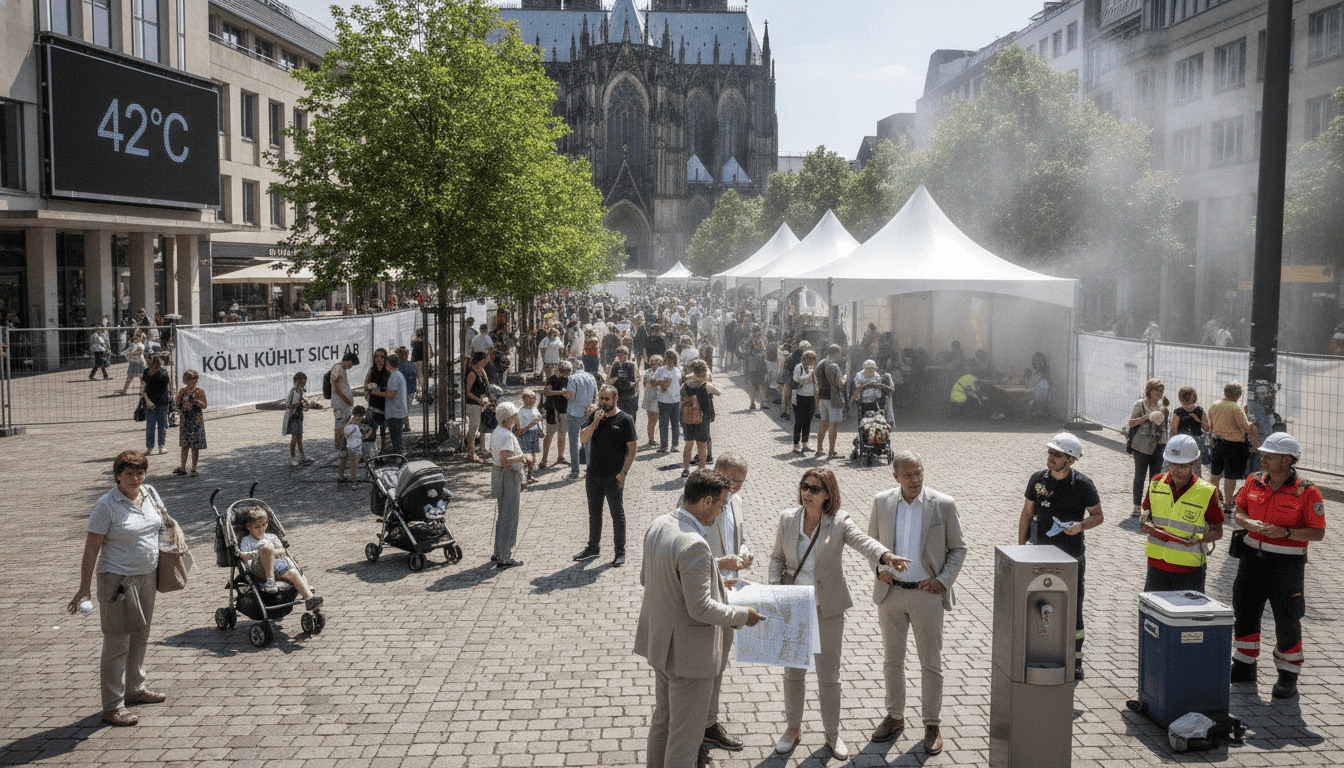
Cologne has been deploying short-term cooling measures in heavily used public spaces to deliver immediate relief. Controlled misting installations on major squares and routes temporarily lower temperatures for passersby, with officials noting perceptible drops in ambient heat without leaving people soaked.
In high-footfall shopping areas where planting trees is impractical, the city has tested suspended white fabric canopies that form partial shade while allowing airflow. Measured reductions of two to five degrees Celsius in the afternoon have been recorded, and perceived cooling can be even greater during still, sun-drenched hours. The materials are inexpensive and widely available, though urban regulations such as fire-safety rules can limit where they are feasible.
Research, modeling and the limits of stopgap solutions
Academic and applied research in Cologne is pairing 3D urban climate models with observational data to quantify cooling effects from measures like façade greening and targeted misting. Students and scientists are simulating scenarios to prioritize interventions that yield the largest local temperature declines for the least cost.
Experts caution that while tactical innovations can reduce exposure and improve comfort, they do not substitute for systemic changes required to adapt cities to long-term warming. Structural challenges—such as dense paving, limited space for trees and regulatory hurdles—mean temporary measures must be combined with longer-term investment to alter urban heat dynamics at scale.
Cologne’s experience illustrates both the immediate human costs of extreme heat and a municipal toolkit that other cities might adapt: targeted outreach to vulnerable residents, crowd-sourced information on cooler public spaces, temporary street-level cooling and evidence-driven planning to guide future measures. The city’s efforts provide relief for now, but officials and researchers emphasize that more comprehensive urban redesign and public-health capacity will be needed if extreme temperatures become the new normal.
