
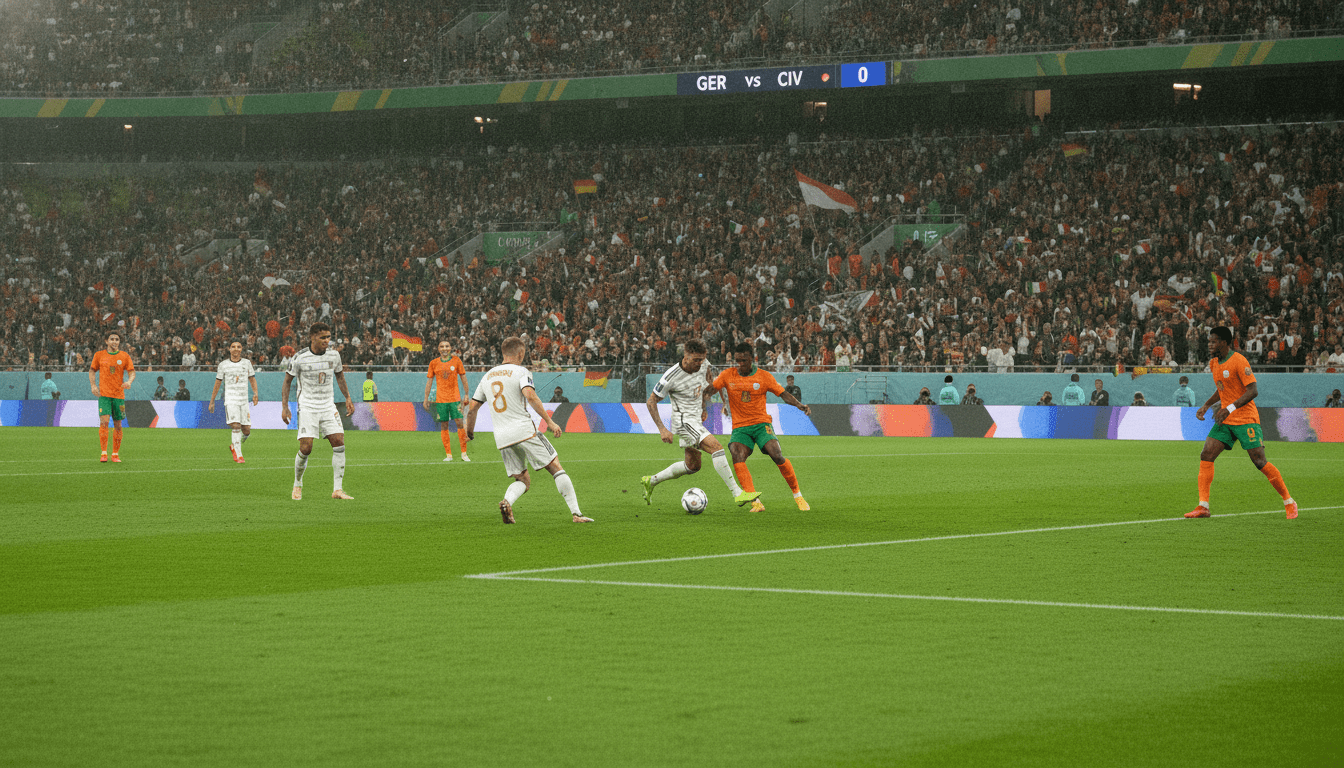
Germany vs Ivory Coast: DFB face tougher test in World Cup Group match on June 20, 2026
Germany vs Ivory Coast World Cup preview: Kick-off Saturday, June 20, 2026 at 22:00 CEST in Toronto; lineups, TV coverage and tactical keys for the DFB.
Matchday summary and stakes
Germany vs Ivory Coast opens as the second group game for the DFB at the 2026 World Cup on Saturday, June 20, 2026, with kick-off set for 22:00 CEST in Toronto (16:00 local time). Germany arrives buoyed by a 7–1 opening victory over Curaçao, while the Ivory Coast claimed a late 1–0 win over Ecuador thanks to Amad Diallo’s stoppage-time strike. On paper Germany are slight favourites, but the Ivorian performance and personnel demand a focused response from the hosts.
The result will shape Group standings early and influence tactical choices for both teams in the remaining fixtures. For Germany, the match is an opportunity to consolidate group leadership and build momentum, but the encounter has the hallmarks of a tougher physical and tactical contest than the Curaçao game. For the Ivory Coast, a second successive positive result would position them strongly as contenders for the knockout phase.
Kick-off, venue and match timing
The fixture takes place in Toronto on June 20, 2026, with kick-off at 22:00 Central European Summer Time and 16:00 Eastern Daylight Time. Organizers scheduled the game in the same match window as other Group stage fixtures to maximize global broadcast audiences. The evening timing for European viewers places the match in a prominent slot for German television coverage.
Players and coaching staff will manage long travel and recovery after group travel rotations, making early match fitness and rotation decisions key. Weather, pitch conditions and crowd composition in Toronto may also factor into tactical plans and substitutions as both teams seek an early edge.
Broadcast schedule and pre-match analysis
German viewers can watch Germany vs Ivory Coast live on ZDF, which begins its pre-match coverage at 21:00 CEST immediately following Sweden vs Netherlands. ZDF’s broadcast team will include Christoph Kramer, Per Mertesacker, Christian Streich and Friederike Kromp, with Jochen Breyer leading the studio presentation. MagentaTV will stage its own preview show from 21:00 CEST featuring Johannes B. Kerner, Thomas Müller and Jürgen Klopp.
The dual coverage offers contrasting analytical angles: ZDF’s studio emphasizes tactical breakdowns and former-player perspective, while MagentaTV blends pundit insight with broader tournament narratives. Both outlets are expected to examine Germany’s attacking depth and the Ivory Coast’s transition threat in their pre-game segments.
Tactical dangers posed by the Ivory Coast
The Ivory Coast arrive as a compact, defensively organized side with rapid wing options and a direct attacking approach. Coach Emerse Faé signalled intent ahead of the match, saying his team will “play for the win” and try to “tear down the German wall.” That rhetoric underlines a desire to be proactive rather than solely defensive.
Key threats include Amad Diallo, who came off the bench to score a dramatic late winner against Ecuador, and flank players who operate in the German domestic leagues: Bazoumana Touré at Hoffenheim and Yan Diomande at RB Leipzig. Those players combine experience of Bundesliga systems with the physicality and pace that can unsettle high defensive lines. Germany must guard against quick transitions and set-piece opportunities.
Projected lineups and what they indicate
Germany’s projected starting eleven lists Manuel Neuer in goal behind a back four of Joshua Kimmich, Jonathan Tah, Nico Schlotterbeck and Rico Lewis Brown. The midfield pairing of Pavlovic and Felix Nmecha would aim to control central spaces while an attacking trio of Leroy Sané, Jamal Musiala and Florian Wirtz supports Kai Havertz as the focal striker. That selection reflects a balance between physical presence and creative tempo.
The Ivory Coast lineup projects Y. Fofana in goal with a defensive unit of Singo, Kossounou, Agbadou and Konan. Midfield experience would come from Kessie and I. Sangaré alongside Inao Oulai, while the front three feature Amad Diallo, Bonny and Diomande. The Ivorian eleven suggests a compact defensive block with rapid outlets up the wings and a capable match-winner on the bench.
Historic context and previous meeting
Germany and the Ivory Coast have met only once previously in an international friendly, a 2–2 draw on November 18, 2009, in Gelsenkirchen. Lukas Podolski’s late goal rescued Germany from defeat after Eboué and Doumbia had given the Ivory Coast an early advantage. That sparse head-to-head record adds a fresh competitive element to Saturday’s match, as both nations seek to write a new chapter in competitive tournament play.
The 2009 friendly remains the sole competitive reference, meaning coaches and analysts rely primarily on recent club form and the teams’ opening World Cup performances to shape strategy. The lack of a prolonged rivalry reduces familiarity and increases the premium on in-game adaptation and scouting.
Group implications and key moments to watch
A win for Germany would place the DFB in a commanding position in the group and reduce pressure for the final group fixture. Conversely, an Ivorian victory would transform the group dynamic and set up a high-stakes race for qualifying spots. Watch the early 15 minutes for structural cues: whether Germany presses high or sits deeper, and whether the Ivory Coast commit numbers forward in attempts to force turnovers.
Other decisive factors include set-piece effectiveness, substitution timing and the management of game tempo in the second half. Amad Diallo’s role as an impact substitute makes late-game scenarios especially perilous for a team that concedes space in transition. Discipline and concentration during counterattacks will be crucial for both sides.
Germany vs Ivory Coast is more than a routine group fixture; it is a litmus test of Germany’s tournament readiness and the Ivory Coast’s credentials as a dark-horse contender. The match on June 20, 2026, will offer a clearer picture of which side is better equipped to advance from the group and how tactical flexibility will determine outcomes in a World Cup defined by fine margins.
