
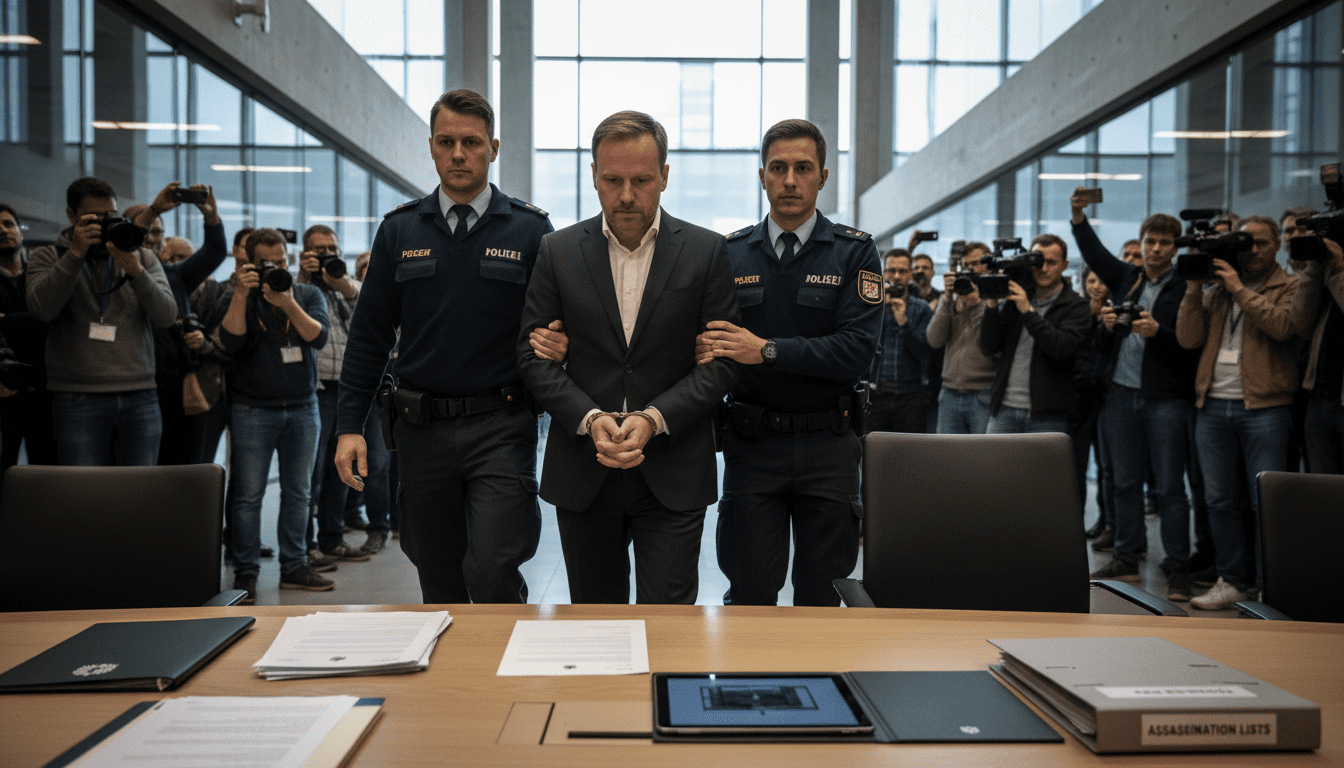
Dortmund man on trial over Darknet death lists and calls for attacks on politicians
A 50-year-old from Dortmund is on trial for creating Darknet death lists and soliciting attacks on politicians via an “Assassination Politics” platform.
A trial opened at the Higher Regional Court in Düsseldorf after prosecutors accused a 50-year-old Dortmund resident of publishing Darknet death lists and soliciting payments to motivate violent attacks. The Bundesanwaltschaft says the defendant built an online platform to call for assaults on judges, police and politicians and sought cryptocurrency donations as bounties. The charges include terror financing and instructions for terrorist acts.
Court opening and defendant’s remarks
The trial began with the defendant appearing in a light-gray tracksuit and portraying himself as a victim of the justice system. At the opening hearing he acknowledged putting material online but characterized the site as provocation, telling the court he had intended to provoke the judge and others.
Prosecutors rejected that account and laid out a detailed case alleging deliberate attempts to incite third parties to carry out murders and to destabilize state institutions. The Higher Regional Court has scheduled multiple sessions and expects to conclude the proceedings on July 17, 2026.
Prosecutors’ charges: terror financing and incitement
The Bundesanwaltschaft says the accused used the Darknet platform to solicit crypto-donations labeled as bounties and to publish “death verdicts” aimed at prompting violence. Investigators allege he also posted manuals and technical instructions on making explosive devices and incendiary mixtures, material prosecutors describe as operational guidance for violent actors.
Those actions form the basis for charges including financing terrorism and providing instructions for terrorist attacks. The indictment frames the conduct as an effort to subvert public order by encouraging and facilitating fatal attacks on public officials and figures.
Who was targeted on the lists
Court filings and statements by the prosecution name prominent politicians, public health figures and media personalities among those placed on the lists. Alleged targets included Olaf Scholz, Angela Merkel, Annalena Baerbock, Karl Lauterbach and Jens Spahn, as well as the virologist Christian Drosten and television presenter Jan Böhmermann.
Prosecutors also say the defendant published personal data for roughly 1,000 additional people, including the former economics minister Robert Habeck and members of his family. The breadth of names raised concern among authorities about increased risk and the possible need for protective measures.
Alleged ideological motives and prior convictions
Authorities describe the defendant as a committed adherent of an extremist racial ideology and say he sought to strip Jewish people and people with migration backgrounds of rights and electoral participation. The prosecution presented evidence intended to show the attacks were ideologically motivated rather than mere trolling.
Court records note earlier convictions for offenses including property damage and incitement of the people. Defence statements at the opening hearing included accusations that lawyers betrayed him and that police and judges had acted unlawfully, which the court treated as part of his contestation of the charges.
Radicalization, scene ties and public demonstrations
According to the prosecution, the defendant radicalized through YouTube content beginning in 2017 and later embedded himself in Dortmund’s far-right scene. Investigators allege ties to known extremists, membership-like support for the neo‑Nazi party Die Rechte, participation in memorial events for extremist figures and attendance at demonstrations linked to Holocaust denial and the so-called Reichstag unrest in Berlin.
Those biographical details are being used to establish a pattern of sustained radicalization and networked activity rather than isolated online provocation. Authorities say the suspect’s connections and public appearances provided context for the seriousness of the online material he published.
Investigation, arrest and court timetable
The Bundeskriminalamt and Bundespolizei arrested the suspect in Dortmund in November 2025 and he has been held in custody since that time, prosecutors said. The indictment was brought by the Federal Public Prosecutor’s Office, which is handling the case because of its national security implications.
The court has listed eleven hearing days and plans to wrap the trial on July 17, 2026. Prosecutors outlined the charges in detail at the opening session and signalled they will call technical experts to discuss the digital evidence and the mechanics of the alleged fundraising and publication scheme.
The case places renewed attention on how extremist material circulates in anonymized online spaces and on the legal tools available to investigate and disrupt violent online networks.
