
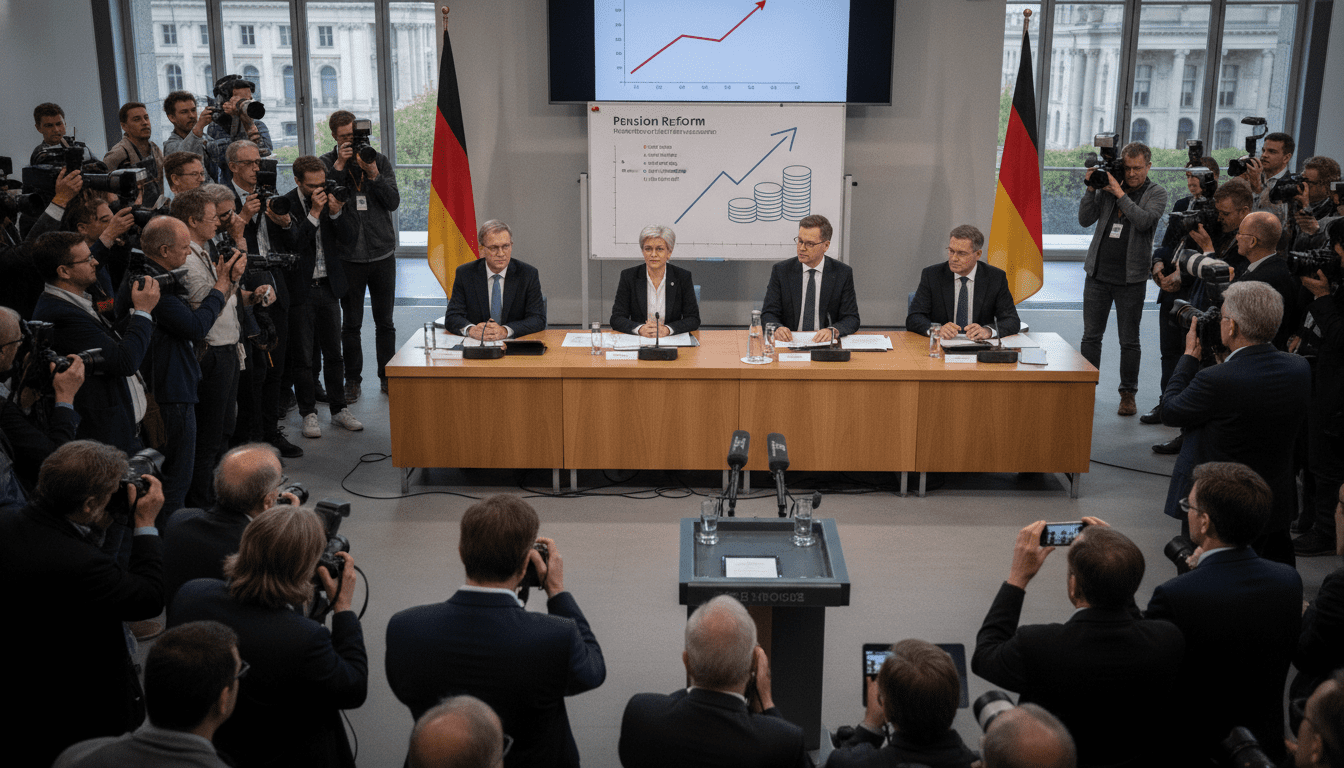
German pension reform panel proposes mandatory capital-funded supplement and ends “pension at 63”
A 13-member commission has delivered an 80-page plan outlining 33 recommendations for German pension reform, including a mandatory capital-funded supplementary pension and the abolition of the entitlement to a penalty-free “pension at 63.” The report, negotiated across 20 sessions and roughly 150 hours, was prepared under the leadership of Constanze Janda and Frank-Jürgen Weise and is due for official presentation to Chancellor Friedrich Merz. The package aims to secure retirement incomes while limiting long-term pressure on contribution rates and the federal budget.
Commission majority backs a 0.5–2% mandatory capital supplement
The commission proposes introducing a capital-funded supplementary pension modeled on Sweden’s premium system, with an initially modest additional contribution. The plan foresees a staged levy starting at 0.5 percent of gross wages and rising toward two percent, creating an individually owned, legally protected claim. Proponents say the supplement will diversify retirement income and gradually support the statutory pension level.
Abolition of the penalty-free ‘pension at 63’ and changes to early exit rules
One of the most politically sensitive recommendations is to remove the current right to retire without deductions at age 63 for those with 45 contribution years. The proposal would also delay the earliest age for reduced early retirement from 63 to 64 for many insured persons, narrowing options for early exit. In addition, the commission recommends a mechanism to allow the statutory retirement age to rise above 67 if life expectancy increases, with one additional year of life expectancy translating into an eight‑month rise in the retirement threshold.
Pension level “halteline” to be preserved through combined benefits
The commission argues it will maintain the SPD-won “halteline” that preserves a minimum pension replacement level, but it would be achieved through the combination of the statutory pension and the new capital supplement. Under the proposal, annual statutory pension increases could be moderated by the demographic factor as the capital pillar grows, which would help slow the rise of contribution rates. Supporters say this coupling keeps the guaranteed standard of living while sharing adjustment burdens between pillars.
New exemption for low-income pensioners in social assistance
To protect those dependent on means-tested basic income support, the panel recommends a new partial exemption for statutory pensions when assessing entitlement to social assistance. Rather than offsetting the full pension, the plan would allow recipients to retain 20 to 30 percent of their statutory pension alongside basic support. The change is intended to improve incentives and dignity for low-income retirees who currently lose most pension entitlements to social benefits.
Political and social resistance expected from unions and employers
The commission’s package balances added individual accounts with curbs on early retirement, but it does so at political cost. Trade unions and many in the SPD are expected to object to the removal of early retirement privileges and to the reliance on capital-funded savings rather than expanded pay-as-you-go benefits. At the same time, employers warn the initial extra contribution will raise labor costs, even if the measure could alleviate pressure on the overall contribution rate in later years.
Fiscal context pressures timing and implementation
The report frames reform as a response to rising pension expenditures driven by ageing and the wave of baby-boom retirements, and it recommends beginning the capital-funded scheme as early as 2028. Officials project that demographic developments would push the statutory contribution rate from the current 18.6 percent toward 20 percent by 2028 even without new measures. Finance Minister Lars Klingbeil faces mounting budgetary strains from increased federal subsidies to the pension system and from earlier coalition decisions that raise medium‑term costs.
Coalition faces choice on a packaged vote or piecemeal changes
The commission calls for the recommendations to be implemented as a coherent package, arguing the measures are interdependent and that piecemeal adoption would undermine the overall balance. Coalition leaders from the Union and SPD are set to discuss the road map in upcoming meetings, where compromises will determine whether the plan moves forward intact. The timing and sequencing will be decisive for political feasibility, given the likely trade-offs across party priorities.
The commission presents German pension reform as a comprehensive response to demographic pressures, proposing a mandatory capital supplement while tightening early retirement pathways and protecting vulnerable pensioners through targeted exemptions. Implementation will hinge on coalition negotiations and public acceptance, and the package could reshape the balance between pay-as-you-go and funded elements in Germany’s retirement system.
