
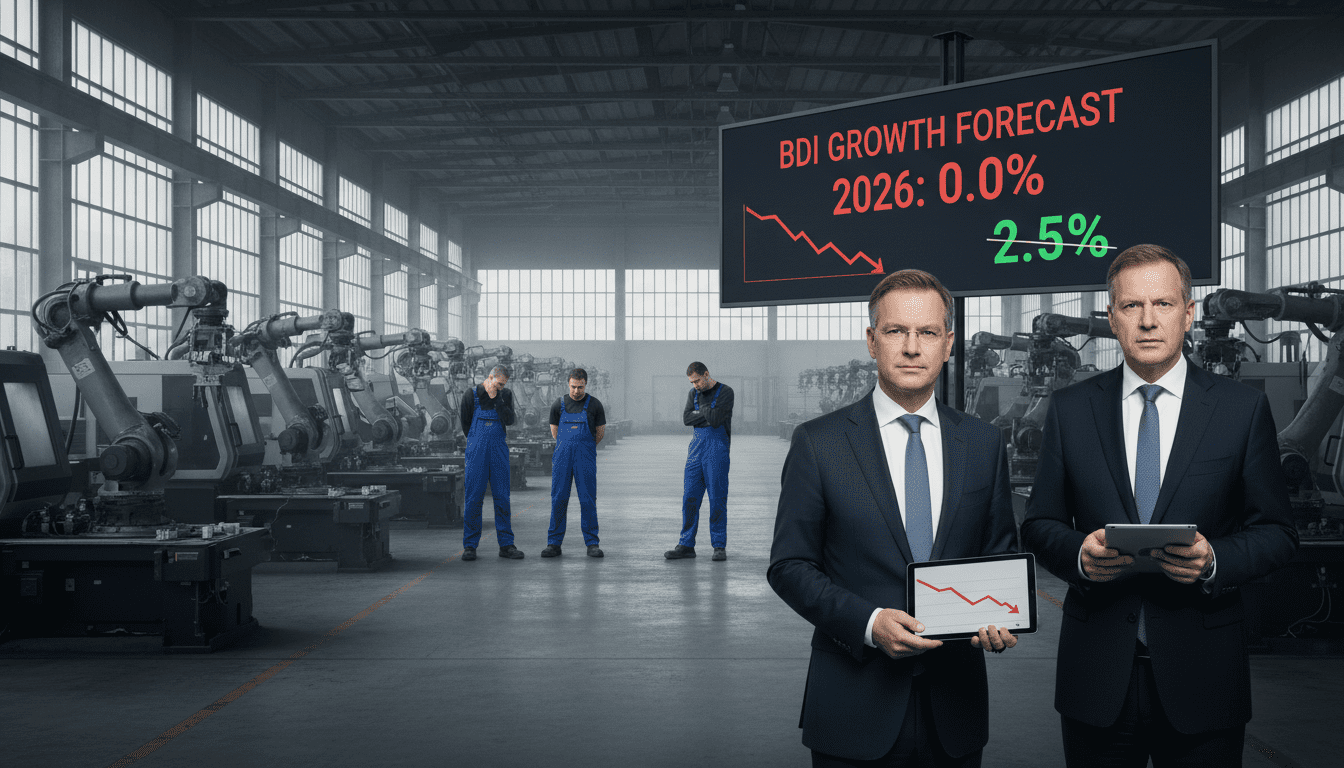
BDI Cuts 2026 Growth Forecast as German Industry Stagnation Looms
Germany’s industrial association BDI warns that German industry stagnation is now the likeliest outcome for 2026 amid weak production, rising energy costs and persistent structural headwinds.
The BDI announced a withdrawal of its modest growth forecast on the opening day of Hannover Messe, saying a weak start to the year and fresh geopolitical risks mean the economy will at best stagnate this year. The association highlighted a multi-year decline in factory output and cautioned that a prolonged disruption to energy and shipping routes could turn stagnation into a renewed contraction.
BDI withdraws 2026 growth projection
BDI president Peter Leibinger told delegates that expectations for even a slight improvement in industrial output had evaporated and were being replaced by projections of stagnation. He noted the industry has faced annual declines in production since 2022 and said, “we are not expecting a recovery in 2026.” The association now views the best realistic outcome for the year as flat output rather than growth.
The decision followed a reported weak performance in the opening months of 2026 and a reassessment of downside risks tied to international developments. The BDI said current indicators do not point to the rebound many had hoped for and urged policymakers to respond to underlying domestic problems rather than short-term shocks.
Geopolitical shocks push up energy costs and risks
The BDI attributed part of the renewed uncertainty to the escalation of conflict involving the United States, Israel and Iran, which has driven up oil and gas prices. The association warned that ongoing disruptions to shipping through the Strait of Hormuz could further squeeze supplies and raise energy costs for manufacturers. Those developments, the BDI said, amplify the risk that production could decline for a fifth consecutive year if they persist.
Industry leaders stressed that geopolitics are an accelerant rather than the root cause of the malaise. Still, higher commodity prices and supply-chain problems linked to maritime blockades were singled out as immediate threats that would compound long-standing domestic vulnerabilities.
Capacity utilization and international comparisons
BDI figures show German industrial capacity utilization at around 78 percent, a level the association described as materially below what is needed to rebuild momentum. Leibinger warned that even if German output appears stable in absolute terms, relative performance is deteriorating because competitor economies continue to expand. The result, he said, is a gradual erosion of Germany’s industrial standing.
Low utilization rates translate into delayed investment and reduced hiring, creating a feedback loop that makes recovery harder. The association emphasized that until firms regain confidence and capacity use rises, growth prospects will remain muted.
Industry calls for sweeping competitiveness reforms
BDI leaders used the Hannover Messe platform to press for a comprehensive reform agenda aimed at restoring competitiveness. They criticized recent government measures as fragmented and insufficient, and demanded faster, bolder action on taxes, labor costs and regulatory burdens. Tanja Gönner, the BDI’s chief executive, urged the government to cut labor-related charges, increase labor-market flexibility and consider raising the retirement age to relieve pressure on employment costs.
The association put particular emphasis on corporate taxation, calling for an expedited reduction of the corporate tax rate this year rather than the slower timetable currently envisaged in coalition plans. BDI officials argued that quicker tax relief would free resources for investment and improve Germany’s attractiveness as a production location.
Government measures draw mixed reactions from industry
Berlin has announced a two-month fuel discount and proposed permitting employers to pay a voluntary, tax-free relief bonus of €1,000 to employees. The BDI welcomed recognition of stress in the corporate sector but described those steps as limited in scope. Leibinger said many companies are already under such economic strain that they cannot afford to fund bonuses themselves, and he called the package “piecemeal” rather than a strategic response.
Employers’ groups have likewise warned that the proposed tax-free bonus could amount to an additional cost for firms rather than a genuine transfer if they must bear the payment themselves. The BDI urged a shift from short-term relief to measures that lower structural costs and reduce bureaucracy for businesses across the economy.
Outlook and downside scenarios for industry
Analysts now see a range of outcomes for the industrial sector, with stagnation the central forecast and a renewed contraction the main downside risk. The BDI highlighted that further energy-price shocks, prolonged shipping disruptions or an intensification of supply-chain constraints would materially raise the chance of output shrinking again. Conversely, decisive domestic reforms, a stabilization of energy markets and targeted investment support could help to arrest the decline.
The association pressed for a government reform package to be presented by the summer, arguing that delayed action will only make recovery harder and more costly. Industry leaders said they are looking for measures that combine immediate relief with structural changes to restore competitiveness over the medium term.
German industry stagnation has shifted from a technical possibility to the scenario most observers now expect, and the coming months will show whether policymakers can match the scale of the challenge with a credible reform strategy.
