
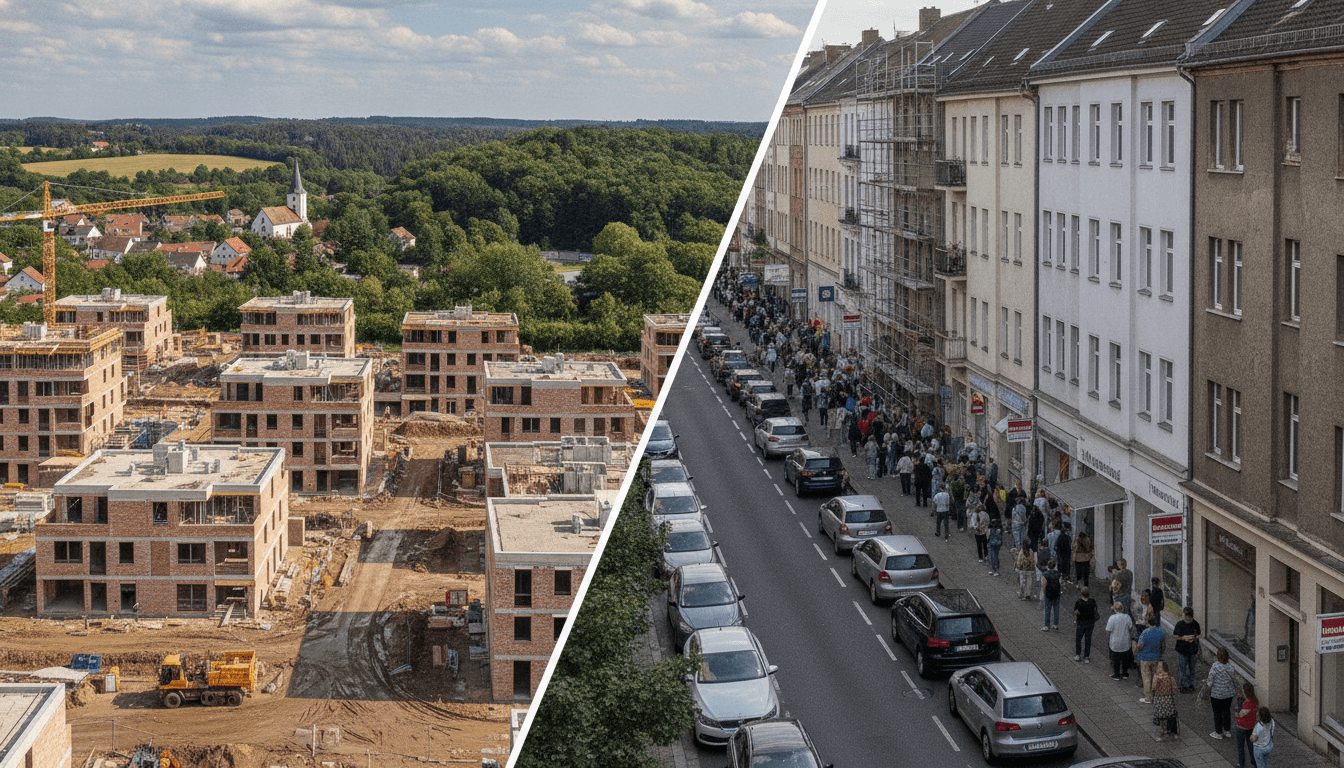
JLL Study: Housing Mismatch Leaves German Cities Short by Thousands of Apartments
JLL finds a housing mismatch in Germany: major cities receive far fewer new units than needed while rural building outpaces demand, worsening urban shortages.
Germany’s leading real estate adviser JLL has identified a stark spatial imbalance in housing delivery that deepens the country’s urban housing shortage. The analysis shows that in the eight largest German cities, for every 10,000 existing apartments, just 42 new units are completed annually while 62 are required to meet demand. Meanwhile, rural areas are producing 41 units per 10,000 — nearly double the local need of 23.
JLL analysis reveals stark spatial imbalance
The JLL findings quantify what many urban planners and tenant advocates have long suspected: construction is happening, but not where it is most needed. The consultancy’s breakdown, focused on Germany’s eight largest cities, highlights a persistent shortfall of smaller, affordable urban units. The data indicate the mismatch is not a lack of overall building activity but a misallocation of new supply.
JLL market researcher Sören Gröbel summed up the pattern succinctly, noting that development often takes place “in the wrong place.” His assessment points to a structural divergence between where developers are building and where households are seeking housing, particularly smaller apartments near jobs and services in big cities.
Cities: Underbuilding where demand is highest
Urban areas are failing to deliver the volume and type of housing that city residents need most. According to the analysis, cities would need roughly 62 new apartments per 10,000 existing units annually to stabilize local supply, yet only 42 are being produced. That gap accumulates year after year, driving up rents and narrowing options for low- and middle-income households.
The shortfall is especially acute for compact, affordable units favored by singles, young families, and lower-income households. Because developers often prioritize larger, higher-margin projects, newly completed city apartments can be larger and pricier than what the changing urban demographics demand.
Countryside: Construction outpacing local need
In contrast to the cities, rural and peripheral areas are seeing more building activity than local demand warrants. JLL’s numbers show 41 new apartments per 10,000 existing units in non-urban areas, while the estimated need is 23. That excess represents resources channeled into lower-demand locations and contributes little to easing urban affordability pressures.
This rural overbuilding often manifests as single-family homes and larger apartments that attract buyers seeking lower land costs and simpler permitting, but these developments do not substitute for the dense, affordable housing urban economies require.
Why developers build larger units outside cities
Several market forces help explain the geography of construction. Land and regulatory costs, longer planning timelines in dense urban areas, and stronger profit margins for larger units in peripheral locations all steer developers away from compact urban supply. The economics of brownfield vs. greenfield development and the availability of larger contiguous plots in the countryside favor bigger projects.
Investor preferences and financing structures also play a role; institutional investors frequently target projects with predictable yields and lower construction complexity, which can mean suburban single-family and multi-family schemes rather than small urban flats that require costly land assembly and complex approvals.
Economic and social consequences for urban renters
The mismatch between where units are built and where people need them has clear consequences for affordability, commuting patterns, and social equity. Shortages of small, centrally located apartments push households into longer commutes, increase living costs, and can contribute to socio-economic segregation as lower-income residents are priced out of inner-city neighborhoods.
Rising rents and constrained availability also affect labor markets, with employers in major cities facing difficulties recruiting workers who cannot find practical housing near jobs. Over time, these dynamics can undermine productivity and the competitiveness of German urban centers.
Policy options to rebalance supply
Experts and municipal officials have a range of tools at their disposal to better align production with demand. Potential measures include revising zoning to allow higher-density infill, incentivizing the construction of smaller units through subsidies or tax structures, and streamlining permitting for urban redevelopment projects. Public land release and targeted financing for affordable compact housing are additional levers.
Policy changes would need to address both the incentives that currently favor peripheral development and the administrative barriers that delay or discourage inner-city projects. Coordinated action by federal, state, and municipal authorities, alongside private developers and investors, will be essential to shift the balance.
Germany’s housing mismatch is not solely a technical problem of bricks and mortar; it reflects broader choices about where growth is steered and who benefits from new construction. The JLL analysis provides a clear metric for policymakers: correcting the spatial imbalance will require deliberate policy alignment and financial incentives to produce the types of homes cities need most.
The longer the misallocation persists, the harder it will be for German cities to restore affordable housing supply and contain the social and economic costs of a growing urban shortage.
