
German aerospace industry posts record €62bn in 2025 as defense and space orders surge
German aerospace industry posts record €62bn in 2025 as defense and space orders surge; Bundeswehr’s €35bn space program and FCAS dispute shape outlook.
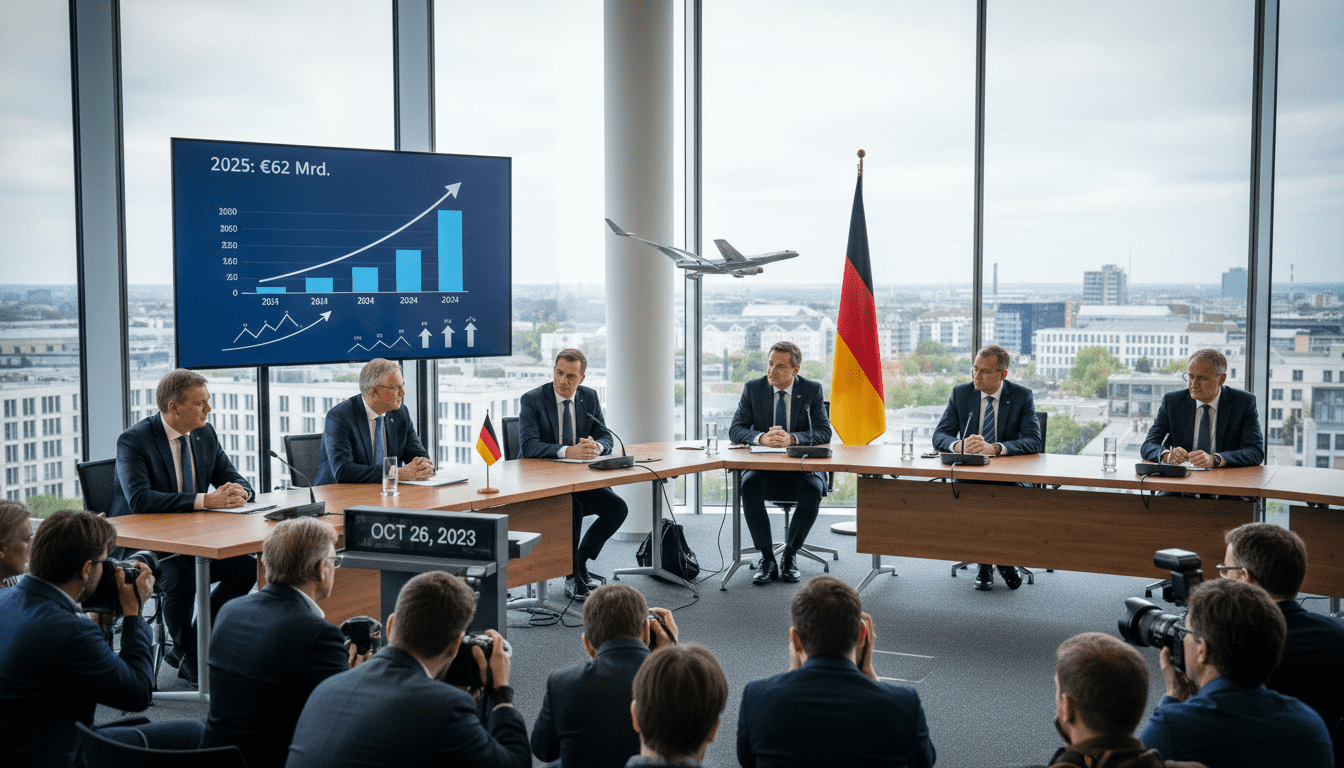
The German aerospace industry recorded an exceptional year in 2025, with revenues rising 19 percent to about €62 billion, driven largely by a surge in defense and space contracts, industry officials said. Michael Schöllhorn, president of the Federation of German Aerospace Industries (BDLI), described the period as extraordinary and highlighted that state orders—especially those linked to military space capabilities—are beginning to appear in company order books. While commercial aviation remains the largest revenue source, the shift toward military and space work is reshaping growth patterns and employment across the sector.
Record revenues driven by defense and space orders
Government and military spending accounted for a substantial portion of the year-on-year increase, with defense-related revenues climbing sharply and major space programs committing new funds to German firms. The BDLI flagged that some of the additional business will flow into reported sales only over coming years because large contracts translate into multi-year production cycles. Executives and trade officials pointed out that the combination of sustained civil demand and stepped-up defense procurement has created an unusually broad-based growth profile for the industry.
Civil aviation remains revenue backbone
Despite the rapid growth in defense and space segments, civil aviation still represents roughly 70 percent of the sector’s turnover, with commercial aircraft manufacturing and the German sites of major OEMs and suppliers contributing about €45 billion. Civil aviation sales rose by mid-teens in 2025, reflecting airline recovery and order backlogs that continue to support production at Airbus facilities and supplier networks in Germany. Industry analysts say that maintaining a healthy civil market is crucial for sustaining the supply chain that now must also accommodate military and space programs.
Bundeswehr’s €35 billion space push enters order books
Officials indicated that a €35 billion Bundeswehr program to boost space security and build national military space capacities will begin to register in company order books starting this year, providing a multi-year pipeline for satellite, launcher and ground-system suppliers. The BDLI warned that order intake does not immediately convert to revenue, as projects often span several years from procurement to delivery, but the program is expected to underpin further growth. Suppliers preparing bids for satellite systems, secure communications and space-domain awareness equipment have already expanded capabilities to meet the anticipated demand.
Military segment posts fastest growth and job gains
The defense-related business grew at a considerably faster rate than civil aviation, with military-linked revenues up roughly 35 percent to about €13.5 billion in 2025, according to the BDLI’s figures. That uptick coincided with rising employment: companies added roughly 10,000 staff last year, bringing total sector headcount to near 130,000 workers, with many of the new roles concentrated in defense and space programs. Trade association representatives said the jobs growth demonstrates the sector’s increasing strategic importance and its multiplier effect across engineering, manufacturing and services.
FCAS fighter project stumbles amid manufacturer rift
Not all defense programs are progressing smoothly; the Franco-German Future Combat Air System (FCAS) has encountered significant challenges, with deep disagreements reported between the aircraft manufacturers involved. FCAS aims to replace current fighters while developing a networked system of manned aircraft, drones and a so-called combat cloud, but industry leaders acknowledge the program is under strain because of unresolved technical and industrial splits. BDLI leadership emphasized that while the program faces “major differences” between partners, such tensions are being managed and stakeholders in Berlin and Paris are actively seeking a path forward.
Industry explores alternatives and timelines ahead of ILA
BDLI executives and senior industry figures have outlined contingency options, including a two-platform approach under the FCAS umbrella or forming new European partnerships that preserve German participation, while dismissing certain off-the-shelf alternatives as incompatible with long-term technological goals. Marie-Christine von Hahn, BDLI director general, has publicly supported a dual-jet solution that would allow Germany and France to pursue different fighter types under cooperative governance, a route Schöllhorn also views as feasible. Observers noted that a concrete sign of progress at the Berlin Air Show (ILA) in June—where the German chancellor is due to present a national aviation strategy—would be politically and industrially significant.
The German aerospace industry’s 2025 surge underscores a pivotal moment in which commercial aviation strength is being augmented by rapid expansion in defense and space activities, creating a more diversified and strategically oriented sector. Industry leaders stress that maintaining civil market momentum while managing complex multinational defense projects will determine whether the sector can sustain the recent gains and translate large order volumes into long-term industrial capacity and innovation.
